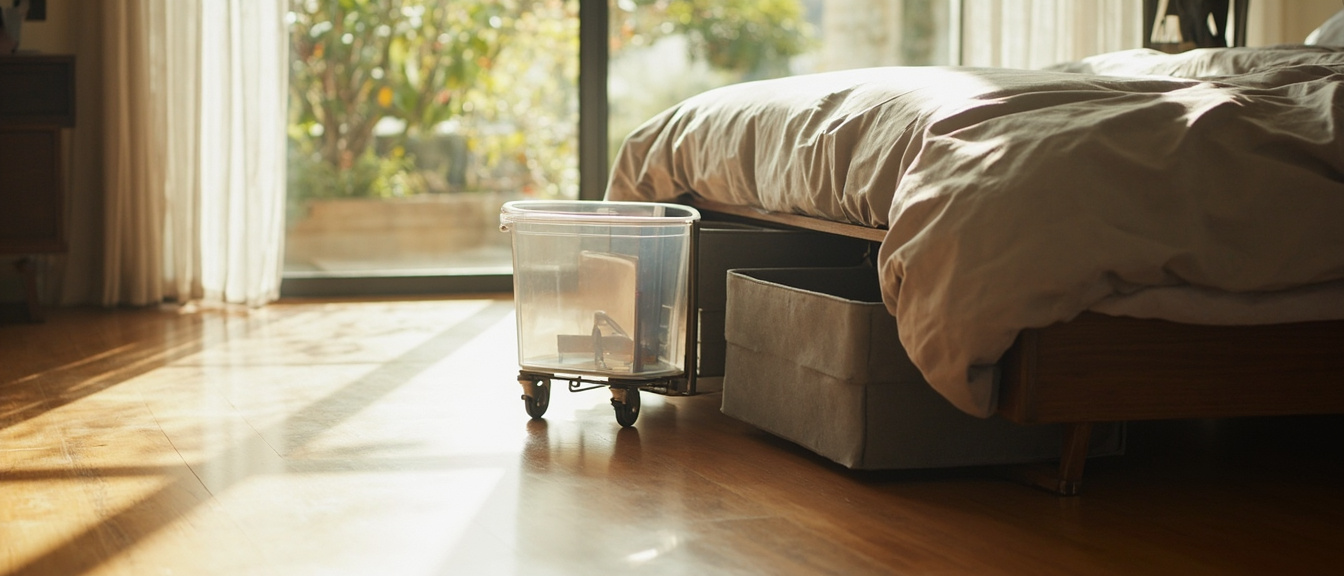
Every bedroom has under-bed space. Most people treat it as a black hole — shove it full, slam it shut, forget it for six months. The fix isn’t more bins. It’s measuring once, choosing the right bin height, and organizing by category.
Why Under-Bed Storage Is the Hardest Zone to Get Right
Reddit’s r/declutter has a thread on under-bed storage with 911+ upvotes, and the top complaint isn’t bins — it’s the gap between having under-bed space and using it. Three problems repeat: bins that don’t fit because nobody measured, opaque bins with mystery contents, fabric bags that sag under shoe weight.
The pain is clearance + accessibility + contents tracking — most guides skip the first. Buy tall for a low platform and they won’t slide under; buy opaque and you forget; buy without a category plan and the zone becomes the bedroom’s junk drawer.
Measure First — Know Your Real Clearance
Five height variants show up in search: 4-inch, 5-inch, 10-inch, 12-inch, and “low profile.” Clearance drives everything.
Measure at the lowest point — slats often dip below the rail height, and that hidden dip scrapes lids that technically should fit.
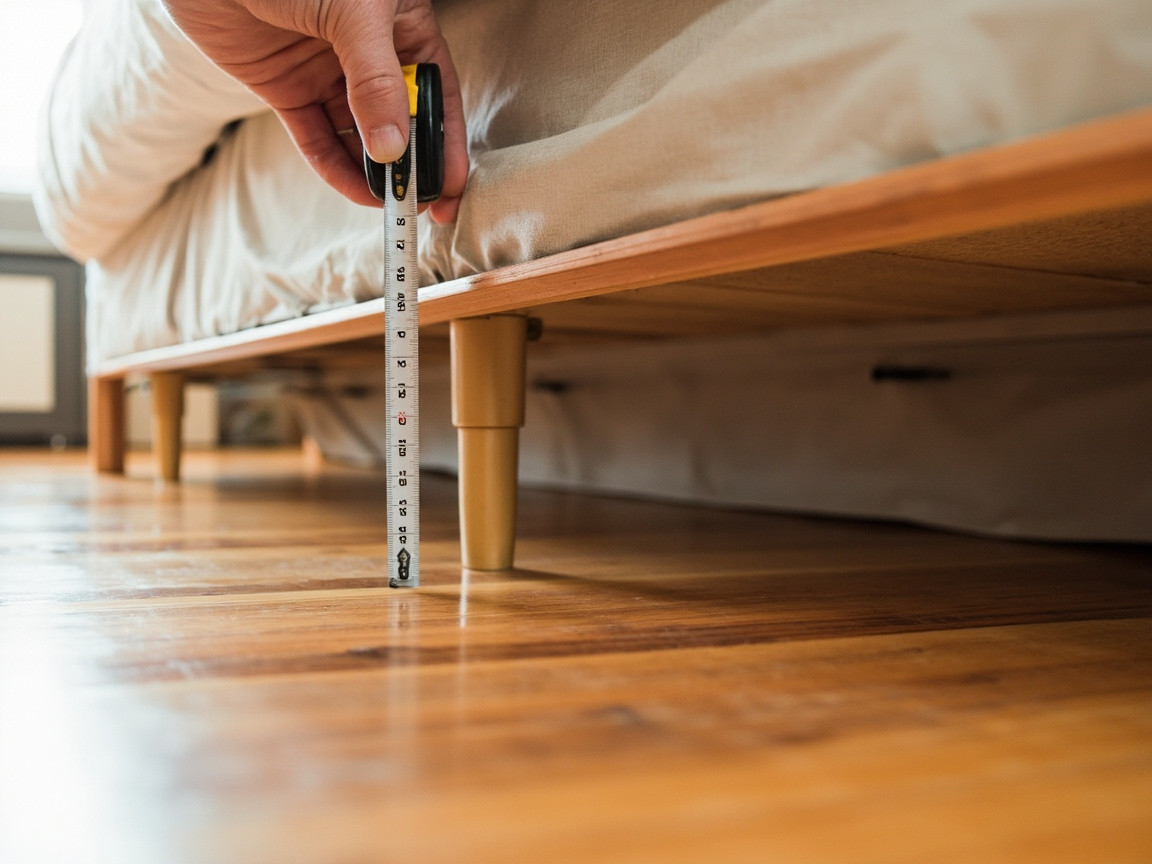
Low-clearance beds (4-6 inches)
Platform beds, metal frames, futons, kids’ beds — the most common setup, and where most recommendations fail because they assume 7-inch clearance.
You need a slim low-profile bin — anything over 5” tall won’t slide under. The TidyCorner 4.5” (below) is built for this range.
Standard raised beds (7-10 inches)
Most adult beds with four legs — the sweet spot. Sterilite 7” 4-pack, Yecaye 6.69” drawer-style, and Amazon Basics 6” fabric bags all fit.
Wheels earn their keep here. Without them, pulling a heavy bin means crouching and dragging — the friction that makes people stop using the system.
Tall beds with drawers or risers (11+ inches)
Loft beds, beds on risers, storage-platform frames. Tall rolling bins (10-12”) and under-bed dresser-drawer units fit.
The Budding Joy 80L (below) was designed for this range — the lid telescopes to fill clearance without wasted air space.
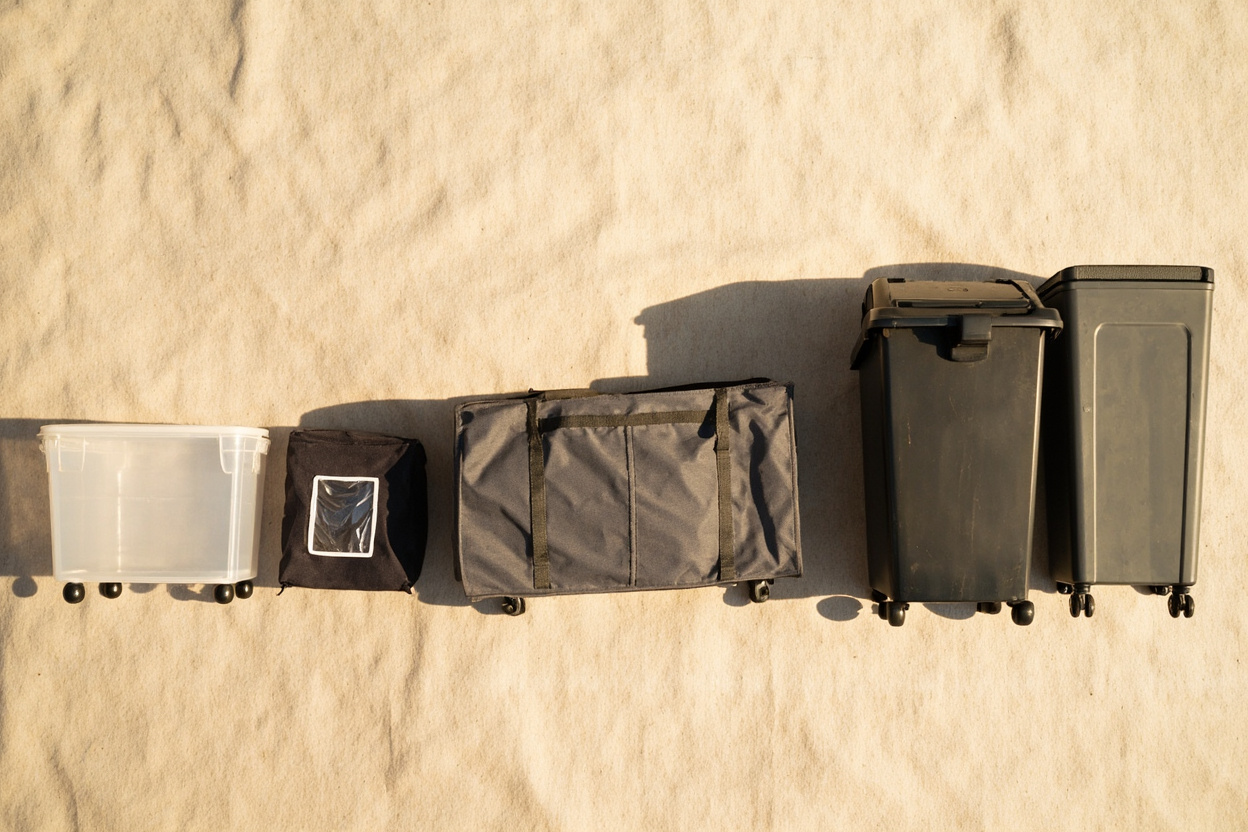
What You’ll Need — 5 Bins for 5 Real-World Use Cases
Five bins cover the realistic use cases. Full decision framework in our how-to-choose-storage-bins essentials.
The workhorse clear bin
The Sterilite 4-pack 56-quart wheeled latching box is the “if you only buy one thing” pick. Clear plastic solves the “I forgot what was in there” failure. See clear vs opaque bins.
The budget fabric bag
For soft goods only — sweaters, linens, off-season bedding — the Amazon Basics 2-pack is the lowest-cost option. The clear window solves the opaque-bin problem. Skip shoes, books, or anything rigid — fabric bottoms tear within six months. See plastic vs fabric bins.
The high-capacity foldable
For one or two bulky categories — blankets, comforters, winter coats — the Budding Joy 90L is the biggest single-bin here. 90L fits a queen-size comforter. No wheels — seasonal access.
The height-adjustable with wheels and lid
The Budding Joy 80L is the most feature-dense. The lid telescopes to fit 6-12 inch clearance, the clear top shows contents without opening. Best for shoes and dorm rooms.
The slim low-profile for tight clearances
For platform beds where 7” Sterilite and Budding Joy don’t fit, the TidyCorner 2-pack 4.5” slim bin is the only mainstream option. Reinforced sidewalls prevent the saggy-fabric failure.
Step-by-Step Guide
A 5-step reset taking about an hour. Order matters — declutter first, organize second.
Step 1 — Measure and plan the zones
Pull everything out. Measure clearance at the lowest point and write it on a sticky note — “6 inches at the slats” is more useful than “about 6 inches.”
Pick three or four zones: seasonal clothes, shoes, linens, and one “rarely used” catchall. The zones are categories, not locations — this is where KonMari’s category-not-location principle applies.
Decide which zone gets wheels (frequent access) and which doesn’t (seasonal, twice a year). The wheels-vs-no-wheels split is the most important quality-of-life decision here.
Step 2 — Sort and purge before you buy
Lay everything out: keep, donate, relocate, trash. Under-bed is not for “I might need this someday” — that’s the closet or donation bin.
If it hasn’t been touched in 12 months, it doesn’t earn under-bed real estate. The 4-pile framework in our declutter fast guide applies here.
Step 3 — Match each zone to the right bin
Match bin type to zone, not the other way around:
- Soft goods → Amazon Basics or Budding Joy 90L
- Shoes → Budding Joy 80L or Yecaye
- Blankets/comforters → Budding Joy 90L
- Platform bed → TidyCorner 4.5”
- Misc zone → Sterilite 4-pack
For the full framework, see how-to-choose-storage-bins essentials. For drawer-style bins, see the drawer-organizers guide. For folded sheet sets that take up too much loose space, the DIMJ Bed Sheet Organizers (6-Pack) at $27.97 keeps sheet sets with pillowcases contained — eliminates the “mystery linens” pile. For shoes stored under tall beds or risers, the SIMPDIY 12-Pack Clear Stackable Shoe Boxes at $29.99 stack to fit 11+ inch clearance and let you see every pair through the clear front.
Step 4 — Label and track
Every bin gets a label on the visible end — the foot-of-bed side. “Winter sweaters.” “Shoes — casual.” “Linen — guest.” A pack of ONUPGO Chalkboard Labels at $9.99 (180 stickers, chalk marker included) lets you label every bin. Chalkboard surface rewrites when contents change seasonally — no peeling adhesive like regular labels.
Photograph each bin’s contents before sliding it under, and store the photos in a phone album titled “under bed.” This solves the “I forgot what was in there” failure. The full labeling system is in how-to-label-anything.
Step 5 — Maintain with a 6-month reset
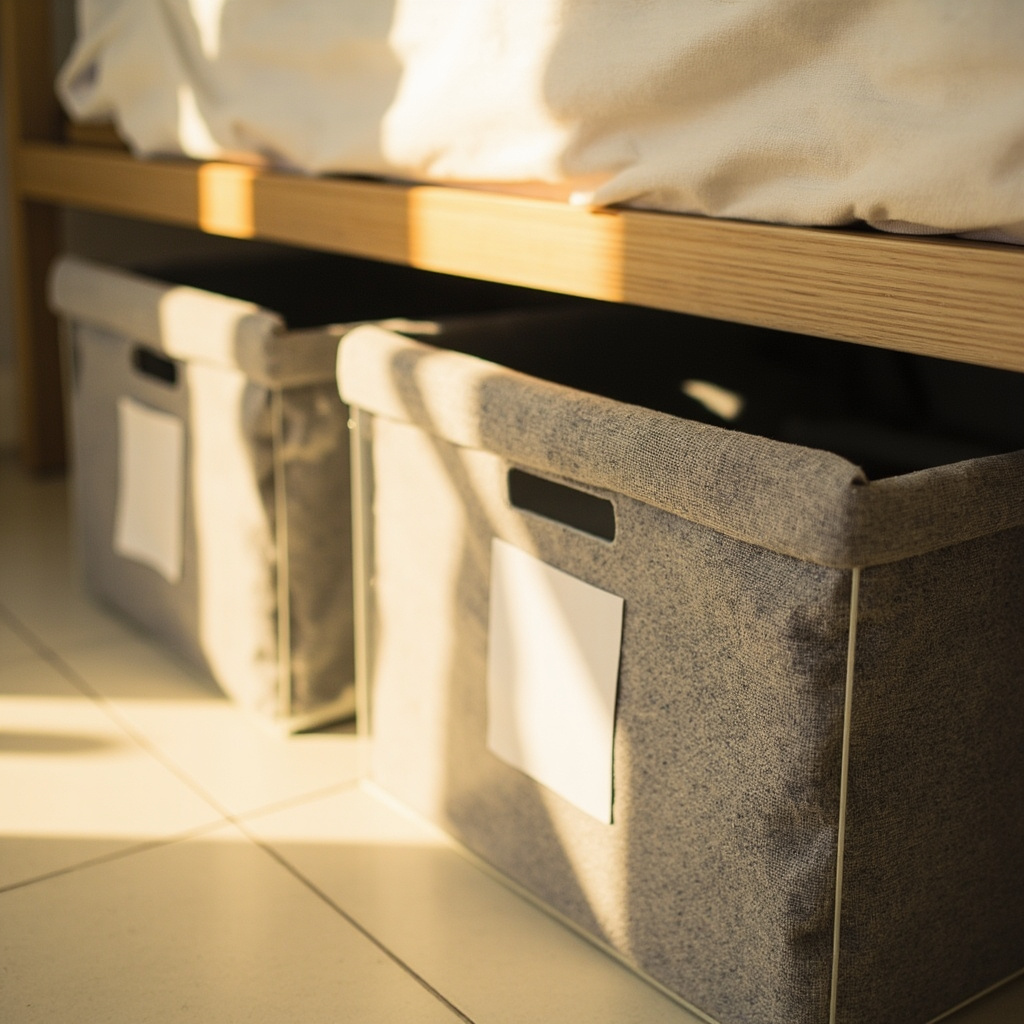
Mark a calendar reminder every six months — January 1 and July 1 is a popular pattern. Pull everything out, re-purge, re-label. Thirty minutes max.
If you avoid the reset, the bins are too tall, heavy, or full — fix the system, not your willpower. If full and you still have more, expand: above-bed shelving (shelf-organizers guide), or a second under-bed zone on the other side.
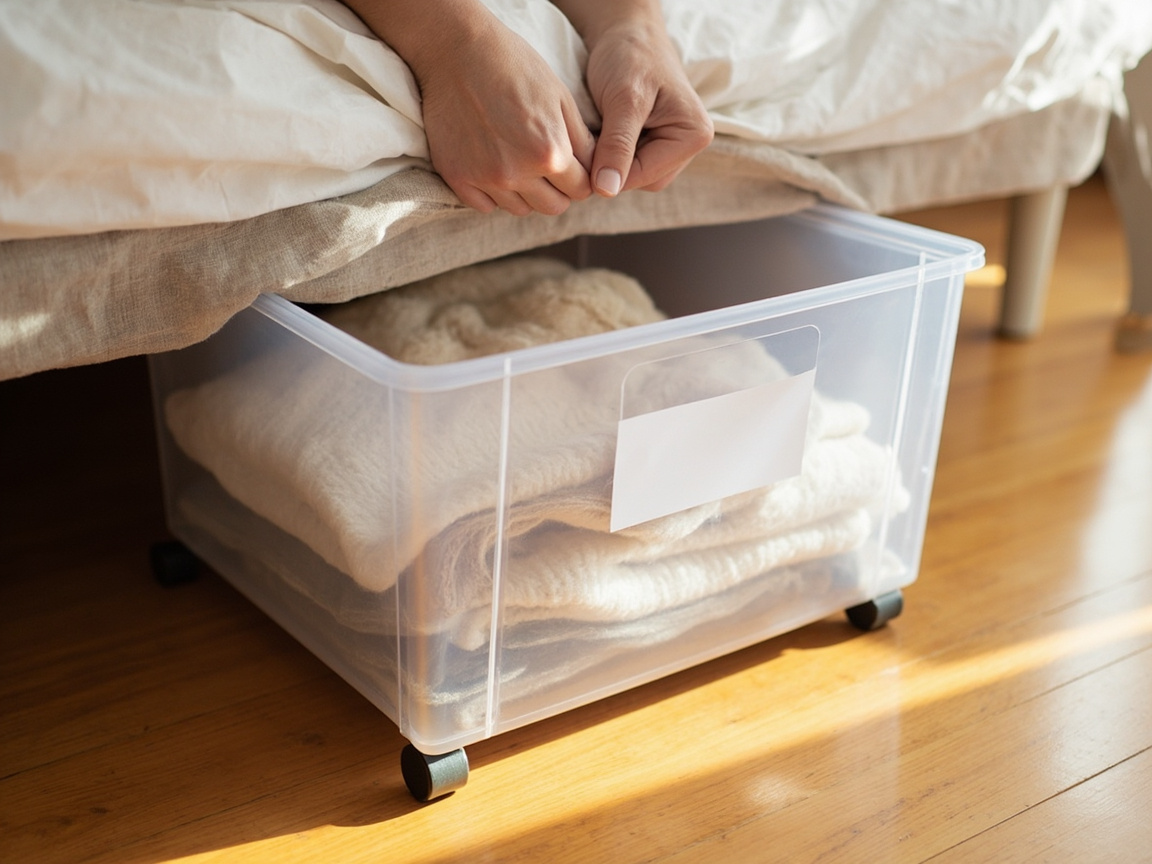
Under-Bed Storage Solutions
The right bin for the wrong category creates the same mess as the wrong bin for the right clearance. Five use cases cover most bedrooms, and each one maps to a specific storage pattern in the rest of the room.
Seasonal clothing rotation
Sweaters in summer, t-shirts in winter — the most common under-bed use. The Budding Joy 90L handles one queen-comforter’s worth of bulky winter sweaters, and the Sterilite 4-pack splits the rest into clear seasonal zones. For the swap-in, swap-out timing that keeps this from becoming a graveyard, the seasonal closet rotation guide walks through the biannual rhythm.
Spare linens and guest bedding
Sheet sets, guest bedding, and the spare comforter belong under the bed for two reasons — they’re bulky and they’re infrequent. A 6-pack bed sheet organizer keeps folded sheet sets with their pillowcases, so you don’t dig for the matching pillowcase every time a guest shows up.
Shoes you wear weekly-not-daily
Work shoes, gym shoes, and off-season boots. Stackable clear shoe boxes at the foot of the bed give you a clear front view of every pair without pulling the bin out. For a broader system that includes shoes in the closet too — especially when the bedroom is tight — the small bedroom organization guide covers the stacking and floor-space trade-offs.
Luggage and travel gear
Empty suitcases fit under most raised beds. Storing luggage under the bed instead of in a closet frees the closet rod for clothes, and the suitcase is right where you’ll need it before the next trip.
Memory boxes and rarely-used items
Sentimental items and once-a-year stuff. The bedroom declutter guide covers where these belong versus what should actually be donated. The short version: under-bed is a use zone, not a store-forever zone — anything that doesn’t earn a clear “I’ll reach for this in the next six months” gets donated or relocated.
Organization Tips
Five habits separate under-bed storage that stays organized from under-bed storage that becomes the bedroom’s junk drawer within six months.
Tip 1 — Photograph every bin before it goes under
A phone photo album titled “under bed” with one snapshot per bin (label + visible contents) solves the “I forgot what was in there” failure mode for opaque bins. If you ever use a fabric bag without a clear window, this is the workaround.
Tip 2 — Label the visible end, not the lid
Lids get pulled out first. Label the foot-of-bed end — the end that sticks out when the bin slides back — so you can read the category without kneeling down.
Tip 3 — Keep one “misc” bin, not zero
A pure no-misc policy sounds disciplined but actually pushes you to abandon the system when a new category appears (a gift, a returned item, a borrowed thing). One dedicated misc bin, clearly labeled, absorbs the one-offs without breaking the four-zone structure.
Tip 4 — Rotate bins seasonally, not randomly
The 6-month reset (Step 5 above) works best when it’s tied to a fixed date, not a “whenever I notice it’s bad” trigger. January 1 and July 1 cover the two main clothing swap seasons. The reset takes 30 minutes if the labeling and zone plan held.
Tip 5 — Match dresser and under-bed for one design read
The bedroom reads as organized when the dresser top, the nightstand, and the under-bed bins share a design language — same wood tone, same metal finish, or all-clear plastic. For a dresser system that holds the same discipline inside the drawers, the dresser organization guide covers drawer-by-drawer zoning. The two systems — dresser top and under-bed bins — work as a pair: same labeling, same category logic, same rotation rhythm.
Common Mistakes
Four mistakes come up in r/declutter and r/BedroomBuild:
-
Buying bins before measuring clearance. The most common failure. Tall bins for a low platform won’t slide under; short bins waste the clearance you have. Measure first — the TidyCorner 4.5” and Sterilite 7” solve most.
-
Opaque bins with no labels. You forget, stop opening, and six months later pull out mystery cables. Clear plastic with a visible label solves this — see clear vs opaque bins.
-
Fabric bags for heavy items. Books, shoes, hardware — anything rigid tears through a fabric bottom within six months. Match fabric bags to soft goods only. See plastic vs fabric bins.
-
“Memories” under the bed. Under-bed is a use zone, not a store-forever zone. Sentimental items belong in labeled memory boxes in a closet.
Related Bedroom Guides
This is one zone in the overall bedroom hub. For cross-room principles, the declutter fast method covers the 4-pile framework, and KonMari covers category-not-location. For the full bin framework, see our how-to-choose-storage-bins essentials.
For specific room surfaces:
- Bedroom Organization Hub — the parent guide
- Bedroom Declutter Checklist — for a full weekend reset
- Nightstand Organization Ideas — under-bed and nightstand are the two surfaces where bedroom clutter accumulates fastest
- Dresser Organization — drawer-by-drawer system
- Closet Within a Bedroom — six retrofit options
- Jewelry and Accessory Storage — five zoning systems
- Small Bedroom Organization — for studios and tight rooms