
The KonMari method is the most rigorously tested home organization philosophy. Developed by Marie Kondo and refined by millions of practitioners, it provides a specific sequence and decision framework that turns tidying from an endless chore into a one-time project.
For speed-oriented decluttering, see our declutter fast system.
The 6 Rules of KonMari
Rule 1: Commit to Tidying Once
KonMari is not a daily maintenance habit. It’s a one-time intensive project. The “once, completely” principle prevents the cycle of decluttering, accumulating clutter, decluttering again. Once you’ve finished, you maintain what you have rather than re-decluttering.
Rule 2: Visualize Your Ideal Lifestyle
Before touching a single item, write down or sketch your ideal daily life. What does your kitchen look like at 6 AM? What does your closet feel like when you open it? What does your living room invite you to do? This vision becomes your decision compass when items don’t spark clear joy.
Rule 3: Finish Discarding Before Organizing
A common mistake: people sort items into bins before deciding what to keep. KonMari reverses this — discard first, organize second. Once you’ve decided what stays, organizing the keepers is fast and clear.
Rule 4: Tidy by Category, Not Location
Most people tidy room by room (today the kitchen, tomorrow the bedroom). KonMari tidies by category across the whole house. You gather all clothes from every room first, then decide what to keep, then organize them.
Rule 5: Follow the Specific Category Sequence
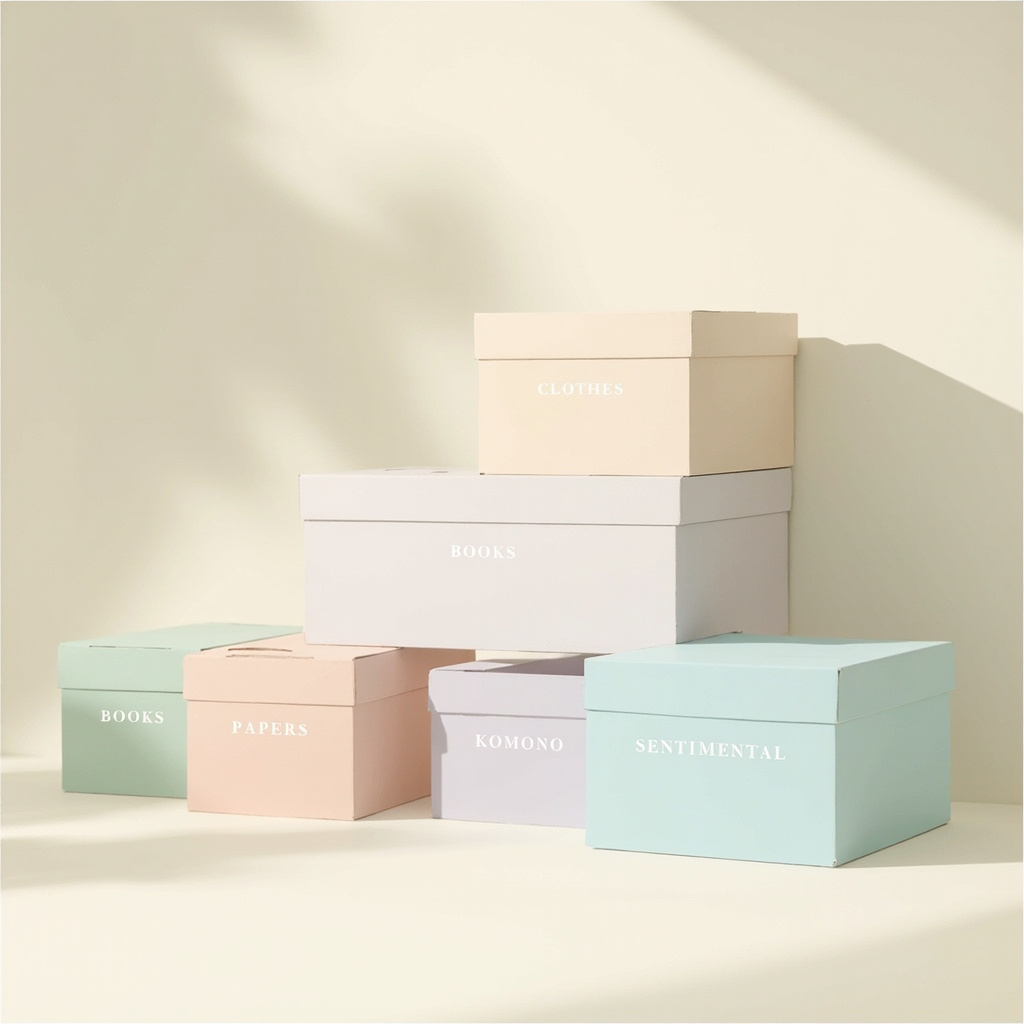
The order matters: Clothes → Books → Papers → Komono (miscellaneous) → Sentimental. This sequence is designed to build decision-making skill gradually. Clothes are the easiest category; sentimental items are the hardest. By the time you reach sentimental, you’ve built the habit.
Rule 6: Ask “Does It Spark Joy?”
For each item, hold it and ask: does this spark joy? If yes, keep. If no, thank it and discard. This isn’t just sentimentality — it’s a way to bypass the rationalizations that keep us holding onto things we don’t use.
The 5-Category Sequence
Category 1: Clothes (Easiest, Start Here)

Gather every piece of clothing from every room — bedroom closet, hallway hooks, laundry baskets, storage bins, the back of the car. Spread them on the floor. Touch each item. Keep what sparks joy; donate the rest.
KonMari-specific technique: fold clothes vertically and store them in drawers so you can see every item at once. The DECOMOMO fabric bins work for storing off-season clothing.
Category 2: Books
Gather every book from every room. Same process — touch each one, keep what sparks joy. Most people discover unread books they’ve been “meaning to get to” for years. KonMari asks: will you read it in the next 6 months? If not, donate.
Category 3: Papers
Gather every paper — mail, bills, receipts, magazines, notebooks, manuals. KonMari is strict on this category: most papers don’t spark joy. Keep only:
- Currently active documents (in-progress projects, current bills)
- Documents with legal or financial importance (tax returns, contracts)
- Items with irreplaceable sentimental value (children’s drawings, certificates)
Recycle or shred the rest. Use chalkboard labels on file folders for ongoing active papers.
Category 4: Komono (Miscellaneous)

This is the largest category — everything that isn’t clothes, books, papers, or sentimental. Sub-categories in order:
- CDs/DVDs
- Skin care and cosmetics
- Accessories (jewelry, watches, bags)
- Kitchen tools and pantry items
- Electronics and gadgets
- Household tools
- Garage and outdoor
- Hobby items
- Decorative items
KonMari insists on sub-categories in this order, not skipping around. Within komono, the mDesign stackable bins work well for kitchen sub-categories.
For kitchen-specific komono, our kitchen pantry guide and pantry checklist walk through kitchen items specifically.
Category 5: Sentimental (Hardest, End Here)
Photos, letters, gifts, mementos, inherited items. By this point in the sequence, you’ve built the decision-making muscle. Apply the joy test — and for items that don’t spark joy but feel obligated (gifts from people you love), thank the item mentally and release it.
For sentimental items you keep, the mDesign bins provide good archival storage.
The Joy Test in Practice
The “does it spark joy?” question sounds abstract. Three concrete ways to feel it:
- Physical sensation — your body relaxes or tightens when you hold the item. Joy feels like warmth, openness. Non-joy feels like heaviness, resistance.
- Mental image — when you imagine using or seeing the item tomorrow, do you feel excited or neutral?
- Past usage — when did you last use it? If 12+ months ago and not seasonal, it likely doesn’t spark joy.
Functional items (toilet plunger, screwdriver) don’t need to spark joy — they need to work. The joy test applies to items with emotional or aesthetic value.

Step-by-Step KonMari Sequence (Quick Reference)
For readers who want the at-a-glance sequence without reading the full guide, here is the 5-category order KonMari prescribes. Following this exact order matters — it reduces decision fatigue by starting with the easiest categories and ending with the most sentimental.
- Clothes — start with tops, then bottoms, dresses, outerwear, socks, bags, accessories, special items.
- Books — keep only those you’d reach for again.
- Papers — three piles: current, important, junk. Most papers are junk.
- Komono (miscellaneous) — work through CD sub-categories in order.
- Sentimental items — last. By then you’ve built the decision muscle.
For the complete guide, see our KonMari method full guide below. For a 1-day version of category-first decluttering, see our declutter fast guide. For the alphabet-based alternative, see our 5S method home guide. For the budget-focused approach, see our declutter on a budget guide. For keeping the result long-term, see our declutter maintenance routine.
Common Mistakes to Avoid
- Tidying room by room — KonMari is category-first. Following room-by-room defeats the method.
- Skipping the visualization step — without your ideal lifestyle defined, decisions feel arbitrary.
- Organizing before discarding — sorting into bins before deciding what to keep wastes time.
- Out-of-order categories — starting with sentimental before clothes exhausts your decision-making early.
- Treating it as a daily chore — KonMari is a one-time project. Once done, maintain, don’t redo.

KonMari for Small Spaces
Small apartments and tiny kitchens need modified KonMari. Three adaptations:
- Sub-categories compress — combine CD/DVD with electronics, since you likely have few of either.
- Storage furniture dictates volume — measure your storage capacity first, then keep only what fits.
- Donation drop-offs are critical — small spaces can’t absorb the “I’ll deal with it later” backlog.
For small-space-specific systems, our small kitchen organization guide covers the kitchen side, and our pantry checklist applies KonMari to pantry zones.

KonMari for Whole-House Application
The method scales beyond a single room. A whole-house pass takes 2 to 4 weekends, working through categories one at a time. Most households find their hardest category is sentimental — it takes the longest because each item requires a feeling check, not a logic check.
Whole-House Sequence
Move through categories in order: clothes, books, papers, komono (misc), sentimental. For each category, gather every item across every room, then apply the Joy Test. Don’t move to the next category until the current one is done. The discipline of finishing each category matters more than the specific outcome.
Bin Selection After Decluttering
After you’ve decided what stays, the next decision is what bin holds it. For clothing, our storage bin buying guide helps match fabric bins to closet zones. For komono (the largest category), our plastic vs fabric comparison and clear vs opaque comparison walk through the visibility-and-material tradeoffs that determine where each bin lives.
KonMari vs Declutter Fast
KonMari is a feeling-based, gradual method. The declutter fast system is a logic-based, one-day method. Both work; choose by your temperament. KonMari suits people who want a permanent relationship change with their possessions. Declutter fast suits people who want a rapid reset before a move or major life change.
Constraint Guide
- if you live alone → KonMari is straightforward; you decide alone.
- if you live with family → each person tidies their own items; shared spaces need negotiation.
- if you have inherited items → set a deadline. Keep what sparks joy; photograph the rest for memory; release the physical object.
- if you’re downsizing → KonMari is the best preparation. Less to move, less to store.
- if you have limited mobility → work one sub-category at a time. Don’t gather all books if your space can’t fit them at once.
- if you’ve tried KonMari before and failed → revisit Rule 1. Were you truly committed to finishing once? Most “failed KonMari” attempts skipped the commitment.
The KonMari Mindset: How Joy Becomes a Decision Filter
KonMari is not a checklist — it is decision-training. The 6 rules and 5-category sequence are the visible structure, but the real change happens in how your brain evaluates an item. Before KonMari, most people sort by rationalization (“I might need this someday,” “It was a gift,” “I paid good money for it”). After KonMari, the same items trigger a faster, feeling-based filter. That shift — from rationalization to recognition — is the part that persists long after the bins are organized.
From Rationalization to Recognition
The pre-KonMari mind generates reasons to keep. The post-KonMari mind generates a sensation: warmth, openness, heaviness, or resistance. The Joy Test works because it bypasses the rational layer that produces every “but I might need it” excuse. Within a few weeks of consistent practice, your body learns to answer the joy question faster than your rational mind can produce a counter-argument. This is why finished practitioners report that decluttering becomes easier over time — the filter is now running on autopilot.
The Decision Taxonomy: 4 Item Types
When you apply the Joy Test across a category, four types of items tend to emerge:
- Spark-joy keepers — keep visible, easy access.
- Functional tools — keep, but organize by use frequency, not by joy.
- Sentimental keepers with no clear function — keep in a designated memory zone (photo box, single shelf).
- Neither-joy-nor-function — donate or release.
Most pre-KonMari clutter sits in the fourth bucket. The method’s biggest payoff is shrinking bucket 4 to near-zero, which then frees attention for the keepers in buckets 1 and 3.
What “Joy” Feels Like in Practice
Joy is not euphoria. It is a quiet positive feeling — the same sensation you get opening a favorite room or unwrapping a meaningful gift. Common physical signals: a softening of the shoulders, a slight smile, a small intake of breath. Common non-joy signals: tension, hesitation, mental scrolling through reasons to keep. When the answer is unclear, hold the item for 5–10 seconds. The body usually resolves the question before the mind does.

Joy as a Default Filter, Not a Special Exercise
A finished KonMari home runs the joy filter on incoming items too — at the store, when receiving gifts, when sorting the mail. The filter doesn’t take willpower because it has become a habit. Most relapses happen because the filter was never installed at intake; only at the storage stage. For items you want to label and return to designated zones after a Joy Test pass, chalkboard labels make the aftercare stage easier because you can re-label zones as your preferences evolve.
For more on how the Joy Test pairs with quicker one-day methods, see our declutter fast system guide.
Conclusion
The KonMari method works because it’s specific — there’s a right order, a right decision framework, and a defined end. The 6 rules and 5-category sequence remove the “where do I start?” paralysis that defeats most decluttering attempts. Most people who finish the method report the same shift: they stop acquiring reflexively and start curating intentionally. The Joy Test becomes a default filter, not a special exercise. That habit shift — not the immediate tidying result — is the real payoff of KonMari, and the reason practitioners rarely relapse even years after finishing.
For other organization approaches, see our declutter fast system for one-day room decluttering. For room-specific systems, our kitchen pantry guide shows how KonMari principles apply to the kitchen. For a closet application, our closet hub walks through clothing-zone organization using Joy Test principles.
KonMari Aftercare: Keeping the Joy Long-Term
The KonMari method ends with “now maintain.” That one-line prescription hides the real work: building habits that keep your home in the state you finished it in. Without aftercare, the average home returns to clutter within 18 months — not because the method failed, but because daily life pushes back against an immaculate state.
The 10-Minute Daily Reset
The most reliable aftercare pattern is the 10-minute daily reset. Pick one consistent time — most practitioners use right after dinner or first thing in the morning — and return each item to its designated spot. Fold the day’s clothes back into the drawer. Move the day’s mail into the paper zone. Wipe the day’s dishes. The reset prevents small drifts from compounding into the kind of clutter that triggers another full decluttering pass.
For a complete aftercare routine, our maintenance rhythm module covers the specific 10-minute, weekly, and quarterly rituals that pair with KonMari’s category framework.
Quarterly Joy Audits
Every 90 days, spend 30 minutes re-applying the Joy Test to your “borderline” items — the ones you kept but weren’t sure about. Some will have lost their joy (donate them). Some will have grown in meaning (promote them to a more visible spot). The audit prevents accumulation drift without requiring a full re-tidying.
What Comes Back In
A finished KonMari home still receives new items: new clothes, new books, new gadgets. The One-In-One-Out rule (for every new item, release one) keeps the count stable. Without this rule, even a perfectly tidied home will eventually overflow. The Joy Test applies to incoming items too: pause before purchase and ask “does this spark joy?” If the answer is unclear, you don’t need it.
Family Households: Teaching the Method
In households with children, the Joy Test works differently. A 4-year-old cannot articulate what sparks joy, but can answer “do you want to keep this or pass it on?” Adapt the question by age. For older children, walk through a single drawer together. For partners with different standards, run the method on your own items first — finished personal tidying often motivates the other person to follow.
KonMari Quick Start Checklist
If you want to begin today without reading the full method first, here are the five steps to get moving:
- Set a completion date. Pick a target date 3–6 months from now. Write it down. KonMari only works as a “once, completely” project — without a deadline, it becomes another unfinished decluttering attempt.
- Gather category 1 (clothes) from every room. Don’t sort the bedroom closet and call it done. Collect clothes from the closet, dresser, laundry room, coat rack, storage bins, and garage. Pile them on the bed.
- Hold each item and ask: “Does this spark joy?” Not “do I wear this?” or “might I need this?” — the joy question only. If yes, keep. If no, thank the item and place it in the donate pile.
- Move to the next category. After clothes: books → papers → komono (kitchen, bathroom, garage misc) → sentimental (photos, keepsakes). Each category must be fully complete before moving on.
- Assign every kept item a designated spot. Items without a home become clutter. Give each surviving item a specific drawer, shelf, or container.
For the full category-by-category walkthrough, continue reading below.
KonMari vs Minimalism vs Declutter-Fast: Method Comparison
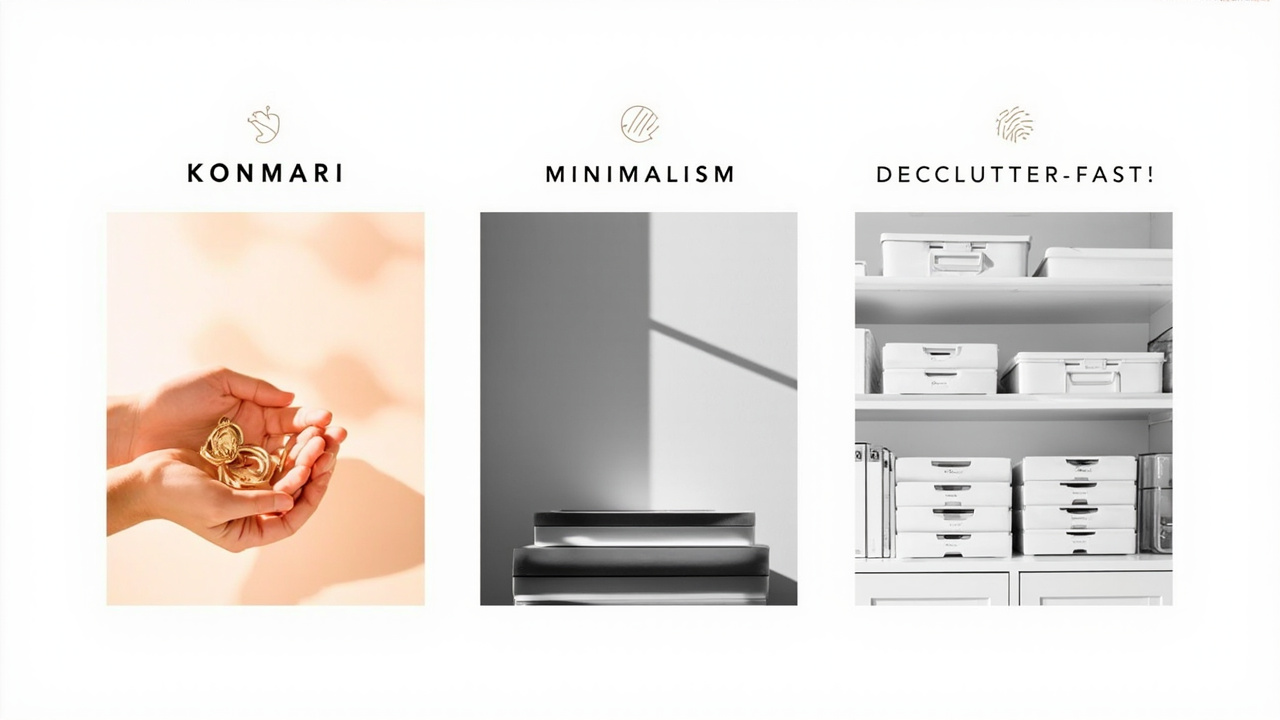
KonMari is one of several tested decluttering methods, but each suits a different temperament and timeline. The most common comparison points are minimalism (a lifestyle philosophy) and the declutter fast system (a one-day logic-based reset). Understanding how KonMari differs from these helps you pick the right method for your situation — or sequence multiple methods over time.
KonMari vs Minimalism
KonMari and minimalism both reduce volume, but they answer different questions. KonMari asks “does this spark joy?” — a feeling-based filter that can produce curated abundance (50 books if all 50 spark joy). Minimalism asks “do I need this?” — a logic-based filter that produces a target count (only 30 books on the shelf). KonMari ends when the Joy Test is finished; minimalism is ongoing because the target can always be tightened. Most households that finish KonMari and still feel surrounded by stuff run a minimalist pass afterward to cap the keepers.
KonMari vs Declutter-Fast
KonMari is feeling-based and gradual — a 3-to-6-month project. The declutter fast system is logic-based and one-day — a 4-hour triage using clear action rules (trash, donate, sell, keep). Choose KonMari when you want a permanent relationship change with your possessions and have weekends to commit. Choose declutter-fast when you face a move, a divorce, a downsizing deadline, or a household reset you want done this week. They are complementary, not competing: declutter-fast removes the bulk quickly, then KonMari refines the keepers using the Joy Test.
KonMari vs 5S and ABC Methods
The 5S method home guide is a workplace-derived system built around five workplace verbs (Sort, Set in order, Shine, Standardize, Sustain). It is more procedural than KonMari and less emotionally demanding. The ABC declutter method is a 26-week room-by-room sweep — useful when you want a slow, low-pressure build-up rather than KonMari’s “once, completely” intensity. Households with limited daily energy often prefer 5S or ABC; households wanting a defined end prefer KonMari.
Choosing by Temperament
A simple rule: if you want a feeling-based permanent change with a defined end → KonMari. If you want a logic-based rapid reset → declutter-fast. If you want a workplace-style ongoing system → 5S. If you want a slow weekly pace → ABC method. For most households, the highest-impact choice is to start with declutter-fast for the bulk purge, then run KonMari on what remains. That pairing removes the “I’m stuck on what to do with this” paralysis that defeats either method run alone.
When KonMari Doesn’t Work
Three household situations where the method struggles:
1. Joint Households with Different Standards
Two adults with different decluttering tolerances often finish a category with one partner holding more than the other. The method assumes individual decision-making. Joint households benefit from negotiation sessions before the Joy Test, not after. For joint-household alternatives, our declutter fast system works better since it focuses on categories with clear action rules.
2. Households with Active Hoarding Tendencies
The KonMari method requires honest emotional engagement with each item. People with hoarding tendencies may not be able to do this without support. If the Joy Test triggers anxiety or inability to discard, professional help is the right next step. KonMari is a household-organization method, not a clinical intervention.
3. Time-Pressured Moves or Transitions
KonMari takes weeks to complete properly. Households facing a move, divorce, or major life change usually need faster triage. The declutter fast system is better suited to time-pressured situations — it accepts that “good enough now” beats “perfect never.” You can run KonMari after the immediate transition.
Spark-Joy Tools
For the donation category, reusable grocery bags double as donation totes and shopping bags. To refresh a freshly organized drawer, line it with non-adhesive shelf liner — the visual cue of clean lines reinforces the spark-joy feeling. For the Komono (miscellaneous) category, woven baskets contain varied items while creating visual calm — KonMari’s principle of “designated spots for everything.”
Apply KonMari by Room
The KonMari method works room by room during the Komono (miscellaneous) category. For room-specific guides that pair with the KonMari sequence:
- Bedroom Organization Hub — closet, dresser, nightstand, and under-bed zones
- Bathroom Organization Hub — vanity, under-sink, linen closet, and shower zones
- Closet Storage Solutions — 4-zone map for hanging, shelf, floor, and door
- Bedroom Declutter Checklist — 9-step weekend reset