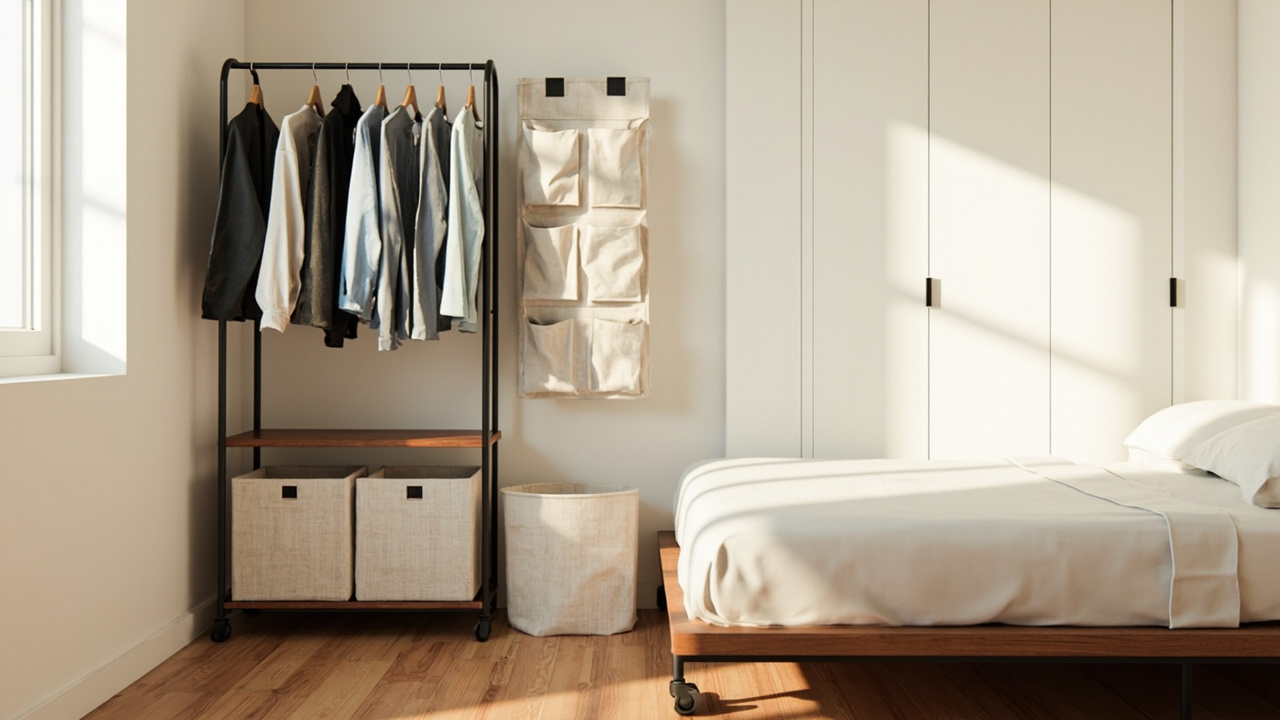
No closet in your bedroom? You’re not stuck. Here’s how to organize clothes in any space using 12 proven storage solutions.
| If you need… | Pick | Price | Why it works |
|---|---|---|---|
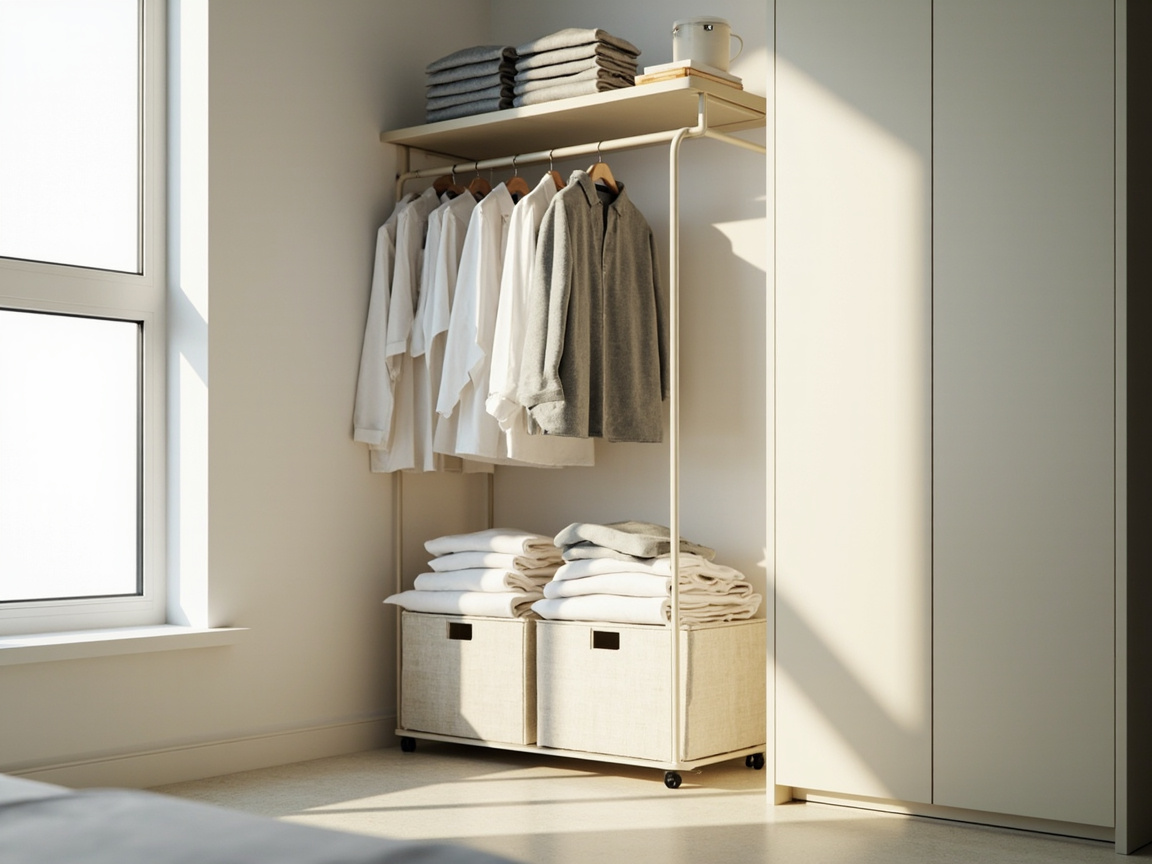
| A full hanging zone | HOMIDEC Wardrobe | $49.99 | 4-tier freestanding wardrobe with cover, shoe rack bottom + hanging rod. Fake-closet look for renters. |
| A rolling rack | Sakugi 79.5” Rack | $45.99 | Tall rack on wheels with bottom shelves. Zero wall damage, movable. |
| Door-back storage | Ofiray 10-Pocket | $28.99 | 5-tier over-door organizer. Holds scarves, hats, belts without drilling. |
| Seasonal bin storage | ZOBER 90L 4-Pack | $17.95 | 4-pack under-bed bags. Fits 6-inch clearance. |
| Double hanging | HYSEYY Double Rods | $34.19 | Two rods stacked vertically. Doubles capacity without more floor space. |
A no-closet bedroom feels like a permanent problem, but it’s a solvable constraint. This guide walks through 12 specific solutions and shows you the 6-step method. The framework also powers our closet storage solutions hub for built-in closets and the small closet organization guide for tight reach-ins. Our closet shoe organization guide covers the dedicated shoe-zone question.
Why Organizing Without a Closet Actually Works
Three reasons a no-closet bedroom can hold as much as a built-in.
The 3 Constraint Categories: Rental, Studio, Small Bedroom
First, identify which constraint you’re solving for. Rentals ban drilling and permanent install — that pushes you toward over-door organizers and rolling racks. Studios have no wall separation between bed and living area, so a wardrobe acts as a room divider. Small bedrooms under 100 square feet force vertical-first storage — anything floor-level takes space you don’t have. Each constraint maps to a different product mix. The Constraint Guide later in this article handles all 6 scenarios with specific product pairs.
Declutter First, Buy Second (KonMari Foundation)
Most people buy organizers before decluttering, and that’s the leading reason the system fails. The KonMari rule is the opposite: remove what you don’t wear first, then measure what’s left, then buy storage. A bedroom declutter pass typically removes 30-40% of clothes by volume — so the wardrobe you would have bought at 60-inch wide becomes a 40-inch wide one. The full method lives in our A-B-C declutter method.
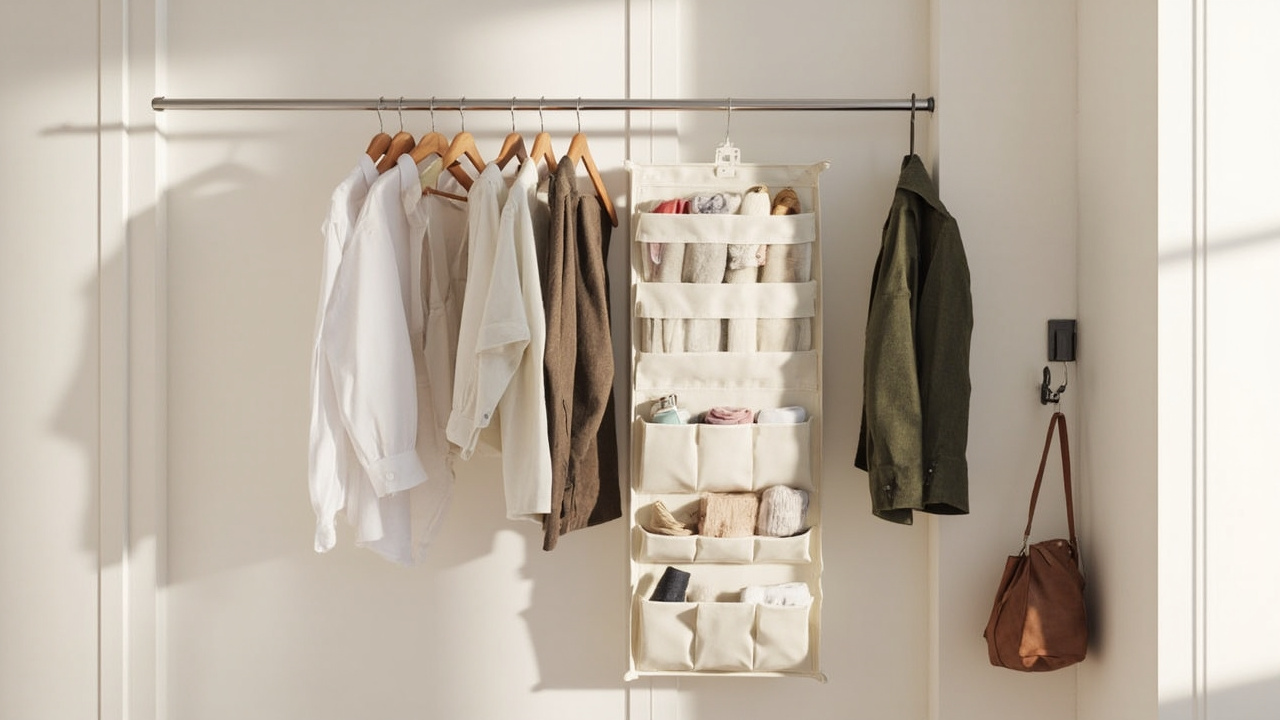
The 12-Solution System: A Step-by-Step Method
Order matters. The 6 steps run in sequence — start at Step 1 first.
Step 1: Audit & Donate First (KonMari Joy Check)
Pull every piece of clothing out of storage — drawers, suitcases, the chair pile — and lay it on the bed. Run the KonMari joy check on each item: does it spark joy, and have you worn it in the last 12 months? If both answers are no, donate. Anything you haven’t worn in 12 months that’s not seasonal (winter coat, formal wear) is a donate candidate. This step typically removes 30-50% of volume before you touch a single organizer. The A-B-C declutter method gives the full framework.

Step 2: Categorize by Use Frequency (Daily / Weekly / Seasonal)
Sort the remaining clothes into 3 piles by how often you wear them. Daily pieces (work clothes, underwear, everyday shirts) need the most accessible spot — the hanging rod or dresser top drawer. Weekly pieces (weekend wear, occasional outfits) go on shelves or mid-tier bins. Seasonal pieces (winter coats in summer, swimsuits in winter) go in under-bed storage or the back of the top shelf. The seasonal closet rotation covers the twice-yearly swap that keeps this system honest.
Step 3: Choose Your Storage Zones (Bedroom Corner / Closet Substitute / Wall)
Map the 3 piles to 3 physical zones. The hanging zone lives in the bedroom corner — a freestanding wardrobe like the HOMIDEC Wardrobe Closet ($49.99) handles daily + weekly hanging in one unit with cover, shoe rack, and rod. The rolling rack option (Sakugi or HYSEYY double-rod) works when the corner is too narrow. The door-back zone holds accessories via the Ofiray 10-pocket over-door organizer. The under-bed zone covers seasonal via the ZOBER 90L 4-pack.
Step 4: Install Vertical Storage (Rails, Hooks, Over-Door)
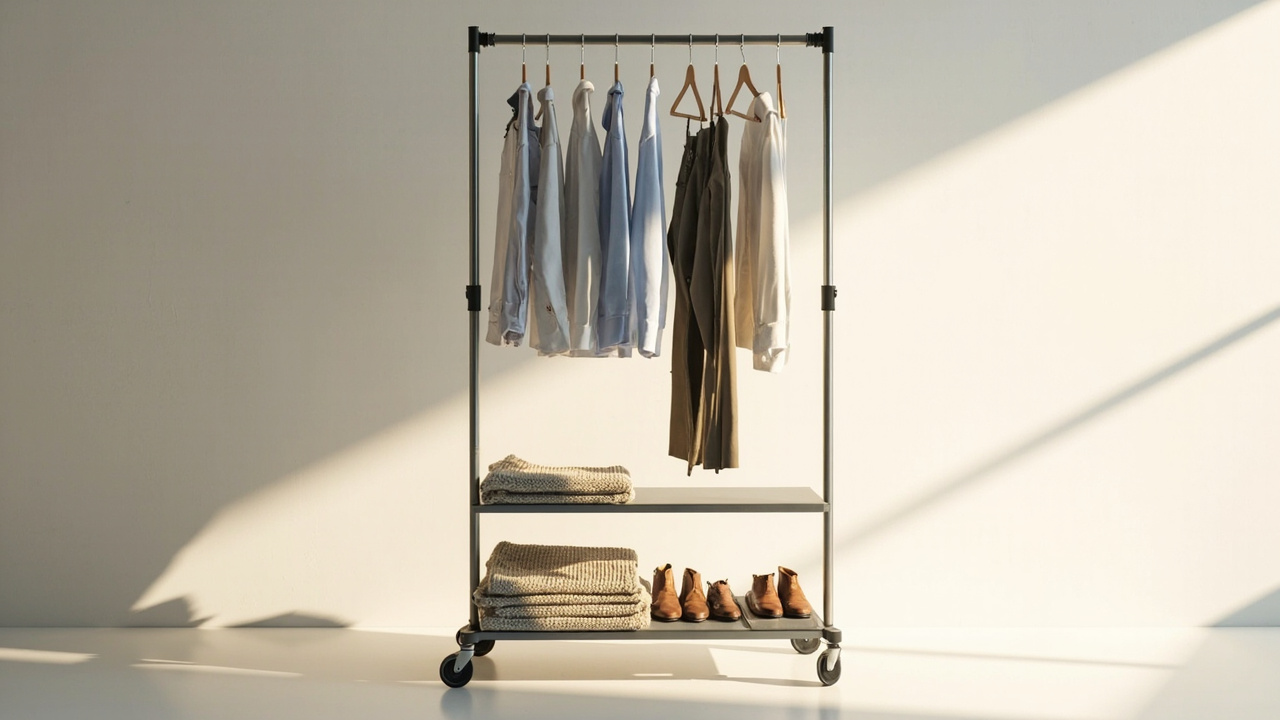
Vertical-first rule: anything on a door or wall beats anything that takes floor space. The fastest vertical win is the over-door organizer — it costs nothing in floor space and adds 10 pockets in a 5-tier configuration. Wall hooks handle bags, jackets, and tomorrow’s outfit (the hooks racks vertical storage guide covers command-strip options for renters). If you own the walls, add a wall-mounted rail above the door for an extra hanging bar.
Step 5: Rotate Seasonal Clothes (Under-Bed Storage)
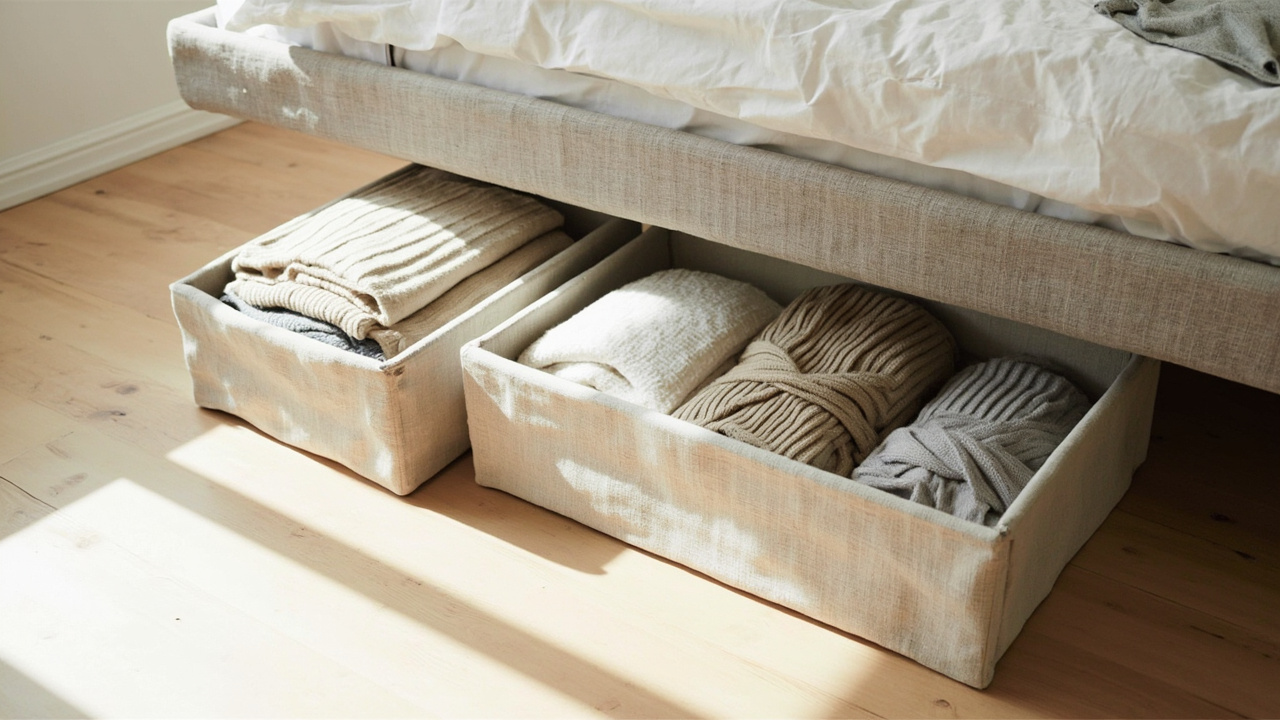
Twice a year — spring and fall — pull every seasonal item out and swap. Summer clothes go into the under-bed bins (ZOBER 90L 4-pack, $17.95 for the full set), winter clothes come out. Label each bin with contents and season — chalkboard labels or masking tape both work. The seasonal closet rotation guide has a full swap checklist. Don’t skip labels; the March hunt for your winter coat is the failure case Mistake #4 covers below.
Step 6: Maintain Monthly (15-Minute Sunday Reset)
The system holds only if you run a 15-minute monthly reset. Pick a Sunday, set a timer, do 3 things: (1) return anything that landed on the floor or chair to its zone, (2) scan for donation candidates — anything you didn’t reach for in 4 weeks, (3) vacuum the floor under the rolling rack and wipe down the wardrobe cover. The reset prevents the 30-minute seasonal hunt and keeps the wardrobe from becoming a junk-drawer. Most readers who skip this step see the system collapse in 6-8 weeks.

Storage Solutions by Budget
Three tiers cover most budgets.
Budget Tier: Under $30
Two products cover the basics. The Ofiray 10-pocket over-door organizer at $28.99 handles scarves, hats, belts, and accessories on any door — no drilling. The ZOBER 90L 4-pack at $17.95 covers seasonal sweaters, coats, blankets under any standard bed. Total $46.94. Skip hanging in this tier and rely on dresser drawers if you have them.
Mid Tier: $30-60
Three products fill out the hanging zone. The HOMIDEC Wardrobe Closet at $49.99 handles the main hanging zone with cover, shoe rack bottom, and rod. The Sakugi 79.5-inch rolling rack at $45.99 handles overflow and is movable when rearranging. The HYSEYY double-rod rack at $34.19 doubles hanging capacity without more floor space. Pick one based on whether you need cover (HOMIDEC), wheels (Sakugi), or double-rod (HYSEYY).
Premium Tier: $60+
Combine 2-3 mid-tier units. HOMIDEC + Sakugi ($95.98) gives a closed wardrobe for daily wear plus an open rack for overflow. HOMIDEC + HYSEYY ($84.18) gives a closed wardrobe plus a double-rod rack for shirts and pants. Sakugi + HYSEYY ($80.18) gives two rolling racks in different spots — useful when one person needs the corner and the other needs the wall. Don’t stack premium units without a floor-space audit; Mistake #2 below covers the failure case.
Constraint Guide (Decision Tree)
Six scenarios cover most no-closet situations.
If you live in a STUDIO APARTMENT
Position the wardrobe as a room divider. The HOMIDEC Wardrobe Closet ($49.99) sits behind the sofa with the closed side facing the living area — visually it reads as a wall, not as storage. Add a ceiling-mounted rod above the bed for high-frequency items like tomorrow’s outfit. Pair with the Ofiray 10-pocket over-door organizer ($28.99) on the bathroom or bedroom door for accessories. Studios punish visual clutter, so closed storage beats open racks.
If you SHARE A ROOM with a roommate
Split zones by owner, not by category. The HYSEYY Double Rods Rolling Rack ($34.19) splits cleanly — left rod for one person, right rod for the other, each with their own under-bed bin. Add a tall dresser behind the bed for folded items. Pair each side with an Ofiray 10-pocket over-door organizer ($28.99) on the door — one per occupant keeps accessories separate. Avoid the HOMIDEC wardrobe in shared rooms — one person ends up with 70% of the rod and the other feels shorted. Open racks with defined zones are fairer than closed units with implicit ownership.
If you live in a DORM
Three units, all under $80 total. The Ofiray 10-pocket over-door organizer ($28.99) on the dorm-room door handles accessories and small items. The ZOBER 90L 4-pack ($17.95) under the dorm bed stores off-season clothes and extra bedding. A 3-cube organizer (not in our product lineup but widely available at Target) handles folded items. Total ~$47 covers the dorm room — the dorm bed’s built-in clearance handles the rest. Skip wardrobes in dorms; floor space is too tight.
If you live in a SMALL BEDROOM (under 100 sq ft)
Vertical-first rule. Wall hooks (the hooks racks vertical storage guide covers command-strip options) handle bags, jackets, hats. The Ofiray 10-pocket over-door organizer ($28.99) covers accessories. The HOMIDEC Wardrobe Closet ($49.99) goes in the corner — 33 inches wide fits a 5x5 corner. Skip rolling racks under 100 sq ft; they eat 14+ inches of wall. See the small bedroom organization guide for the full playbook.
If you live in a RENTAL (no drilling)
Zero-drill kit. The Ofiray 10-pocket over-door organizer ($28.99) hooks over any door with zero install. The Sakugi 79.5-inch rolling rack ($45.99) rolls on wheels, no wall anchors needed. The ZOBER 90L 4-pack ($17.95) slides under the bed. Total $92.93 covers a no-closet rental with zero wall damage. Move-out in 30 minutes — pick up the rack, take the over-door off, slide the bins out. Security deposit untouched.
If you live in a CLOSET-LESS BEDROOM with sloped ceilings
Low-profile only. The HOMIDEC Wardrobe Closet ($49.99) at 67 inches tall fits under most 8-foot ceilings with sloped edges. Pair with the Sakugi 79.5-inch rack ($45.99) only on the wall where the ceiling is full height. Skip tall dressers; they hit the slope at the wrong spot. The sloped-ceiling constraint also rules out ceiling-mounted rods.
Common Mistakes
Five failure cases from Reddit and organizer forums.
-
Buying organizers BEFORE decluttering — The most common failure pattern. You buy a wardrobe, fill it, and within 4 weeks it’s overflowing because you never measured what you actually own. Fix: always run Step 1 first. The KonMari method removes 30-50% of volume, and the bedroom declutter guide walks through the full pass.
-
Stacking 5+ over-door organizers on one door (door won’t close) — The Ofiray 10-pocket organizer at 5 tiers is heavy when loaded with scarves and hats. Add a second organizer to the same door and the door won’t latch — the load pulls the hooks off. Stick to one over-door organizer per door. For more accessory storage, use the dresser top drawer with the hooks racks vertical storage guide hooks. See dresser organization guide for drawer-based alternatives.
-
Ignoring humidity (mildew on clothes stored in under-bed bins) — The ZOBER 90L 4-pack is breathable fabric, which works in dry climates. In humid climates (Southeast US, basement bedrooms, coastal areas), the same bags absorb moisture and develop mildew. Fix: add a cedar block or two inside each bin, or switch to plastic bins with sealed lids. Don’t trust “breathable fabric” marketing if your bedroom runs above 60% humidity.
-
Forgetting to label seasonal bins (March = “where’s my winter coat?”) — You packed the sweaters in October. March rolls around and you spend 30 minutes opening every bin looking for the wool sweater. Fix: label each bin with contents and season on the outside and on a small card inside. The seasonal closet rotation guide has a printable label template. Cost: $5 for labels. Time saved: 30 minutes twice a year.
-
Skipping the donation step (closet-substitute becomes junk-drawer) — You buy the HOMIDEC wardrobe, fill it with everything from your old dresser, and skip the donate pass. Six months later, the wardrobe is a horizontal pile of clothes you never wear. The donate step is what makes the system work. If you’re moving, the declutter before moving guide has the apartment-move version.
Layout by Bedroom Type
Two layout patterns cover most no-closet bedrooms.
Pattern A — Bedroom Corner (P1 HOMIDEC + P3 Ofiray)
The closed-corner pattern. The HOMIDEC Wardrobe Closet ($49.99) sits in the bedroom corner with the cover facing out — visually it reads as furniture, not storage. Add the Ofiray 10-pocket over-door organizer ($28.99) on the bedroom door for accessories. Total $78.98. Best for: rentals where you don’t want visible clutter, bedrooms with full ceiling height, and small bedrooms under 100 sq ft where closed storage beats open racks.
Pattern B — Wall-Along (P2 Sakugi or P5 HYSEYY + P4 ZOBER)
The open-rack pattern. The Sakugi 79.5-inch rolling rack ($45.99) or the HYSEYY double-rod rack ($34.19) runs along the longest wall. Pair with the ZOBER 90L 4-pack ($17.95) under the bed. Total $63.94 to $80.93. Best for: walk-up apartments where you want the rack movable for cleaning, shared rooms, and bedrooms with a sloped ceiling where a corner wardrobe won’t fit.
Maintenance Rhythm
Three tiers, total 25 minutes per week. The rhythm holds the system for years, not weeks.
Daily 2 minutes. Before bed, return today’s outfit to its zone. 30 seconds for the dresser drawer, 30 seconds for the hanger, 30 seconds for the accessory organizer, 30 seconds to scan the floor for strays. Daily maintenance fails the moment it takes more than 2 minutes.
Saturday 10 minutes. Run the mid-tier reset: return anything that migrated (chair pile, floor pile, guest bed), wipe down the wardrobe cover, check the rolling rack wheels. Saturday morning with coffee works for most readers.
First Sunday of the month, 15 minutes. The monthly audit: scan for donation candidates (anything you didn’t reach for in 4 weeks goes in the donate bag), vacuum under the rolling rack, wipe the over-door organizer pockets, check the under-bed bin labels. This is the only step that catches the slow drift back to chaos — without it, the system fails in 6-8 weeks.
For the broader bedroom rhythm, see our bedroom declutter checklist and the seasonal closet rotation for the twice-yearly swap.
Related Guides
For the full closet picture across built-ins, reach-ins, walk-ins, and shoe-specific systems, start at the Closet Hub and the companion Closet Storage Solutions, then dive into the sister guides:
- Closet Hub — the 4-zone framework for all closet types
- Closet Storage Solutions — 10 picks by zone
- Walk-In Closet Organization — systems for closets with floor space
- Small Closet Organization — solutions for closets under 4 feet wide
- Shoe Organization for Closets — dedicated shoe storage
- KonMari Declutter Method — the foundational framework before buying organizers