
Closet storage usually goes wrong because people buy a product for a zone that never had the problem. Every closet has four zones — rod, shelf, floor, door — so the ten picks below are sorted by zone, with today’s measured price and the single problem each one fixes.
| Zone | Solution | What it fixes | Price today | Tier | No-drill |
|---|---|---|---|---|---|
| 1 Rod | Double-rod converter | Ran out of hanging space | $33.99 | Better | Yes — tension fit |
| 1 Rod | Slim velvet hangers, 30-pack | Clothes sliding off the rod | $17.71 | Good | Yes — nothing to install |
| 2 Shelf | Hanging shelf, 5 tiers | No shelf space below the rod | $39.99 | Better | Yes — hook-hung |
| 2 Shelf | Fabric storage baskets, 4-pack | Folded piles collapsing | $19.99 | Good | Yes |
| 2 Shelf | Freestanding wire rack, 3 tiers | No shelf exists at all | $32.04 | Better | Yes — assembles without tools |
| 3 Floor | Tiered shoe rack | Shoes stacked by the door | $9.99 | Good | Yes |
| 3 Floor | Freestanding fabric drawer unit | Floor space, no folded storage | $62.99 | Best | Yes |
| 4 Door | Over-door pocket organizer | Nowhere for accessories | $16.14 | Good | Yes — hook-hung |
| 4 Door | Accessory hanger, 2-pack | Scarves and belts in a drawer | $16.99 | Good | Yes — hook-hung |
| 2 + 3 | Modular cube system | Multi-zone or an open layout | $43.99 | Best | Yes — tool-free |
One thing stands out before you read further: not one of these ten needs a drill. Every pick hangs, tensions, or stands on its own, which matters more than price if you rent. One price above drops for Prime members: the wire rack falls from $32.04 to $26.36. Two others show a higher regular price beside them — the baskets at $24.99 and the over-door organizer at $22.99. Check the price on the product page before you order.
Why Closet Storage Solutions Fail
One-Size-Fits-All Thinking
Most people buy a closet storage solution before asking which zone needs fixing. A hanging shelf solves a “shelf space” problem. An over-door organizer solves a “no accessory storage” problem. Both are wasted money if the actual failure is that the rod is physically full.
Start from the zone, not the product category. The closet hub carries the same four-zone framework applied across every closet type, and this article runs one product per zone rather than a generic list.
Product Before Problem
Buying storage before measuring is the second common mistake. A single freestanding drawer unit at $62.99 solves “I have floor space but no folded storage.” If your real problem is “shelves collapse under folded items,” a $19.99 basket set is the smarter first purchase — and if it’s “shirts slide off plastic hangers,” $17.71 in velvet hangers ends it.
Every section below states the problem first, then the option, then the price.
The 4-Zone Product Framework
Zone 1 (Hanging Rod): double rod converters, velvet hangers, tie and belt holders. Zone 2 (Shelf): hanging organizers, storage baskets, freestanding wire racks. Zone 3 (Floor): shoe racks and freestanding drawer units. Zone 4 (Door): over-door pockets and accessory hangers.
The storage bin guide and the shelf organizer guide go deeper on the Zone 2 picks if that is where your failure sits.
Zone Planning — How to Actually Plan Each Zone
Closets don’t usually backslide because the products were wrong. They backslide because nobody measured the zones first. A five-minute tape measure run before you open a product page prevents most of the disappointment described in the mistakes section below.
The Four Zones at a Glance
Every product recommendation in this guide hangs off one of these four zones. Locate yours before you measure anything, because the zone you skip is usually the one that is failing.
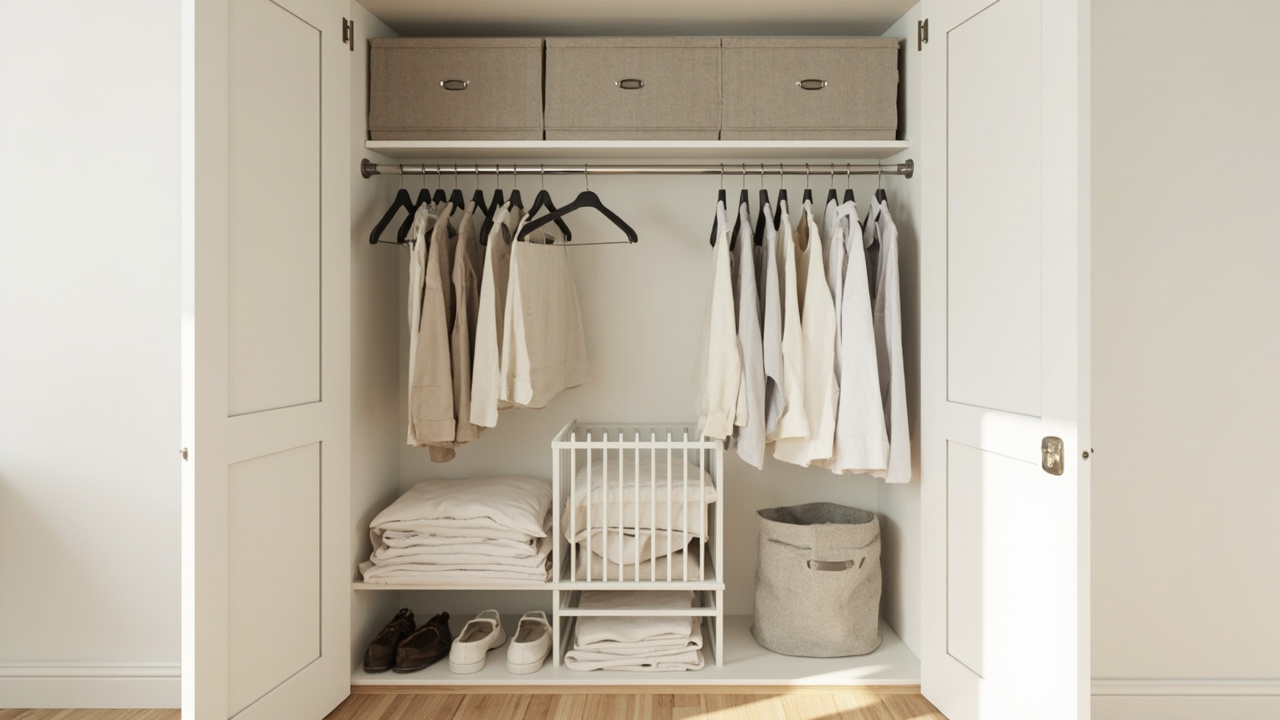
Step 1: Measure Each Zone
Walk through with a tape measure. Zone 1 (Hanging Rod): record the rod length and the ceiling height above it — that gap decides whether a double rod or hanging shelf fits. Zone 2 (Shelf): measure shelf depth and the length between supports. Zone 3 (Floor): measure floor width and the clearance from whatever is above, because that decides whether a drawer unit fits or has to sit outside the closet. Zone 4 (Door): measure door height and width, and check for hinges that stand proud — over-door organizers need a flat back to hang from.
Step 2: Identify the Failure Zone
Every closet has one zone failing harder than the rest:
- Clothes sliding off plastic hangers, rod overflowing → Zone 1 fails.
- Folded piles collapsing on the shelf, nowhere for handbags → Zone 2 fails.
- Shoes piled by the door, handbags on the floor → Zone 3 fails.
- Scarves in a drawer, belts on a doorknob → Zone 4 fails.
Fix the failing zone first, not the easiest one. Zone 1 is usually the cheapest at under $52 for the rod plus hangers, but if Zone 3 is what you see first thing in the morning, start there.
Step 3: Match Product to Zone by Problem
Once you have measured, picking is mechanical. A hanging shelf only solves “I need more shelf space below the rod.” A double rod only solves “I’m out of hanging space.” A drawer unit only solves “I have floor space but no folded storage.” Map the product to the problem sentence, not to the product’s category page.
Step 4: Test Before Scaling
Buy one product, install it, live with it a week, then buy the second. Closet organization fails when five things arrive at once and conflict. The double rod fouls the shelf above it, the hanging shelf blocks the rod, the cube unit tips on an uneven floor. One at a time catches the conflict while it is still one product.
What You’ll Need — 10 Products by Zone
Zone 1 — Hanging Rod Storage
STORAGE MANIAC Adjustable Closet Rod (2 Pack) — $33.99. Each rod telescopes from 28 to 48 inches and the pair supports up to 80 lb combined. The upper rod sits at eye level for shirts, the lower around 36 inches down for pants. Installation is pure tension against the side walls — no screws. The single highest-impact upgrade available to almost any closet.
Amazon Basics Slim Velvet Non-Slip Hangers (30-Pack) — $17.71. Velvet grips stop clothes sliding, and the slim profile gives back roughly half the rod space a standard plastic hanger wastes. At about $0.59 a hanger this is the best value in the velvet category. If you are choosing between hanger styles, the how to choose hangers guide covers the tradeoffs.

Zone 2 — Shelf Storage
X-cosrack 5-Tier Hanging Closet Organizer with Hooks — $39.99. Five wire basket tiers hang off the rod you already have, each about 12 by 11 inches, which sits comfortably inside a standard 24-inch reach-in depth. Four side S-hooks add hanging room for ties, bags, and belts. Wire construction lets stored items breathe, which matters for anything you do not want sitting damp.
Criusia Large Closet Storage Baskets (4-Pack) — $19.99, with $24.99 shown beside it as the regular price for non-members. Each basket is roughly 14 by 10 inches, so it clears a standard 16-inch deep shelf. Handles mean you pull one basket out rather than excavating a pile, and they collapse flat for off-season storage. Sold by the brand rather than Amazon, so the regular-price figure is the one that applies to most readers.
Amazon Basics 3-Shelf Steel Wire Rack — $32.04, dropping to $26.36 for Prime members. This is the pick for a closet with no shelf anywhere in it. It stands on its own, measures 23.2 by 13.4 by 30 inches, and each shelf holds 250 lb evenly distributed for 750 lb across the unit. Amazon’s own feature bullet says it assembles without tools. The 30-inch height is the catch — it will not clear a low-hung rod, so measure Zone 2 before ordering.

Zone 3 — Floor Storage
Kitsure Non-Woven 3-Tier Shoe Rack — $9.99. Three tiers hold up to 12 pairs. At 27.5 inches wide and under 14 inches deep it fits a single-door closet without crowding the rod, and the tiers stack if you need more. For seasonal bedding and bulk linen beyond the closet, the linen closet organization guide covers the rest of the house.
Amazon Basics Extra Wide Fabric 5-Drawer Storage Organizer — $62.99. Five fabric drawers on a steel frame with a laminated wood top, 40.2 inches wide, 11.85 deep, and 21.7 tall. Adjustable-height feet stop it wobbling or marking the floor. At that width it will not go inside a narrow reach-in closet — it belongs against a bedroom wall or a walk-in wall, where it effectively replaces a dresser. Sold by Amazon.com at a flat price, not a Prime deal.

Zone 4 — Door + Accessory Storage
ULG 1 Pack Over-Door Organizer with 5 Large and 10 Mesh Pockets — $16.14, with $22.99 shown beside it as the regular price for non-members, and sold by a third-party seller rather than Amazon itself. Five large pockets plus ten mesh sides hang over a standard 1 3/8-inch door with no screws. Rated to 44 lb, so shoes and accessories are fine.
Tosnail Scarf Hanger Holder (2-Pack) — $16.99, so under $9 per hanger. Each holds 12 scarves, belts, or ties on 360-degree rotating hooks and hangs from the rod, adding zero footprint.
AWTATOS 12-Cube Storage Organizer — $43.99. Twelve interlocking plastic cubes with no tools required for assembly. Configure them as a 3 by 4 shoe wall, a 2 by 6 shelf run, or a divider that carves a closet section out of an open room. Each cube is 13.8 inches, holding two pairs of shoes or one folded sweater.
Storage Types by Function
Hanging Solutions
Double rod converters plus velvet hangers are the highest-impact upgrade for any closet. The STORAGE MANIAC double rod at $33.99 and Amazon Basics velvet hangers at $17.71 come to $51.70 together, and they compound: the rod doubles your runs and the slim hangers make each run hold more.
Shelf Solutions
Hanging shelves add tiers below the rod, baskets tame the overhead shelf, and a freestanding rack fills the gap when the closet has no shelf at all. Material decides how each one behaves under load.
| Solution type | Material | Load | Durability | Fits where | Watch out for |
|---|---|---|---|---|---|
| Modular cube (10) | Rigid polypropylene | Light to medium | High, no sag | Any closet | Not for damp rooms |
| Freestanding wire rack (5) | Steel wire, epoxy coat | 250 lb per shelf, 750 lb total | High | Anywhere with 13.4” depth and 30” height | 30” tall, will not clear a low-hung rod |
| Hanging shelf (3) | Steel wire basket | Medium | High | Any rod | Hangs from one point — check rod strength |
| Fabric baskets (4) | Non-woven polyester | Light only | Low to medium, sags when overfilled | Overhead shelf | Overfill it and the pile collapses |
| Fabric drawer unit (7) | Steel frame, laminated wood top | Heavy | High | Bedroom or walk-in wall | 40.2” wide, measure first |
| Double rod (1) | Steel and ABS | Up to 80 lb | High | Any rod | Useless in a rodless closet |
For the broader question of rigid plastic versus fabric versus wire, the wire cube vs wood closet system guide runs the same material axis at more depth.
Floor Solutions
Narrow shoe racks and freestanding drawer units turn dead floor into storage. The Amazon Basics drawer unit at $62.99 is the priciest pick here and doubles as a dresser, but it needs 40.2 inches of clear width. In a bedroom that already has a dresser, a closet within a bedroom setup may serve the same purpose for less.
Door Solutions
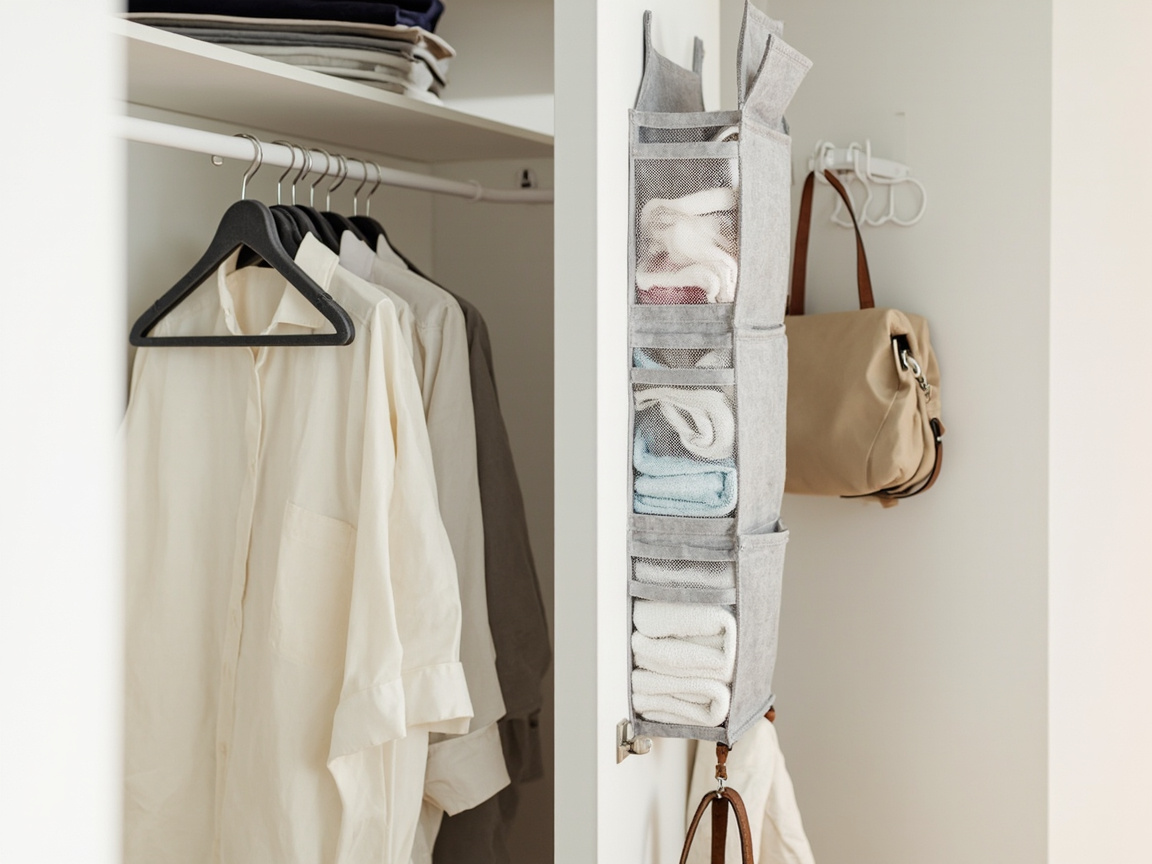
The back of the closet door is the most under-used surface in the room. Pockets and accessory hangers add storage without touching shelf or floor space. The ULG over-door organizer at $16.14 ($22.99 at the regular price) covers daily-access items; the Tosnail scarf hanger at $16.99 handles accessories. Both assume a door exists to hang from.
The Selection Framework: Good / Better / Best
Good ($9.99–$19.99)
Solves one specific problem with one product. The Kitsure shoe rack, Amazon Basics velvet hangers, Criusia baskets, ULG organizer, and Tosnail hanger all fix a single zone for under $20 apiece.
Better ($32.04–$39.99)
Expands capacity rather than just tidying one surface. The STORAGE MANIAC double rod, Amazon Basics wire rack, and X-cosrack hanging shelf each add a whole tier or run of storage, and they stack. The rod and the hangers together are what actually double hanging capacity.
Best ($43.99–$62.99)
System scale. The AWTATOS cube system reconfigures across zones and doubles as a room divider; the Amazon Basics fabric drawer unit replaces an entire dresser. Both solve several problems at once, which is why they cost more.
All Three Tiers Side by Side

Layout by Closet Type — Reach-In, Walk-In, Small, and Open
The four-zone framework is universal. The priority stack is not, because each configuration fails on a different axis — depth, space, width, or appearance.
| Closet type | Signature constraint | Priority zone | Works | Skip or measure first | Typical first spend |
|---|---|---|---|---|---|
| Reach-in (24” deep) | Depth | 1 then 2 | Rod, hangers, hanging shelf, shoe rack, over-door, accessory hanger | Drawer unit — 40.2” wide will not clear a narrow opening | $61.69 for rod + hangers + shoe rack |
| Walk-in (36”+ deep) | Space allocation | 1 then 3 | All ten | Nothing | Wire rack and drawer unit both fit comfortably |
| Small closet (under 4 ft wide) | Width | 1 then 4 | Hangers, hanging shelf, over-door organizer, accessory hanger | Double rod if the rod is short; wire rack at 30” tall if ceiling height is tight | $34.70 for hangers + accessory hanger |
| Open layout (no door) | Visual | 1 then 2 | Rod, hangers, hanging shelf, baskets, cube system | Over-door organizer and accessory hanger — nothing to hang them on | Cube system doubles as the room divider |
The Four Layouts Side by Side
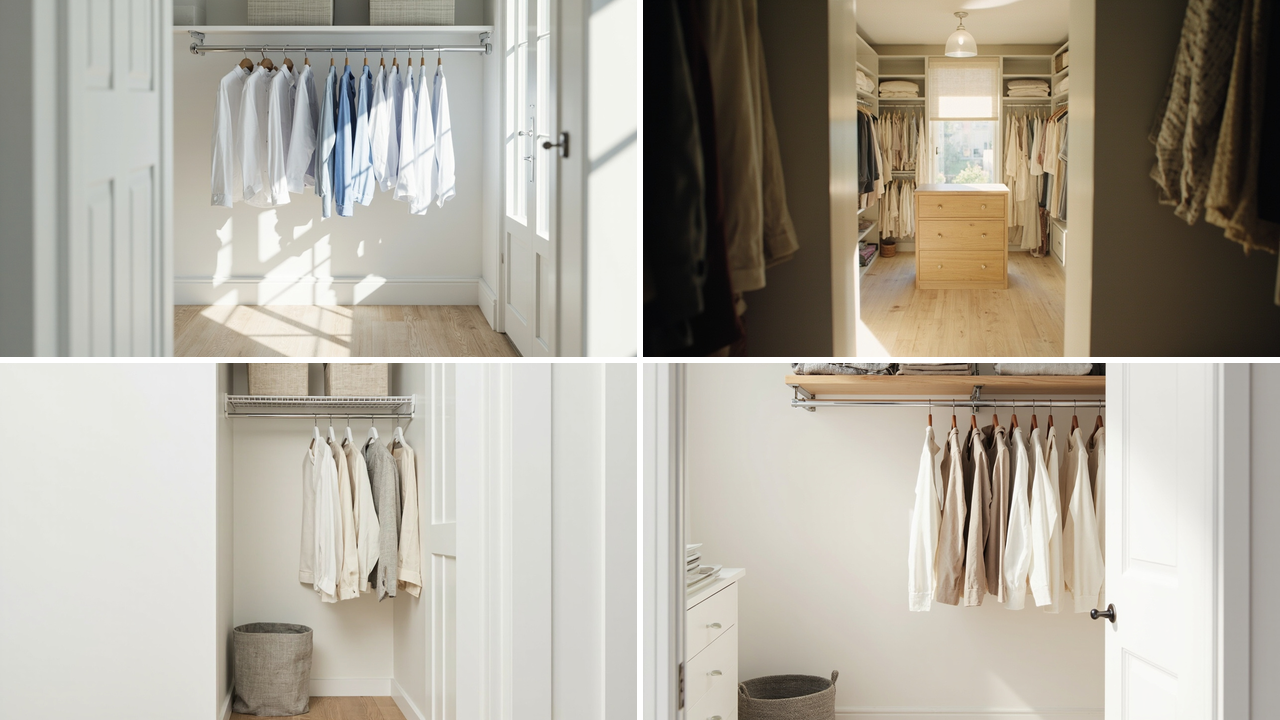
Reach-in Closet (24 Inches Deep, Single Rod or Single Shelf)
Depth is the constraint. Most reach-ins have one rod and one shelf, sometimes just a rod. Zone 1 is the highest-impact fix because a double rod converter plus velvet hangers doubles capacity in the same footprint. Zone 2 is second, because the existing shelf is usually wasted — a hanging shelf that hangs off the rod gives you five tiers without needing a shelf at all. Zone 3 is rarely useful, since a reach-in is too narrow for the 40.2-inch drawer unit; the shoe rack is the only floor pick that fits without crowding. Zone 4 is open territory because most reach-ins have a door.
Walk-in Closet (36+ Inches Deep, Floor Space Available)
The constraint is allocation, not depth. Walk-ins can support everything — wire shelving along a wall, the fabric drawer unit, cube storage as a divider. Zone 1 is still first, though you have more rod length so a double rod stacked above a single run is the common pattern. Zone 3 becomes second priority because floor space finally exists. Zone 2 shifts toward accessories rather than primary folded storage, and Zone 4 often drops out because many walk-ins have no door on the closet itself. For the full playbook see walk-in closet organization.
Small Closet (Under 4 Feet Wide)
Width is the constraint, which makes this the honest answer to this guide’s own small-space framing. A closet under four feet wide has a short rod, and that changes the ranking. Velvet hangers matter more than a double rod, because you recover width on every run without needing rod length to spare. Zone 4 is unusually valuable here — the door is one of the few unused surfaces, so the over-door organizer earns its space. Zone 2 is squeezed by width too, and a hanging shelf that drops from the rod beats a rack standing on the floor. Skip the 30-inch-tall wire rack if your ceiling height under the rod is tight.
Open Layout (No Door, Exposed Storage)
The constraint is visual. An open closet is part of the room’s sightline, so products have to look intentional as well as work. Zone 4 drops out entirely — nothing to hang from. Zone 3 becomes visible furniture, so the fabric drawer unit reads as a dresser rather than as closet hardware. Zone 1 and Zone 2 stay the priority because they hide the mess behind hanging clothes and covered baskets. The cube system earns its price by carving a defined closet section out of an open room. For layouts built around having no closet at all, see organizing clothes without a closet.
Constraint Guide — Six If-Then Scenarios
If You Rent
Nothing here needs a hole in a wall, so nothing here needs your landlord’s permission. The double rod at $33.99 tensions against the side walls and the over-door organizer at $16.14 simply hooks on. The only constraint worth checking is what your deposit covers — an over-door organizer fitted tight can mark paint on a freshly finished door.
If You Cannot Drill
You are in a better position than most people assume, because after re-verifying every product on this page, none of the ten requires a drill. What replaces the drilling worry is space. The 3-shelf wire rack at $32.04 assembles without tools but still needs 13.4 inches of depth and 30 inches of height. The 5-drawer unit at $62.99 needs 40.2 inches of clear width.
If You Are on a Tight Budget
Buy in zone order. Zone 1 first: the double rod plus velvet hangers is $51.70 and gives the largest capacity jump. Zone 4 next: over-door organizer plus accessory hanger is $33.13. Zone 2 after that: hanging shelf plus baskets is $59.98. Zone 3 last — the shoe rack at $9.99 is the only floor pick worth buying early.
If You Rotate Clothes Seasonally
Baskets exist to hold one season at a time so the swap is a single move rather than a rebuild. The 4-pack of fabric baskets at $19.99 gives you one basket per category per season, which is what makes rotation cheap, and they collapse flat in the off-season. Pair them with the 5-tier hanging shelf at $39.99 if you want the current season visible while the next one waits.
If Your Closet Is a Rod With No Shelf
This is the most common reach-in configuration and the one most guides skip. The answer is the 5-tier hanging shelf at $39.99, which hangs off the rod and manufactures five tiers out of air. The 3-shelf wire rack at $32.04 helps too — it needs no wall to fix to, only floor. What you cannot do is put baskets on a shelf that does not exist.
If You Share the Closet or Need Overflow Above the Door
Two people sharing one closet is a volume problem, not an organization problem, and low ceilings make it worse. The 5-tier hanging shelf at $39.99 stacks vertical tiers onto rod space you already have, and the gap between the top shelf and the ceiling — often the single most wasted volume in the room — takes the fabric baskets at $19.99. The 12-cube system at $43.99 is the overflow answer when you have run out of wall and shelf entirely.
Common Mistakes to Avoid
-
Buying the wrong product for the zone. A hanging shelf does not fix a full rod. An over-door organizer does not fix a collapsing shelf. Map the product to the zone before you map it to the price.
-
Buying organizers before measuring. Baseboard and wall texture routinely shave usable depth from a nominal 24 inches. Measure width, depth, and height at three points before ordering the 40.2-inch fabric drawer unit or the 30-inch-tall wire rack — both fail on a single mis-measurement.
-
Choosing form over function. A decorative wicker basket rarely survives 15 folded shirts. Non-woven fabric baskets like the Criusia set are utilitarian precisely because they are light-load; overfill them and they sag. Buy for stackability, correct sizing, and durability first.
-
Ignoring the space below the rod. The gap between rod and floor is usually the largest dead zone in a closet. A $39.99 hanging shelf or a $62.99 drawer unit converts it into usable storage, and most closets are losing 2 to 3 cubic feet there.
-
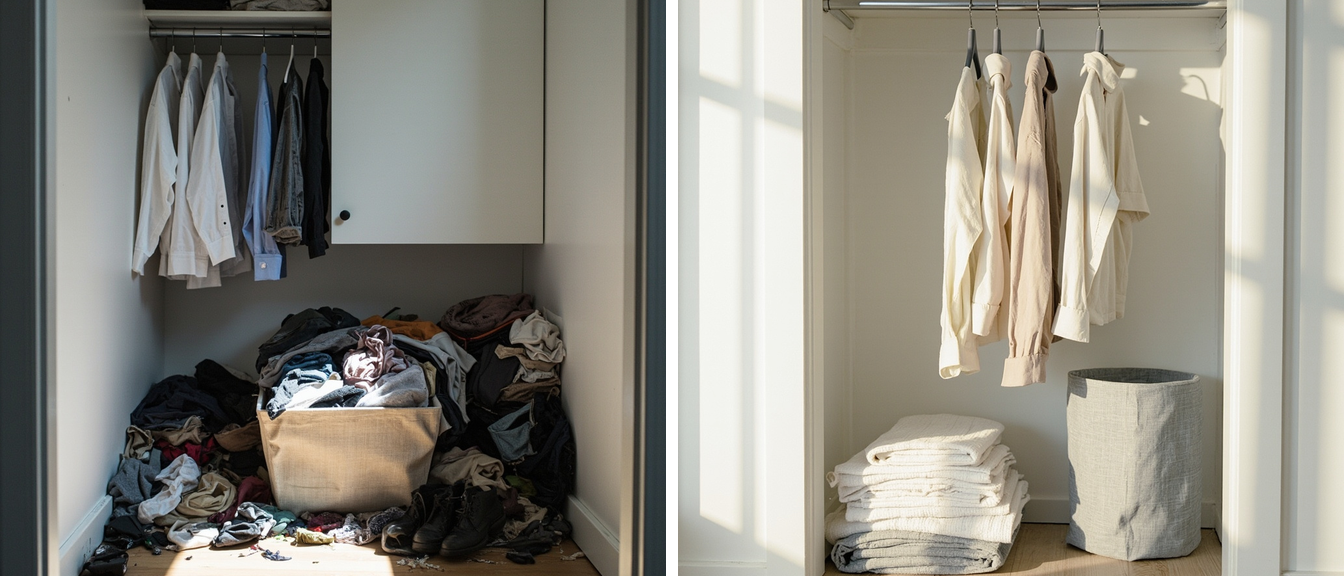
Over-buying when a smaller fix solves it. The full spread here runs $9.99 to $62.99. If your only complaint is that shirts slide off plastic hangers, $17.71 in velvet hangers is the entire answer. Buying a system-scale organizer for that is paying four times over for a one-zone problem. The closet hub helps you identify which zone is actually failing before you spend.
Related
- Closet Hub — the four-zone framework applied across every closet type
- How to Declutter Fast — the assessment method to run before buying any storage product