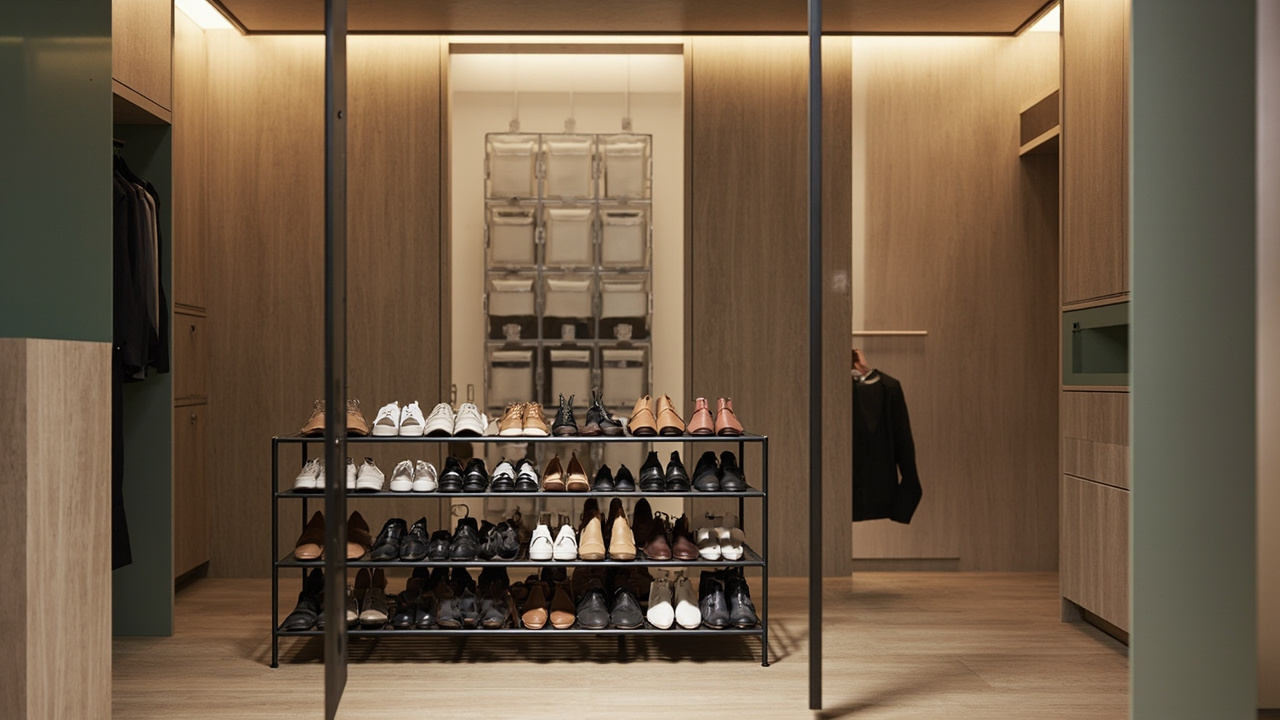
Shoes are the most under-optimized zone in most closets. The default — stack on the floor, shove under the bed, scatter across the entryway — wastes 4-7 cubic feet of vertical space. The fix isn’t more shelves; it’s matching the system to your closet type.
This guide covers the 5-step method + 4 system types + 3 layout variants + constraint guide + 90-second reset. The broader closet context lives in our walk-in closet organization guide.
Why Closets Get Shoe-Cluttered
Three forces stack against shoe organization:
Daily-rotating pressure. Shoes move in and out 2-4 times a day. The constant motion is the main reason shoe zones fall apart — no other storage category gets touched this often.
Seasonal volume swing. Winter boots take 3x the space of summer sandals. A single system can’t handle both unless it scales. The fix is under-bed storage for off-season rotation.
Pair-tying physics. Shoes need to stay together (left + right). Boxes solve pair-tying; open racks solve quick access. The hybrid pattern (open rack + clear boxes) handles both.
What You’ll Need
Five products cover most shoe organization problems — over-door × 2, clear boxes, hanging shelf, boot rack.
Over-door shoe organizer, clear pockets
For reach-in closets, the Simple Houseware 24-Pocket Crystal Clear Over-Door Organizer is the budget pick at $9.97 — 24 clear pockets hold 12 pairs. Crystal-clear lets you see inside. 64”×19” fits standard 80-inch doors.
Over-door shoe organizer, mesh heavy-duty
For athletic households, the GORILLA GRIP 24-Pocket Breathable Mesh Organizer holds up to 40 lb and prevents moisture buildup. Mesh is see-through enough to identify shoes.
Stackable clear plastic shoe boxes (12-pack)
For owners with 30+ pairs, the SIMPDIY 12-Pack Clear Stackable Shoe Boxes holds up to size 10 sneakers per box, stacks 4-5 high. $2.50/pair is the lowest per-pair cost. See our clear vs opaque bins guide.
Hanging 10-shelf closet shoe organizer
For closets with one main rod, the Simple Houseware 10-Shelf Hanging Organizer hangs from the rod without drilling. 10 shelves fit 5 pairs. Zero floor footprint.
Freestanding boot rack (8 pairs)
For boot-heavy households, the pickpiff Free Standing Boot Rack holds 8 pairs of tall boots. The only product that comfortably handles knee-high boots.
The 5-Step Method
Order matters. Declutter first, then organize.
Step 1: Declutter with the 4-quadrant system
Apply the declutter-fast 4-quadrant system — Trash (broken single shoes) / Donate (unworn 12+ months) / Keep (used monthly) / Relocate (entryway shoes for the entryway closet).
Shoe rule: if you haven’t worn a pair in 12 months AND it’s not seasonal, donate. Styles change faster than clothes.
Step 2: Define the closet type
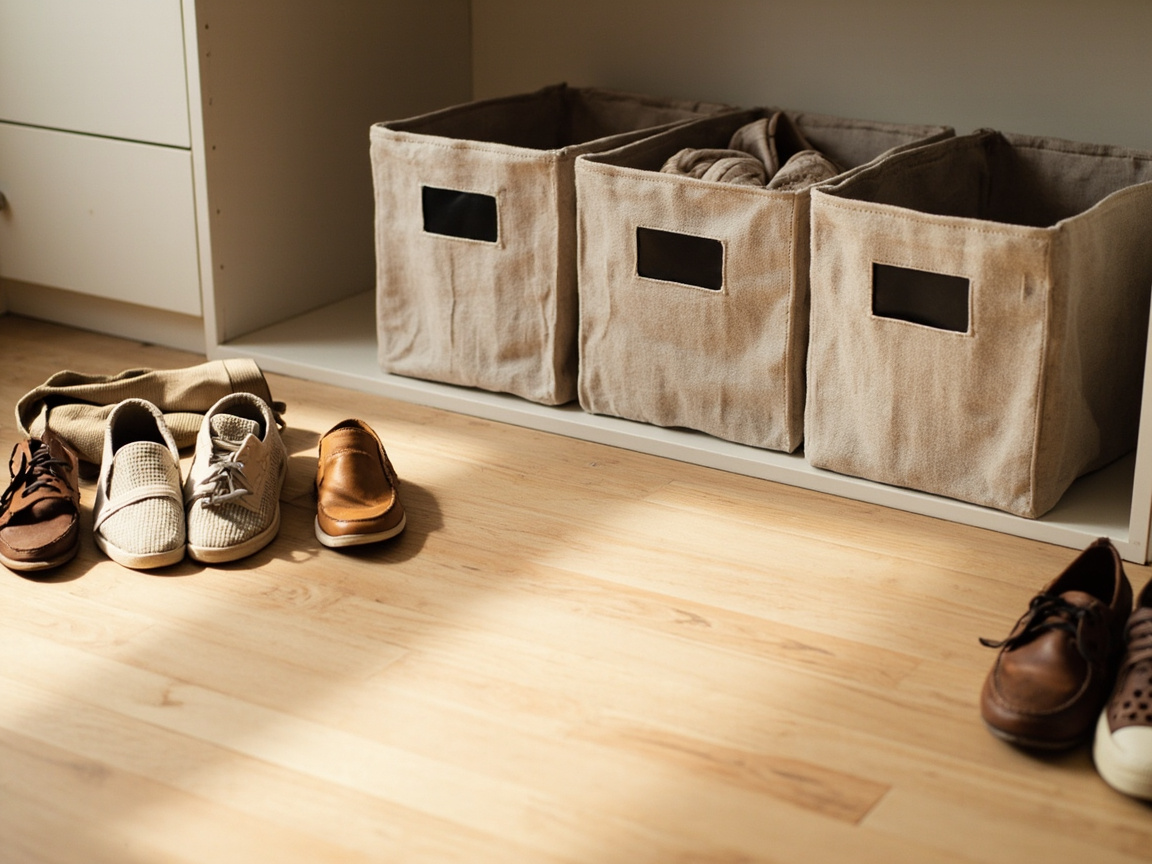
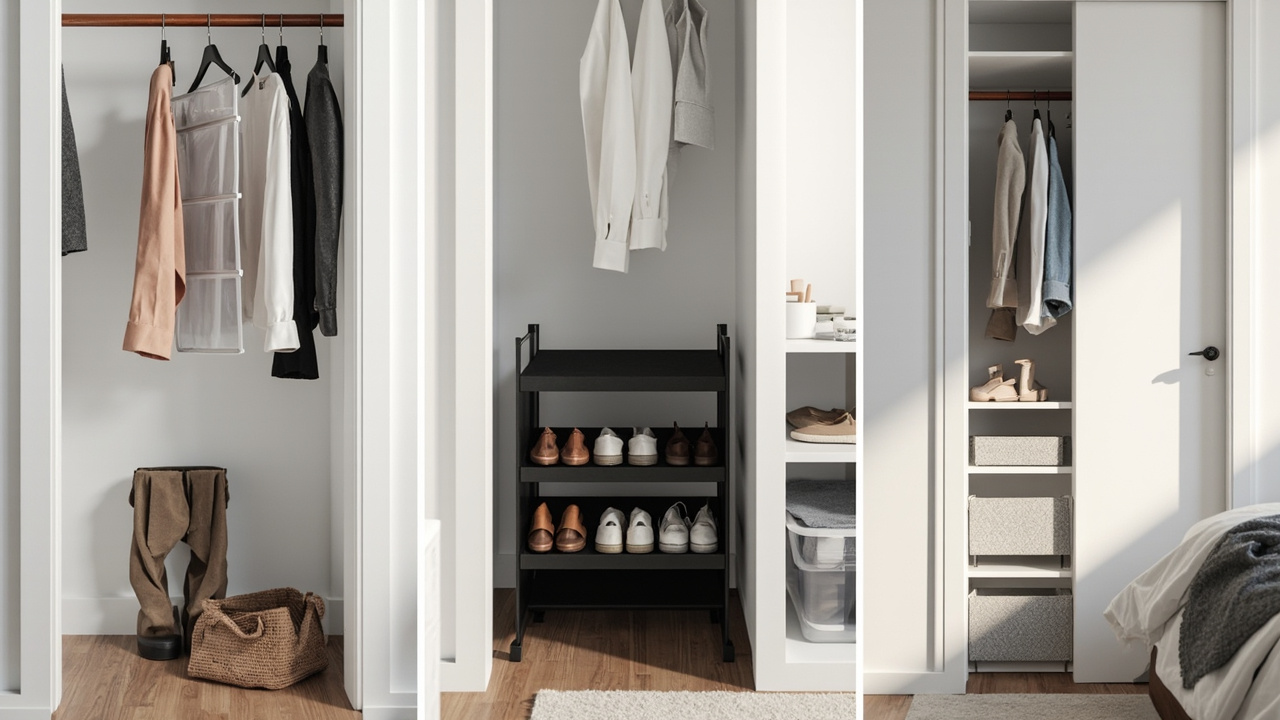
Three closet types drive system choice. Reach-in (under 24” deep) — over-door + hanging shelf only. Walk-in (5x5+ ft) — floor rack + clear boxes dominate. Small apartment (no dedicated closet) — bedroom door + entryway tray + under-bed storage.
Step 3: Pick 1-2 systems
Don’t try all 4 systems at once. Reach-in → start with over-door. Walk-in → start with floor rack. 30+ pairs → start with clear boxes. Boot-heavy → add freestanding boot rack.
Step 4: Place daily-wear first
Daily-wear (3-7 pairs) go in the most accessible zone — over-door front pockets, floor rack top shelf. Less-frequent go behind: clear boxes stacked high, floor rack bottom shelves. See walk-in closet organization guide.
Step 5: Schedule seasonal rotation
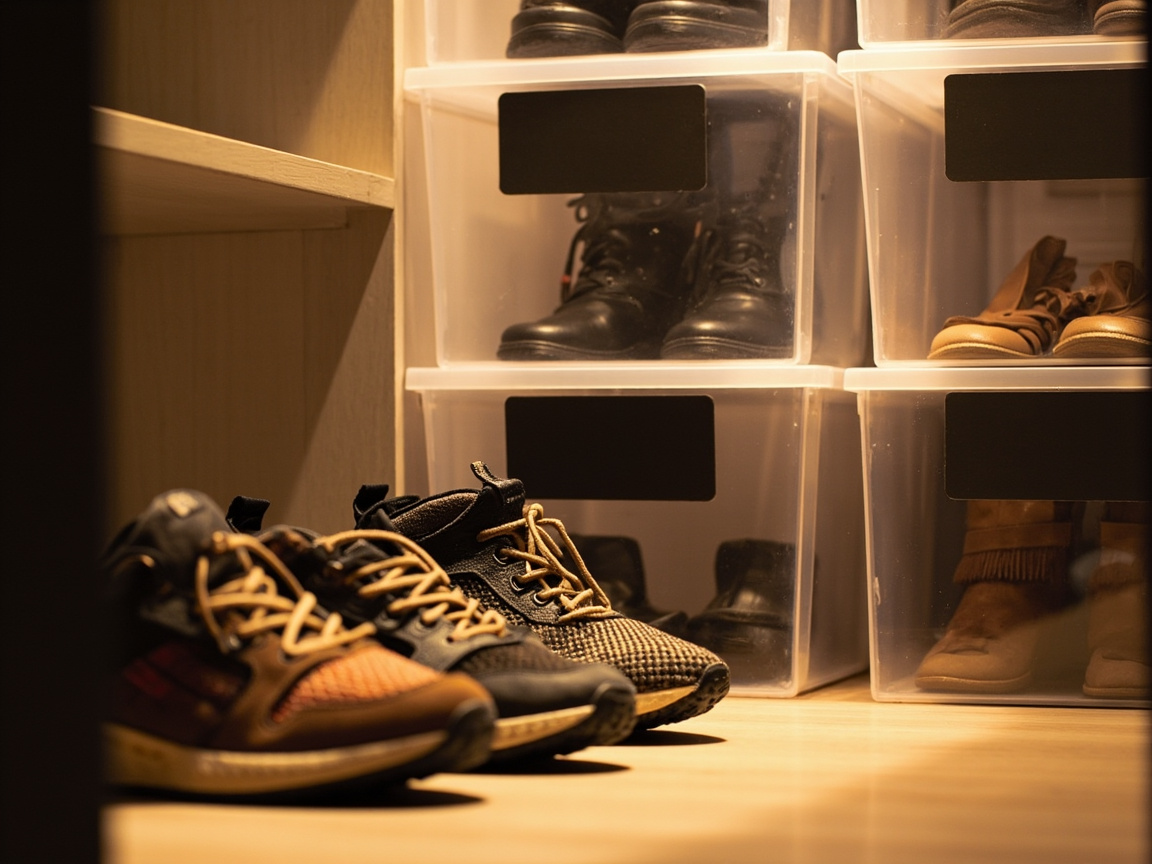
Twice a year (same dates as daylight saving shifts), rotate seasonal shoes. Off-season goes to under-bed storage in clear boxes. Our bedroom-declutter-checklist covers the swap.
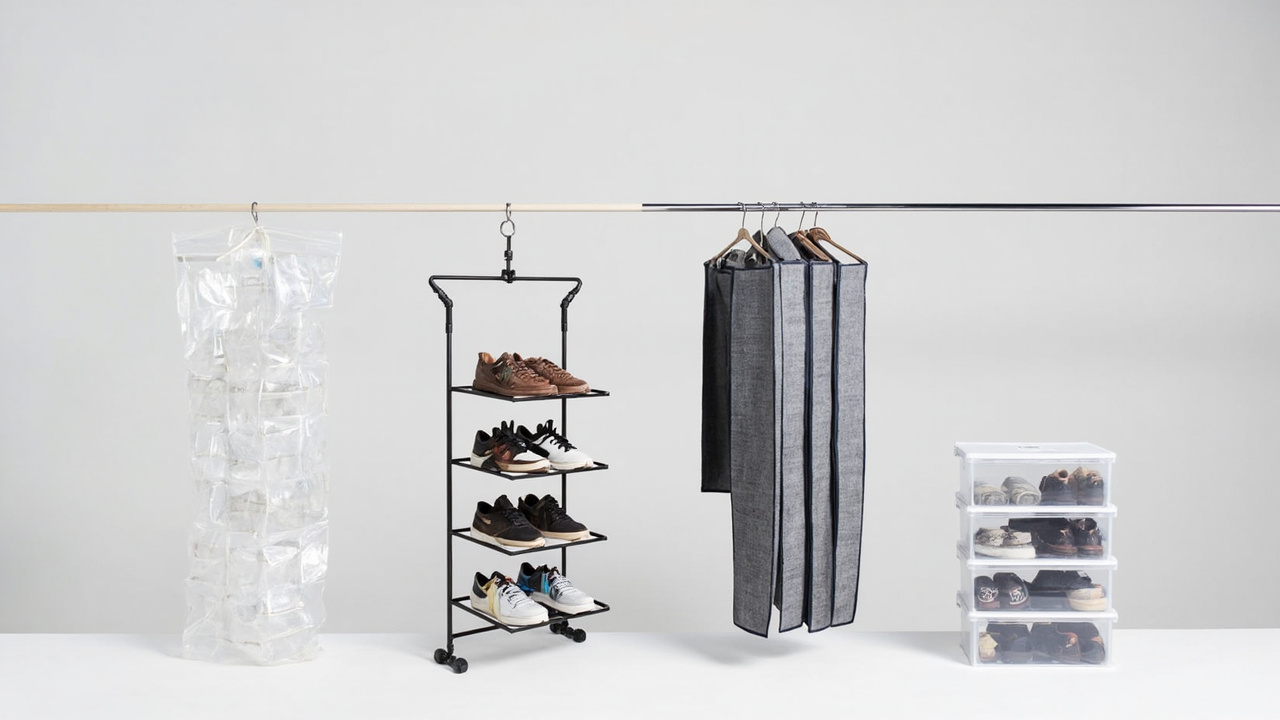
4 Shoe System Types Compared
All 4 system types in one place. WikiHow covers wooden pallet + hanging only. House Beautiful scatters ideas.
Over-door organizers
Pros: zero floor/shelf footprint, no install, cheapest ($10-25), fits 12-20 pairs. Cons: only flat shoes, door needs 1.5-2 inch clearance, moisture buildup in clear pockets (use mesh variant). Best for: reach-in closets + apartments + owners without heels/boots.
Floor racks
Pros: best price-per-pair ($25-100 holds 16-30 pairs), scales with stackable units. Cons: consumes 12-36 inches of floor width, dust accumulates. Best for: walk-in closets + athletic/work shoe collections.
Hanging shelves
Pros: hangs from existing rod (no drilling), zero floor footprint. Cons: only flat shoes, can sag under heavy boots. Best for: closets with one main rod + limited shelf space.
Clear stackable boxes
Pros: protects from dust + moisture, vertical scalability, clear visibility, fits all shoe types. Cons: $2.50-3 per box, 30 seconds to access a pair, needs label discipline. Best for: 30+ pairs + long-term storage.
Layout by Closet Type
Reach-in closet (under 24” deep)
Over-door organizer + hanging shelf (1/3 of rod) + clear boxes on shelf above. Covers 12 + 5 + 12-24 pairs without consuming floor or shelf space. For seasonal overflow, see under-bed storage.
Walk-in closet (5x5+ ft)
Floor rack (3-tier, 16-20 pairs) + clear boxes (2-3 stacks for overflow) + one corner boot rack. See our walk-in closet organization guide.
Small apartment (no dedicated closet)
Bedroom-door over-door organizer (12 pairs) + entryway boot tray (8-12 pairs) + under-bed storage for rotation. Total footprint: zero. Our hooks-racks-vertical-storage guide covers rental entryway options.
Constraint Guide by Scenario
Four scenarios cover most shoe organization constraints.
Renting (no drilling, no permanent install)
If renting, use over-door organizers (zero install) + freestanding floor racks (no mounting) + clear boxes (no install). All 5 products in this article are rental-friendly.
Budget under $50
If budget is under $50, skip clear boxes and boot rack. Buy only the Simple Houseware over-door organizer at $9.97. Total ~$10, with $40 remaining for a folding rack.
Many pairs (50+ — sneakerhead / collector)
If 50+ pairs, use 4-5 clear stackable boxes (12 pairs each = 48-60). Add one over-door organizer for the 12 most-worn. Skip floor racks.
Boot-heavy collection (knee-high or thigh-high)
If most shoes are boots, over-door / hanging shelf / clear-box systems handle boots awkwardly. Use the pickpiff free-standing boot rack as primary (8 pairs tall boots) + one clear box for short boot overflow.
Common Mistakes
Five failure patterns in nearly every shoe zone that returns to chaos:
-
Buying organizer before decluttering. Fill 24 pockets or 12 boxes, then realize 40% is donate-worthy. Fix: 4-quadrant first. See declutter-fast.
-
Wrong system for closet type. Floor rack in reach-in consumes the entire width. Fix: match system to closet type — see Step 2.
-
Over-buying organizers. 4 system types create more mess than one well-used system. Fix: 1 primary + 1 secondary max.
-
No seasonal rotation. Winter boots stay on the floor through summer. Fix: twice-yearly swap with under-bed storage.
-
Mixing casual + formal. Muddy boots next to white heels = staining. Fix: athletic on floor rack + clear boxes for dress + boot rack for boots.
Maintenance: The 90-Second Reset
Three rules for the 90-second weekly reset.
- Return daily-wear shoes to the over-door organizer front pockets (the 3-7 pairs you actually wore this week).
- Scan the floor — anything that landed on the floor goes back to its zone.
- Spot-clean scuffs — once a week prevents the “all shoes need cleaning” crisis.
For closet context, see the closet hub and walk-in closet organization guide. For the small-space strategy, see small-bedroom-organization and under-bed storage. For the broader method, see declutter-fast and bedroom-declutter-checklist. For visibility tradeoffs, see clear vs opaque bins and hooks-racks-vertical-storage.