Pick entryway shoe storage by answering two questions: do you want shoes visible or hidden, and how many pairs land at the door daily. Narrow racks (10 to 14 inches deep) handle 6 to 12 pairs visibly for under $35. Hidden flip-drawer cabinets conceal 12 to 24 pairs in a 9 to 12 inch footprint. Pair either with an over-door organizer for boots and a bench for seating. This guide walks through a five-step system: measurements, layout scenarios, and mistakes to avoid. For the broader room system, see the entryway organization hub.
Why Entryway Shoe Storage Fails First
The entryway is the highest-traffic drop zone in the home, yet it is the room most often skipped when planning storage. In our experience, this pattern repeats in nearly every home: shoes pile up because three forces collide in a 3-by-5-foot area: incoming traffic (people wanting to drop and go), seasonal volume (winter boots occupy three times the footprint of summer sandals), and visitor shoes (guests rarely know where to put theirs). The result is a shoe pile that grows daily and resists casual tidying because it has no designated home.
A five-step method fixes this by treating shoes as a category (the KonMari principle of grouping by type, not by room) rather than scattering them across hall tree, bench, and floor. The method works in any entryway — narrow hallway, mudroom, apartment nook — because it starts with measurement and ends with a maintenance cadence rather than a one-time purge. If you are also managing coats and bags alongside shoes, the shoes + coats combo sister guide covers the combined setup.
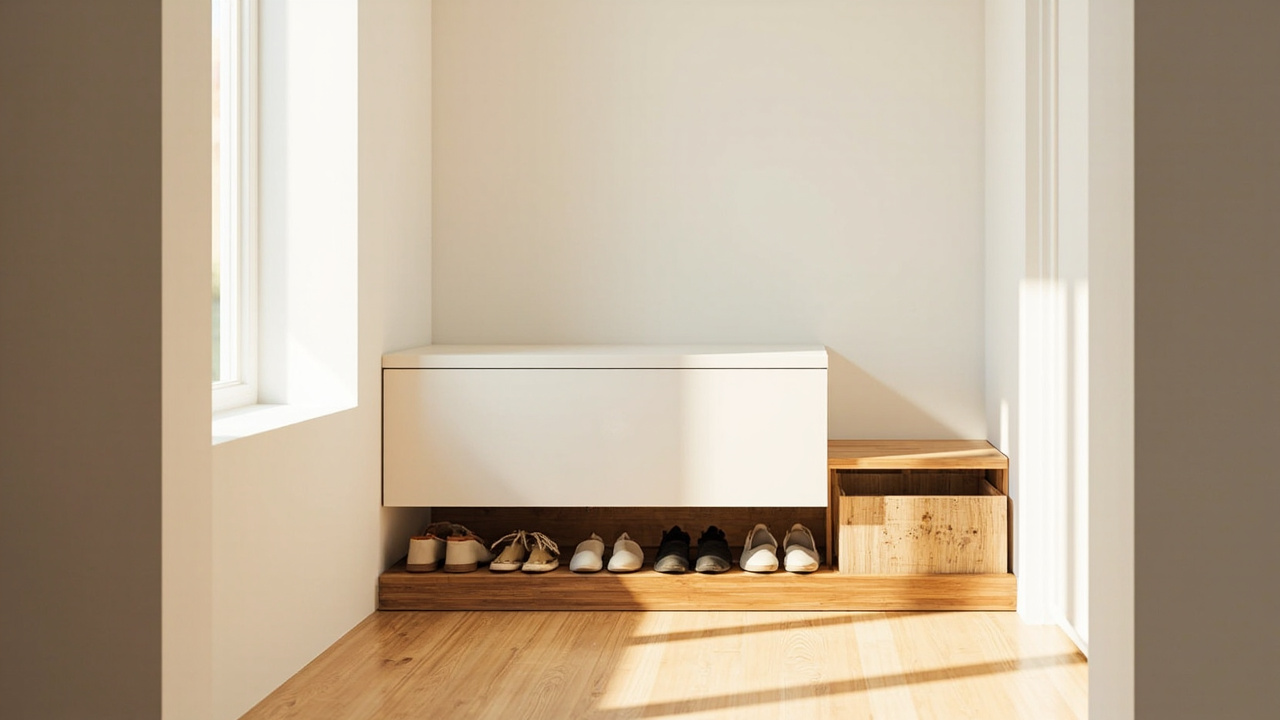
The 5-Step Narrow Rack + Hidden Cabinet System
Step 1 — Measure before you buy
Measure three numbers before opening a single product page. First, wall width available — subtract 4 inches for coat-hook clearance if you are sharing the wall. Second, floor depth from baseboard to the opposite obstacle (door swing, rug edge, or opposite wall). Third, ceiling height only if you are considering a tall tower. Write these numbers on a sticky note and keep them on your phone. Every product page lists dimensions, and the note keeps you honest. The most common entryway mistake is buying a 15-inch-deep cabinet for a 12-inch-deep nook.
Step 2 — Choose visible rack vs hidden cabinet
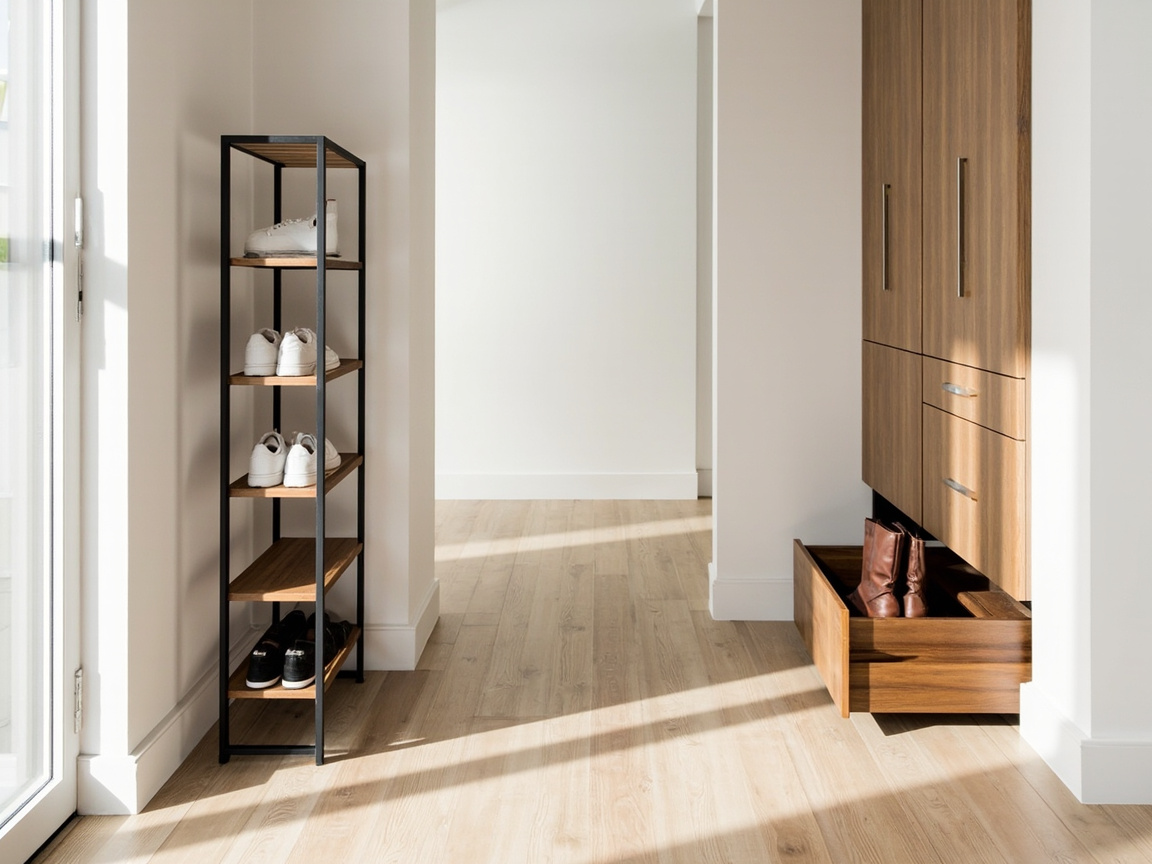
This is the fork that shapes every other decision. Visible racks (open metal slats, bamboo tiers, stackable wire) work when you don’t mind shoes being seen and when the entryway is for immediate family only. Cost runs $10 to $50, capacity 6 to 18 pairs, install under 5 minutes. Hidden cabinets (flip-drawers, sliding doors, barn-door fronts) work when the entryway is visible from the living room, when you host often, or when aesthetics matter. Cost runs $60 to $200, capacity 12 to 28 pairs, install 30 to 60 minutes. The BORNOON flip-drawer cabinet bridges both worlds at $102 when budget allows.
Quick reference: visible or hidden?
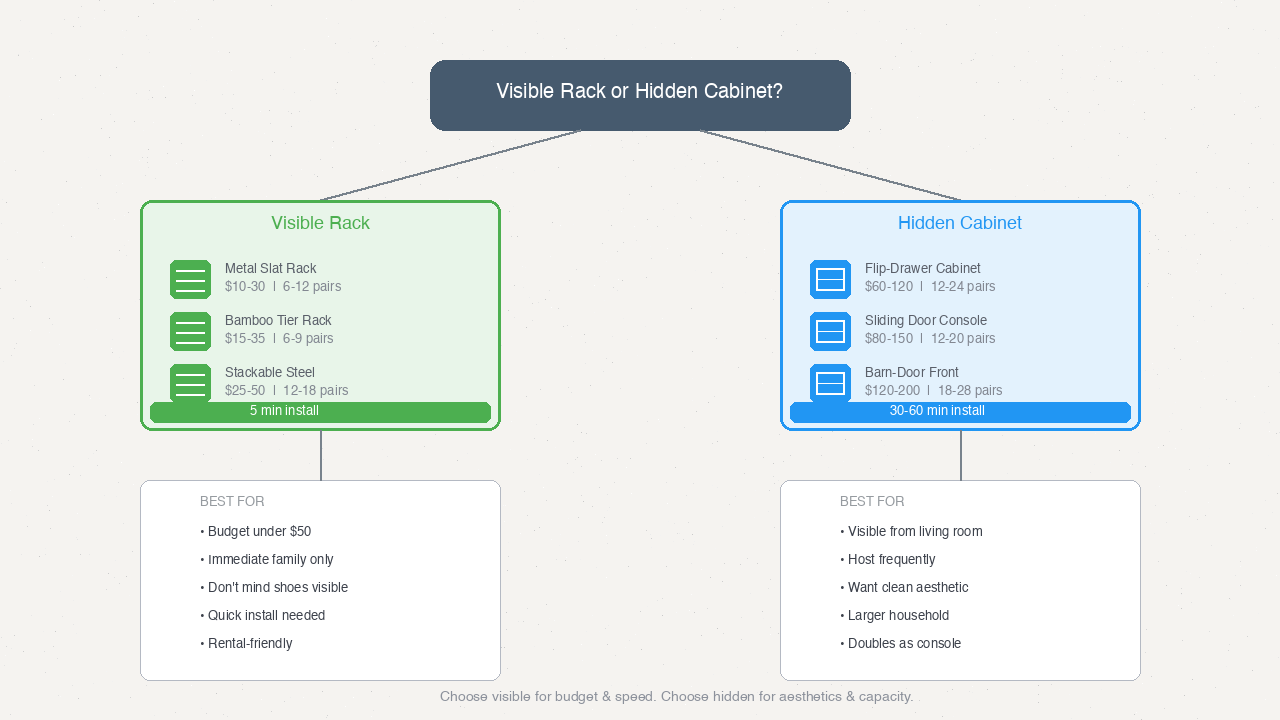
The fork is simple in practice. If your budget is under $50 and you don’t mind shoes being seen, go visible. If your entryway opens into the living room and you want a clean look, go hidden. Most households end up with both — a visible rack for daily drivers and a hidden cabinet (or over-door organizer) for overflow.
Step 3 — Match capacity to household size
Count the shoes that actually live at the door — not the total owned, just the daily drivers. A working rule we use: 2 pairs per adult (everyday shoes plus athletic), 1 pair per child, plus 2 visitor pairs. A 2-adult household needs space for 6 pairs minimum; a family of four needs 8 to 10; a family of five with teens needs 12 or more. Capacity should be 25 percent above current count to absorb seasonal spikes — winter boots displace sneakers, so plan for the busy season.
Step 4 — Pair with bench or over-door
Shoe storage alone isn’t enough. A VASAGLE padded bench gives seating for lace-ups and a flat surface for the daily bag drop. An Amazon Basics 24-pocket over-door organizer captures winter boots, slippers, and kid shoes that don’t fit rack tiers. Pair the two and the floor stays clear even during winter boot season. For deeper bench options, see the entryway bench storage guide.
Step 5 — Weekly reset
Shoe storage fails without maintenance. I recommend the 5-minute weekly reset: return stray shoes to their assigned tier or drawer, remove any shoes no longer in active rotation, wipe rack slats or cabinet drawers with a damp cloth, confirm the bench top is clear of mail, and verify over-door hooks are not overloaded. This mirrors the entryway family reset routine — shoes are step one of that daily cadence, and the entryway drop zone guide expands on the full reset rhythm.
Layout by Entryway Type
Narrow hallway (under 36 inches wide)
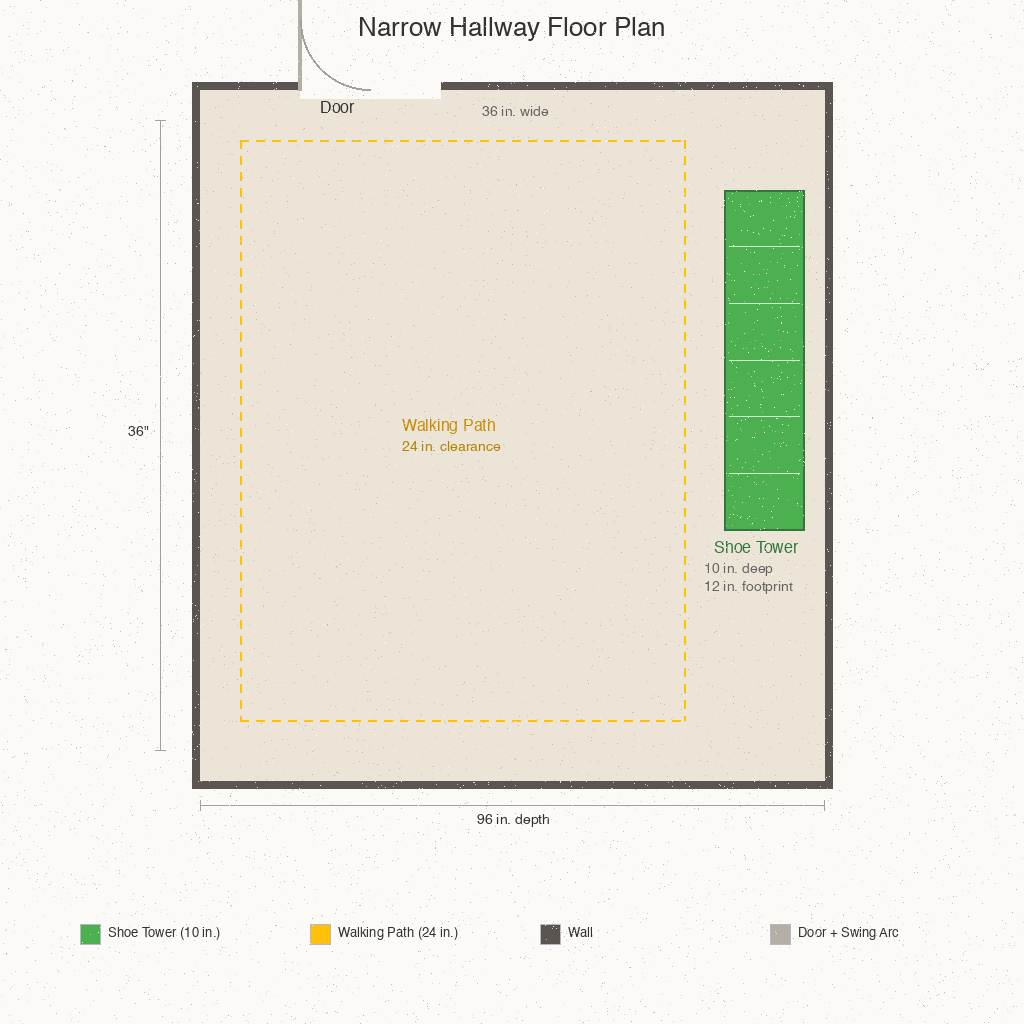
Narrow hallways are the hardest case. Depth is the constraint: most coat closets are 24 inches deep, but a hallway with door swing leaves 12 to 14 inches. Use a 10-inch-deep VTRIN 10-tier tower placed against the wall opposite the door swing. The tall 10-tier unit holds 20+ pairs in a 12-inch-wide footprint. Alternative: a 9 to 10 inch flip-drawer cabinet (the BORNOON at 9.45 inches deep) is invisible from the living room and takes the same wall space as a console table.
Mudroom or wide entryway (36+ inches wide)
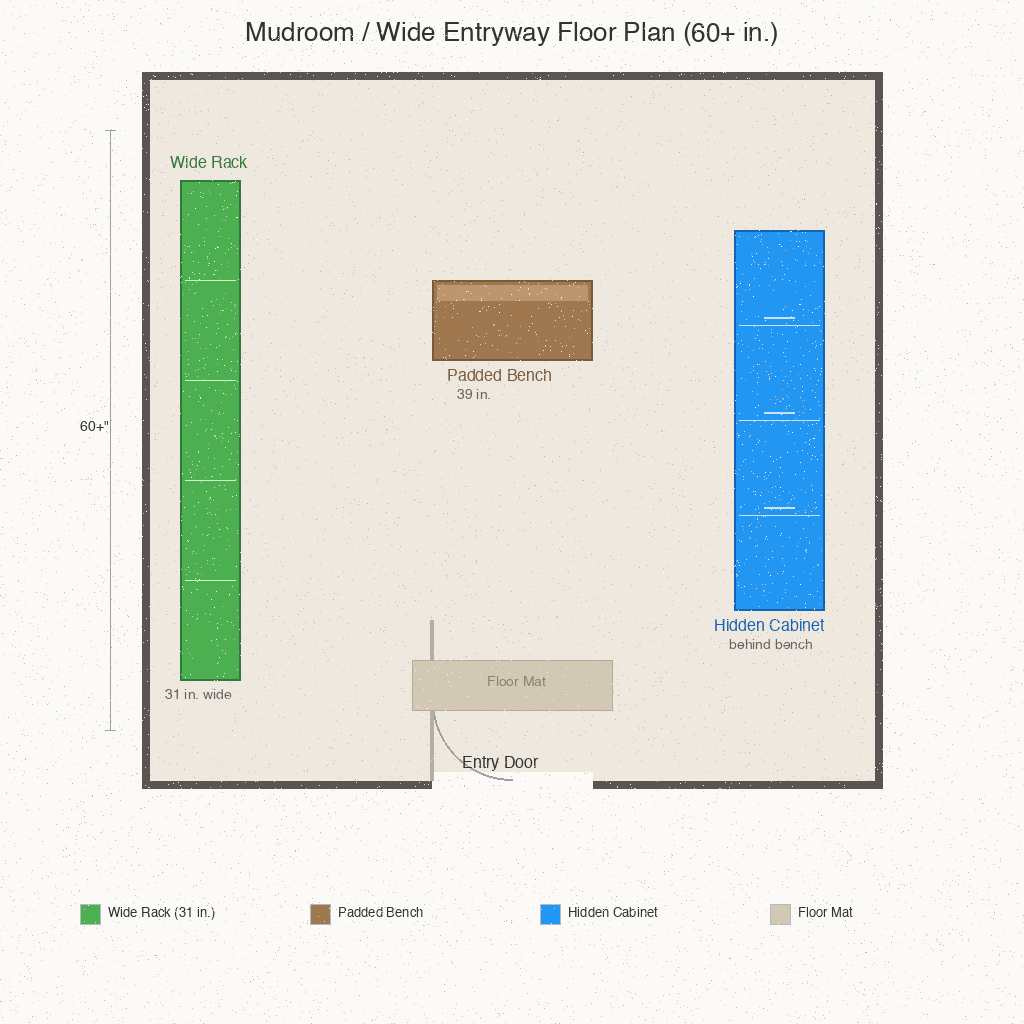
Wide entryways can absorb a full storage wall. Pair a 31-inch-wide Whitmor stackable rack with a 39-inch bench — the bench sits over the rack and gives seating without consuming additional floor space. Add a Seville Classics stackable rack behind or beside the bench for off-season storage. Mudrooms have one advantage hallways do not: a floor mat catches salt, mud, and water before they reach the storage zone.
Small apartment nook (under 18 inches deep)
Apartment nooks are the strictest case. Depth under 18 inches rules out most cabinets. Use a 3-tier ROMGUAR bamboo rack on the floor plus an over-door organizer for overflow. The over-door captures boots and slippers that don’t fit rack tiers. If even a 10-inch rack won’t fit, a wall-mounted shelf or a hanging pocket organizer is the only remaining option — see small entryway organization for ultra-compact strategies.
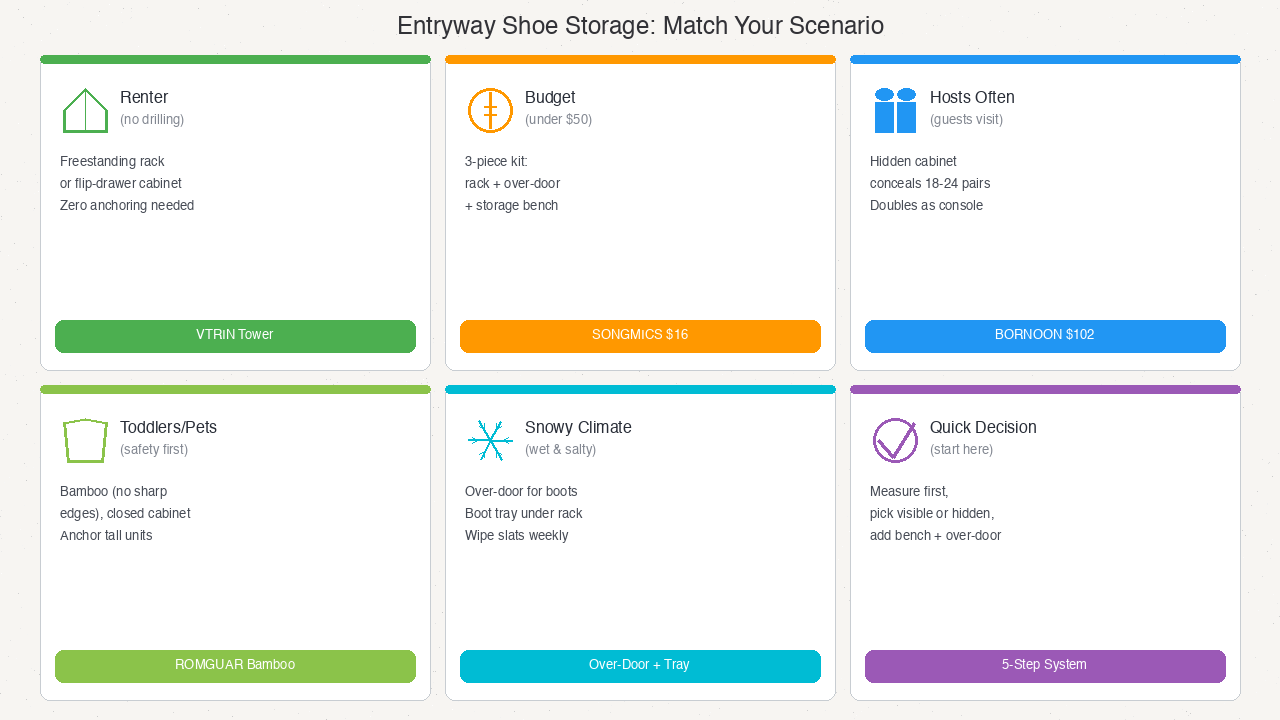
Constraint Guide by Scenario
Five scenarios at a glance
Every household faces at least one of these constraints. Match your situation to the right product combination before buying — a BORNOON hidden cabinet solves the hosting dilemma, while a $16 SONGMICS budget rack handles the under-$50 scenario.
If you rent and cannot drill
Choose freestanding racks or a flip-drawer cabinet. The VTRIN 10-tier tower and ROMGUAR bamboo rack both sit on the floor with zero anchoring. The BORNOON cabinet leans against the wall with no drilling required. Skip wall-mounted shelves — if your door frame can’t support over-door hardware, a floor-based rack plus a SONGMICS 3-tier is your full kit.
If your budget is under $50
Build the kit from three pieces. A $16 SONGMICS 3-tier handles 9 to 12 everyday pairs. A $9 Amazon Basics over-door organizer captures boots and slippers. A $20 storage bench from any home retailer adds seating. This three-piece combination handles 16 to 24 pairs for under $50 and outperforms any single-piece solution at the same price.
If you host often or share the space with guests
Choose hidden storage. A BORNOON flip-drawer cabinet at $102 conceals 18 to 24 pairs behind closed doors. Add a Seville Classics stackable rack at $43 for overflow visible only to family. Place a small decorative tray on top of the cabinet for keys and mail. Guests never see the shoes — the cabinet doubles as a console table when they arrive.
If you have toddlers or pets
Avoid sharp-edged metal racks. Choose ROMGUAR bamboo or a closed BORNOON cabinet so small hands and paws cannot pull shoes down. Anchor any tall unit per the manufacturer instructions — the VTRIN 10-tier comes with wall anchors. Add a small basket below the bench for kid shoes; the basket contains spills and is easy for children to manage independently.
If you live in a snowy or wet climate
Plan for boot trays and drip management. A 3-tier ROMGUAR bamboo rack handles wet shoes better than fabric-shelf racks, which absorb moisture and smell. Place a rubber-backed mat under the rack and add a boot tray beneath for melting snow. Washable over-door pockets handle wet gloves and hats in the same vertical space without consuming floor area.
Common Mistakes
- Buying before measuring
Buyers fall in love with a cabinet photo, order it, and discover it blocks the door swing. Measure wall width, floor depth, and door swing arc before opening any product page. The 4-inch clearance rule (subtract 4 inches from any wall measurement for breathing room) prevents most return shipments.
- Sizing for average instead of peak
A rack sized for the average Tuesday collapses during winter boot season, when each household member adds a bulky pair. Capacity should be 25 percent above current count. A 2-adult household with 6 daily pairs should buy storage rated for 8; a family of four with 10 daily pairs should buy storage rated for 12 to 14.
- Skipping the bench
Shoe storage without seating forces people to balance on one foot while lacing. I’ve found that a bench at 18-inch seat height turns the entryway into a functional dressing zone. Even a small VASAGLE storage bench at $80 pays for itself in daily convenience. If space is tight, a 12-inch-deep storage ottoman or a fold-down wall bench works.
- Forgetting visitor shoes
Households plan for their own shoes and forget guests. A dinner party adds 4 to 8 pairs; a kid birthday adds 8 to 15 pairs. Either reserve one rack tier for overflow, or stash a collapsible fabric bin under the bench for guest shoes. The bin deploys when needed and stores flat otherwise.
- No maintenance cadence
Shoe storage fails without weekly attention. Run the 5-minute reset described in Step 5: stray shoes return, off-season shoes leave, surfaces get wiped. Without this cadence, the rack becomes a shoe pile within two weeks. Link the reset to an existing habit — Sunday coffee or Monday morning launch — so it sticks.
What You’ll Need
| Role | Pick | Why |
|---|---|---|
| Hidden cabinet | BORNOON flip-drawer | Conceals 18 to 24 pairs in 9.45-inch depth, doubles as console |
| Narrow tower | VTRIN 10-tier | 20+ pairs in 12-inch footprint, $20 budget option |
| Bamboo rack | ROMGUAR 3-tier | Kid-safe edges, wet-shoe tolerance, 6 to 9 pairs |
| Seating bench | VASAGLE padded bench | 18-inch seat height, dual storage and seating |
| Over-door | Amazon Basics 24-pocket | $9 overflow capture for boots and slippers |
| Budget metal | SONGMICS 3-tier | $16 everyday rack, 9 to 12 pairs |
| Stackable | Seville Classics 3-tier | Steel slat, stackable for growth, mudroom-ready |
| Wide rack | Whitmor 31-inch | 31-inch width for mudroom storage walls |
In my own entryway, a narrow rack with a bench covers 90 percent of daily needs without crowding the wall.
Related Articles
- Shoes + coats combo — sister article for combined hall-tree setup
- Shoe organization in closet — cross-room shoe strategy for bedroom closets
Key Takeaways
- Pick shoe storage by answering two questions: visible vs hidden, and how many pairs daily
- Measure wall width, floor depth, and door swing before any purchase
- Visible racks ($10 to $50) handle 6 to 18 pairs; hidden cabinets ($60 to $200) conceal 12 to 28
- Pair your rack or cabinet with a bench for seating and an over-door organizer for overflow
- Capacity should be 25 percent above current count to absorb seasonal spikes
- Run the 5-minute weekly reset — without maintenance, any system becomes a shoe pile