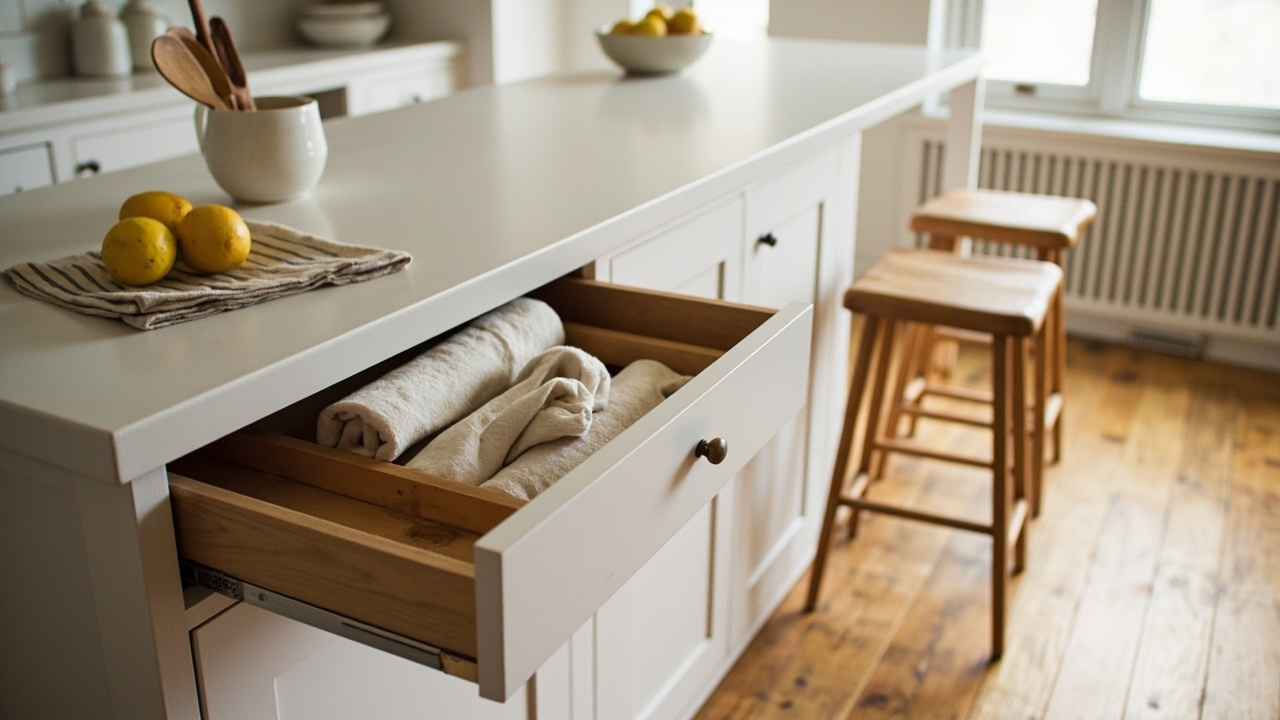
An island has to be a prep bench and a dining table at once, so it collects everything the kitchen has nowhere else to put.
| What you see under the island | Type | The rule that applies |
|---|---|---|
| Drawers and cabinets built into the floor | Type 1 | Fill the drawer; cabinets hold occasional items |
| A counter lip jutting out 12-15 in, stools under | Type 2 | Seat zone stays empty; tiers on the wall side |
| A cart on casters or a fold-away drop-leaf | Type 3 | One permanent job, never overflow duty |
| Plumbing in the island — sink and dishwasher | Type 4 | Deep storage off the drain side; waste pull-out |
| Nothing underneath — a peninsula or ledge | Type 5 | Surface geometry only: rotate, never shelve |
Why Kitchen Islands Turn Into Clutter
Two demands land on the same square feet. The island is the workspace — prep, plating, homework, mail — and the social surface, where stools and guests gather. Anything without a home drifts to the middle, where both collide.
Second: the island sits in the centre, so it becomes the default answer to “where does this go?” for the whole kitchen. Nothing in the full kitchen organization map gives it a job, so it absorbs what the perimeter can’t hold. Decide what it’s for before what goes on it.
The 5 Kitchen Island Types (and Which One You Have)
Type 1: fixed cabinetry island
Cabinets and drawers built into the floor run, no overhang, usually carrying the sink or second cooktop. Storage here is a fit problem — drawer depth, not floor space.
Type 2: storage-and-seating island
A working overhang 12-15 in deep on the seating side, cabinets or a wine rack underneath. That overhang is the whole difference from Type 1.
Type 3: cart or drop-leaf island
Free-standing, on casters, no fixed cabinetry. The renter’s island, and the type that fills fastest — open top, no exit rule.
Type 4: sink island
Plumbing in the island. The hardest type, because every storage decision respects the drain, the dishwasher clearance and the shut-off valves.
Type 5: counter-only overhang, no storage
A peninsula or ledge with nothing underneath. If this is yours, most storage advice below doesn’t apply — only the surface rules do.
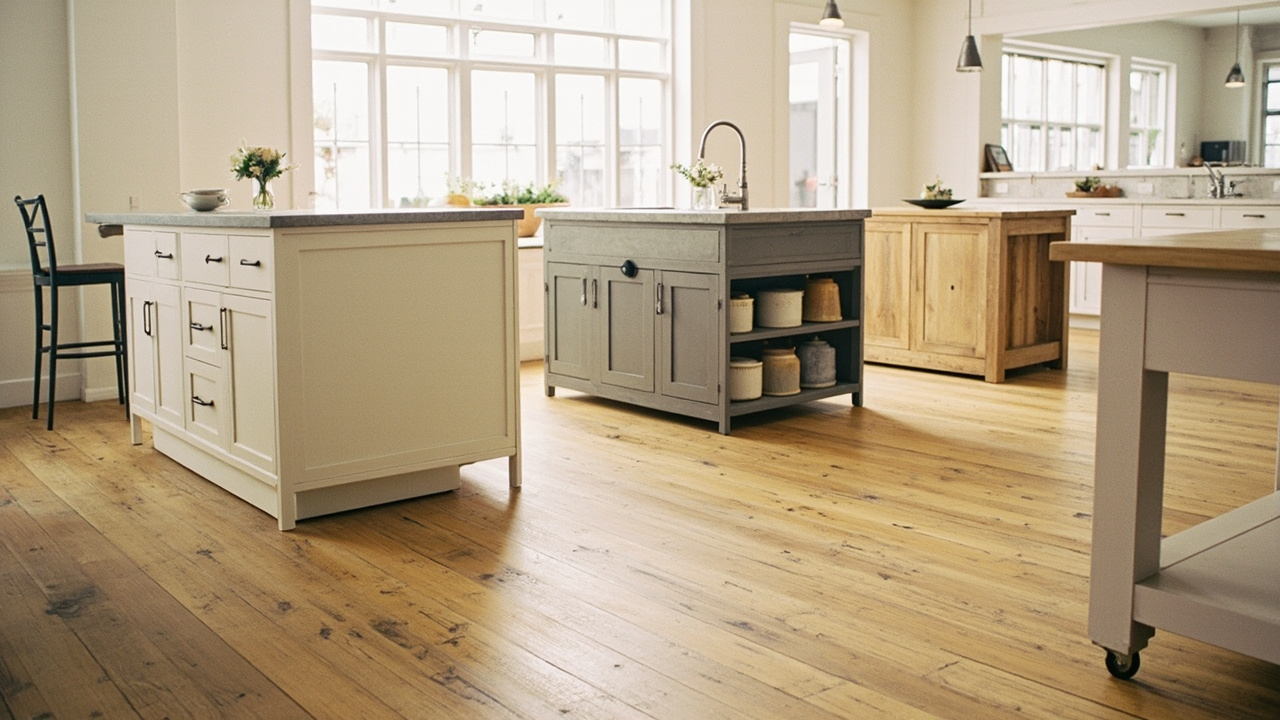
Type 3 is the one you can buy. The VEVOR Kitchen Island Cart with a Solid Wood Top ($143.91) is a 35.4 in solid-wood top over a storage cabinet, spice rack, towel rack and a drawer, on casters. If the aisle can’t take 35 in of fixed width, the VASAGLE Mobile Kitchen Island Cart ($89.99) is the cheaper, narrower route. A fridge next door runs the same overflow — the adjacent appliance zone handles its half.
Measure Before You Buy
Five numbers decide every purchase below.
| What to measure | How | The number that decides the fit |
|---|---|---|
| Island width, longest run | Tape along the counter edge | Under 36 in, a 2-tier unit eats a third of the prep surface |
| Usable overhang depth | Cabinet face to the far counter edge | Under 9 in is no seating overhang; a tier hangs over the drawer fronts |
| Drawer internal depth | Open a drawer flat and measure the box | Under 3 in fits almost no spice tray — decides if a drawer rack is worth buying |
| Aisle clearance, both sides | Floor gap from island to cabinet run | Under 42 in both sides, a full-width cart won’t clear an open dishwasher |
| Knee space under the overhang | Sit in the seat position, look at the drawer fronts | A drawer opening into your knees is the most common island mistake |
Skip every cart until you’ve measured the aisle against an open dishwasher door. Picking a vertical tier that fits the surface and how to choose a drawer tray that actually fits start from those same two numbers.

Organizing by Island Type
Type 1: fixed cabinetry island
Drawers first, base cabinets second. One shallow tray per drawer, never a deep bin — an island drawer is usually 3-4 in internally. The SpaceAid Spice Drawer Organizer with 28 Jars ($26.38) is the flat answer: a 13 x 17.5 in four-tier tray. Anything not daily goes into the base cabinet — one you crouch for is one you stop refilling.
Skip the tray if your island has a lift-up door and no drawer. The cabinet and pull-out system covers that shape, and the full spice-storage method decides what you keep.
Waste goes in a pull-out beside the dishwasher: the LYNK PROFESSIONAL Pull-Out Trash Can Drawer ($49.99) slides a bin out. Supply your own bin.
Type 2: storage-and-seating island
Nothing deeper than the overhang height lives on the seating side, and nothing sits underneath at knee height. On the wall side, where nobody sits, the Giikin Countertop Shelf Organizer ($22.49) turns dead vertical air into two working surfaces. The ANBOXIT 2-Tier Coffee Station Organizer ($21.24) gives the beverage load a home. Under-island vertical storage obeys the same rule: wall side, never over a seat. Skip the coffee station under 42 in.
Type 3: cart or drop-leaf island
A cart has three usable planes and casters, which makes it the overflow valve — and why it fills up. Give it a permanent job: drinks, baking, or waste. The VEVOR Kitchen Island Cart with a Solid Wood Top ($143.91) has the cabinet, drawer and spice rack for it. The VASAGLE Mobile Kitchen Island Cart ($89.99) does the same in a smaller footprint.
Type 4: sink island
The drain-side cabinet holds cleaning chemistry and nothing else. The Cisily Sink Sponge Holder with Brush Holder ($11.19) keeps the sponge and soap off the sink deck; the stainless tray drains into the basin. Skip it if that basin holds produce daily.
Type 5: counter-only overhang, no storage
Nothing to fill, so the only lever is geometry: consolidate onto one footprint, push it out of the seat zone, and rotate rather than stack. A shelf at seat height on a thin ledge is a hazard. The Lipper International 8302 Bamboo Wood 10 in Turntable ($22.99) adds reach without footprint.
The 3-Bucket Island Sort
This is the 3-bucket sort method applied to one surface.
- Daily — used every day, within arm’s reach of the working seat.
- Occasional — one marked shelf or drawer. If it doesn’t clear the type rules above, it doesn’t go on the island.
- Decorative — the bucket that kills island clutter. A decorative bowl on a 42 in island eats real prep surface for zero daily value, so it goes back to the perimeter. How we zone a perimeter countertop decides where it lands.
If nobody has picked it up in 30 days, it isn’t daily, whatever it looks like.

Waste and Recycling on the Island
Two placements. On a Type 3 cart the bin rides on the casters — half of why a cart works. On Type 1 and Type 4 islands, the LYNK PROFESSIONAL Pull-Out Trash Can Drawer ($49.99, your own bin) pulls out beside the dishwasher run.
The constraint is clearance: a pull-out waste frame needs the same strip of aisle as an open dishwasher door. If both open into one gap, pick one. On a Type 5 island waste belongs at the perimeter run — the waste side of the sink run.
Layout by Island Size and Clearance
Under 42 in of island width
Flat only. A 2-tier unit on a sub-42 in island removes a third of the prep surface. Use one 10 in turntable at the far end ($22.99) and leave the middle clear.
42 to 60 in
The workable band. One two-tier unit ($22.49) on the non-seating wall side, one turntable at the far end, nothing in the middle.
Over 60 in, or seating on both sides
Two-sided islands need two separate drop zones, or the far side is dead surface inside a week. Repeat the turntable at the second end.
Aisle clearance under 42 in on either side
Narrow footprints only. The VEVOR Kitchen Island Cart with a Solid Wood Top ($143.91) needs all 35.4 in of its top to clear the aisle, not just the gap beside a closed dishwasher. Measure with the door open.
Constraint Guide by Scenario
If you rent and can’t drill, then
Type 3 is your system: nothing adhesive-mounted on a counter you may have to hand back. The VEVOR island cart ($143.91) and the VASAGLE cart ($89.99) both move on casters.
If you have no built-in island at all, then
Treat the cart as the island and give it a permanent job before it collects overflow — drinks on the VEVOR cabinet cart, baking on the VASAGLE. Keep its top under 60% full; a jobless cart is the room’s junk drawer, with wheels.
If your island has a sink, then
Deep storage leaves the drain-side cabinet; cleaning chemistry only. Sponge in the Cisily sink holder ($11.19), waste in the LYNK frame ($49.99) on the pull-out side. Skip both if the aisle can’t clear an open door.
If you have a seating overhang, then
No knee-height storage opens toward the seats. Put the ANBOXIT coffee station ($21.24) and the Giikin two-tier shelf ($22.49) on the wall side only.
If two people cook at once, then
The island is a landing zone, not a storage zone. The daily load stays in one shallow drawer — a SpaceAid spice tray ($26.38) sized to the box does that without stealing depth. Everything else waits on the 10 in turntable ($22.99) at the far end.
If your kitchen is under 100 sq ft, then
The island loses its “centre” role. Give the surface back to prep: one 10 in turntable ($22.99) at the far end, and move the appliances off it entirely. A VASAGLE cart ($89.99) parks them against the wall. A perimeter-first layout for small kitchens covers the rest.
Common Mistakes
1. Buying organizers before measuring
The five numbers in the measurement table cost five minutes and save a return. A two-tier shelf on a 40 in island was never going to work.
2. Adding an undersized overhang shelf
A unit whose footprint overhangs the seating lip blocks knee space and tips when the drawer below opens. Under 9 in of overhang means no shelf there.
3. Blocking the dishwasher or waste clearance
You measure with the dishwasher closed, then the pull-out bin and the open door fight for the same strip of floor. Measure with the door open.
4. Treating the island as overflow for everything else
There’s no exit rule, so the island absorbs every category the perimeter can’t hold. That’s the root cause behind most island clutter.
The Weekly Island Reset
The island is a zone, so it takes the zone rhythm, not the daily one. Three things weekly: wipe the surface, return the daily load to its drawer, drop anything untouched for seven days. How we run a zone reset covers the longer version.