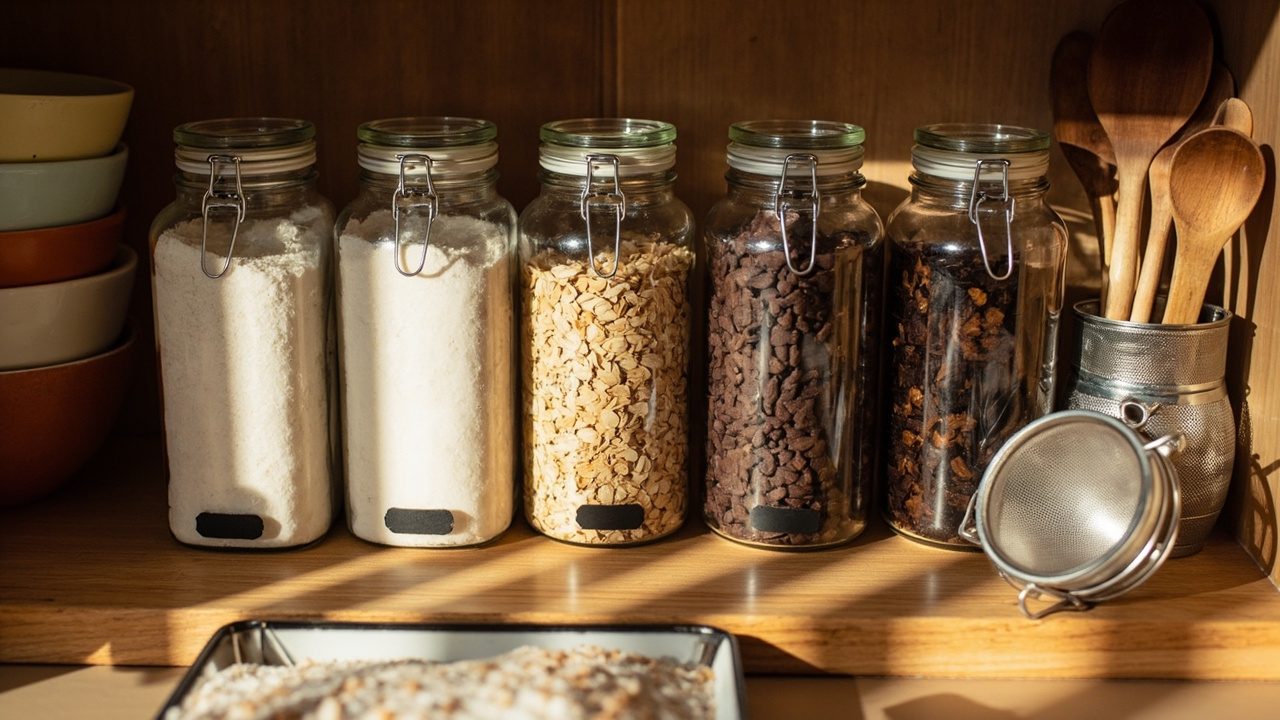
A pantry baking zone is the sub-area of the pantry that holds flour, sugar, oats, cereal, and baking mixes — separated from canned goods, snacks, and spices so high-rotation ingredients stay at eye-level in airtight containers. The setup is four sub-zones (flour, sugar & sweeteners, oats-cereal-granola, mixes), each with its own container family, shelf height, and rotation rule. For the broader kitchen organization hub and the 5-zone pantry system, see the pantry organization hub. We focus here on the baking sub-zone specifically; if you’re setting up the whole pantry, start with the upstream purge first.
Why a Baking Zone Matters
Pantry clutter usually starts in the baking aisle. We see four problems cause this over and over.
Weevils and pantry moths — paper bags don’t seal against Sitophilus oryzae or Plodia interpunctella. Once an adult female enters an opened bag, she lays 300–500 eggs before you notice the webbing. Push-button seals with silicone gaskets block the adults, and a bay leaf adds a second eugenol repellent layer.
Baking powder and soda lose potency — both stop working about 6 months after opening. Label the open date the day you crack a new box.
Original packaging isn’t airtight — flour oxidizes within 2 weeks of opening; brown sugar hardens into a brick the moment air hits it.
Same-category items split across shelves — when flour lives on three different shelves, you over-buy and stale stock gets buried behind fresh.
The fix is structural: four sub-zones with airtight containers, eye-level placement for high-rotation items, and labeled open dates for FIFO rotation. We walk through each zone below with the container family that matches. Our recommended setup starts with flour + sugar containers, then adds oats/cereal stack, then mixes bins.
Zone 1 — Flour Storage (AP, Bread, Cake, Whole-Wheat)
Flour is the highest-volume item in most home pantries.
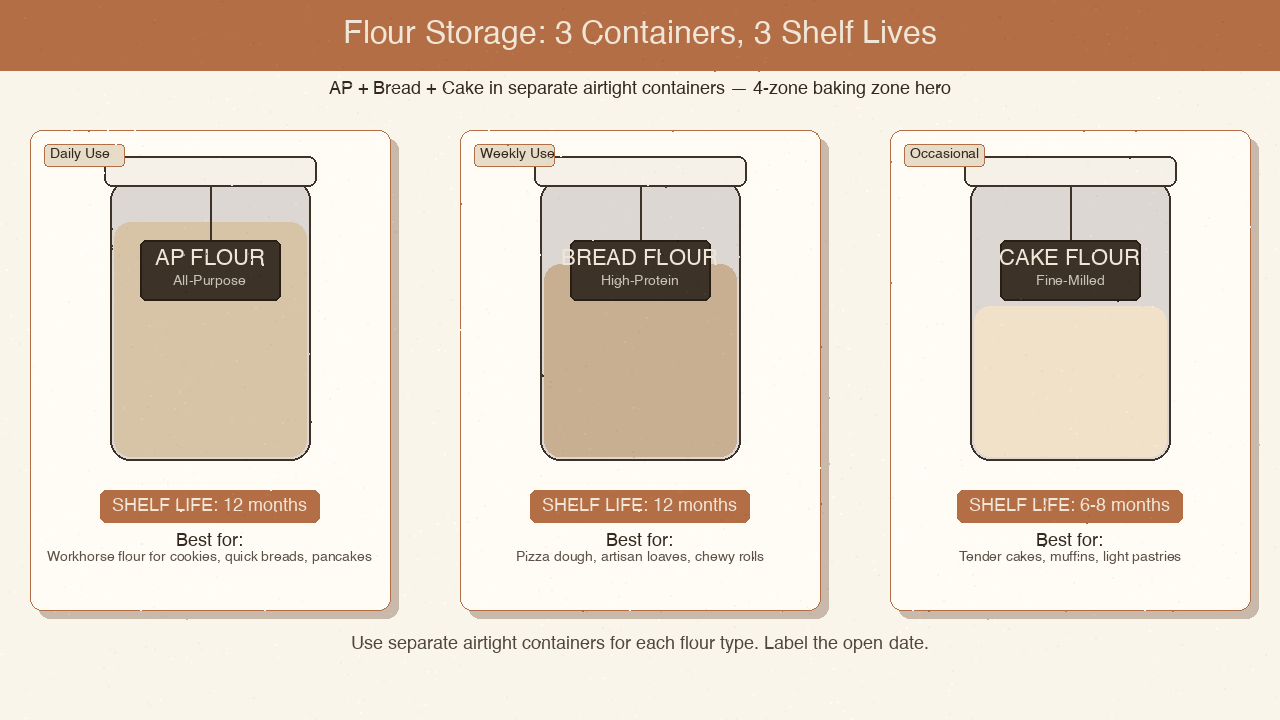
AP, bread, and cake flour belong in separate containers
All-purpose is the workhorse — store in a 2.4L–3L airtight container like the Vtopmart 10-PCS flour and sugar container set. AP lasts up to 12 months airtight. Bread flour has higher protein — keep it in its own container. Cake flour clumps fast in humid pantries; use a smaller 1.5L container.
Split bulk flour between a working container and a backup bag
A 5 lb working container at eye-level plus a 10–25 lb backup bag clipped tight on the deep shelf. Refill every 2–3 weeks. The Vtopmart 5.2L 4-pack fits a 10 lb backup bag.
Three layers of pest defense
Any container with a silicone gasket or push-button seal blocks adult weevils from laying eggs inside the flour. Drop a bay leaf and clove stick into the container for the eugenol repellent effect (replace every 6 months). Before refilling, inspect for webbing. If you spot any, freeze the flour for 4 days before decanting.
Zone 2 — Sugar & Sweetener Storage
Sugars don’t spoil easily but they absorb moisture and clump, brown sugar hardens, and honey crystallizes if neglected.
Granulated, powdered, and brown sugar each need their own setup
Granulated sugar is fine in any airtight container — a 1.5–2L jar from the ComSaf glass pantry set is plenty. Powdered sugar clumps fast — store with a silicone desiccant packet to absorb humidity. Brown sugar hardens into a brick if exposed to air for more than a week; keep it in a small airtight jar with a terra-cotta sugar saver disc, or freeze the working portion.
Brown sugar softener hack
A terra-cotta disc soaked in water keeps humidity around 70 percent — enough to keep sugar soft, not enough to grow mold. Re-soak every 30 days and replace every 2 years. The discs run $6–9.
Honey crystallization fix
Honey crystallizes around 57°F, which is most kitchen pantry temperatures. Set the jar in warm water (110°F, not boiling) for 20 minutes and the crystals dissolve. Store honey in glass rather than plastic.
Zone 3 — Oats, Cereal & Granola
Cereal, granola, and oats are bulky but light. They need pest-proofing — the same weevils and moths that infest flour will move to oats within a week.
Decant bulk oats into a 4-tier stack
Decant into a 4-tier stack like the Lifewit plastic stackable baskets so you can see remaining stock at a glance. Quick oats and steel-cut oats are different sizes — store each in its own tier.
Granola and cereal go in pull-forward bins
Granola and family-size cereal boxes are awkward shapes. Stack 3–4 in a clear pull-forward bin like the Vtopmart 8-pack stackable bins. Label with “opened YYYY-MM-DD.”
Zone 4 — Mixes, Baking Soda, Baking Powder & Small-Pack
The lowest-shelf zone — items you use less often but absolutely need: cake mixes, brownie mixes, pudding mixes, baking soda, baking powder, vanilla extract, and yeast.
Cake, brownie, and cookie mixes in clear stackable bins
Most boxed mixes have a 12–18 month shelf life (printed on the side). Decant into 1L stackable bins and label each bin with the printed best-by date in marker. Rotate FIFO: new box behind the older one. The Vtopmart 8-pack stackable bins cover a full year of mix rotation.
The 6-month rule for baking powder and soda
Both lose potency 6 months after opening. Test before you bake: drop 1 tsp baking powder into 1/3 cup hot water. Vigorous fizz means fresh; no fizz means toss. Mark the open date the day you open a new box — the SUPVAN T50M Pro label maker prints the labels in 5 seconds.
Layout by Pantry Size
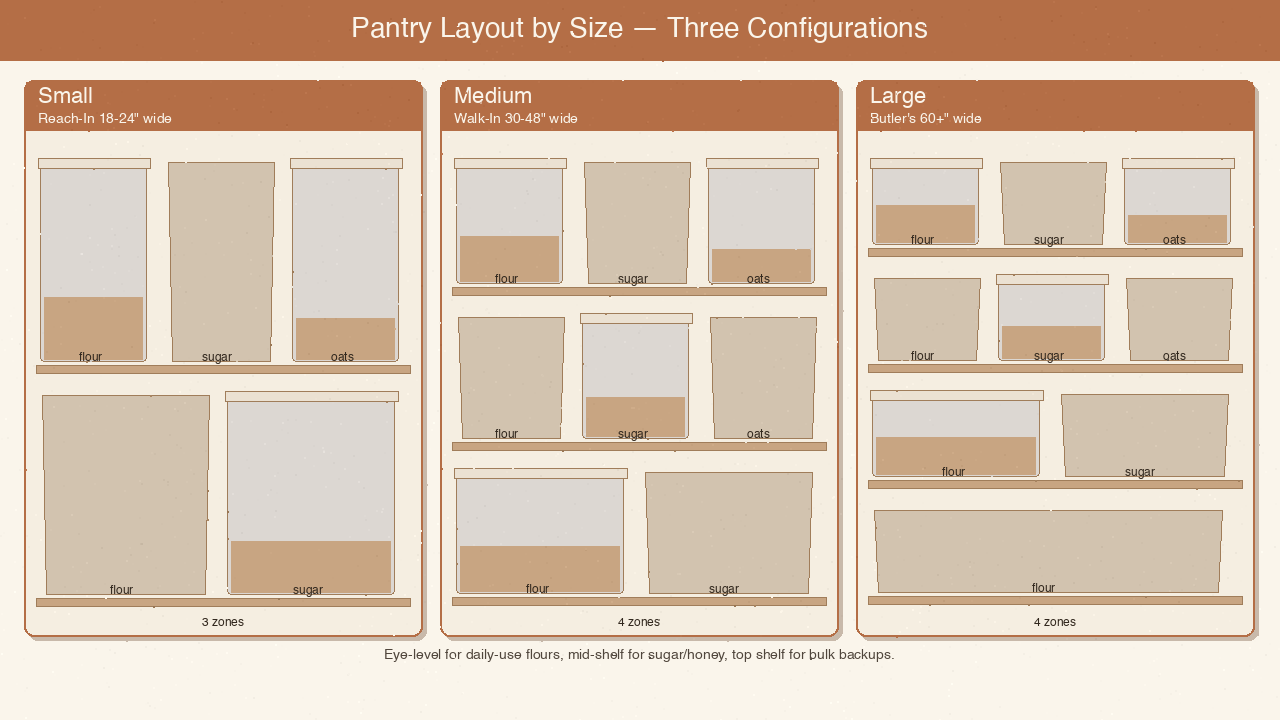
Small reach-in pantry (18–24 inches wide × 12 inches deep)
Eye-level (48–60 inches): stack two Vtopmart 10-PCS sets two-across — flour and sugar in the four biggest containers. Mid-shelf (24–48 inches): the Vtopmart 8-pack stackable bins for cake mixes, baking powder, oats, granola. Deep shelf (floor): backup 25-lb flour bag in a clip-bag.
Medium walk-in pantry (30–48 inches wide × 24 inches deep)
Right wall, eye-level: flour and sugar — three containers plus the 5.2L Vtopmart 4-pack. Left wall, mid-shelf: ComSaf glass jars for sugar and honey. Center floor: the Lifewit 4-tier for oats and cereal.
Large butler’s pantry (60+ inches wide)
Top shelf (60–72 inches): bulk backup bags. Eye-level, left: flour and sugar across the Vtopmart 10-PCS set. Eye-level, center: oats, cereal, granola — the Lifewit 4-tier plus the Vtopmart 8-pack bins. Eye-level, right: glass jars in the ComSaf set.
Three pantry sizes at a glance
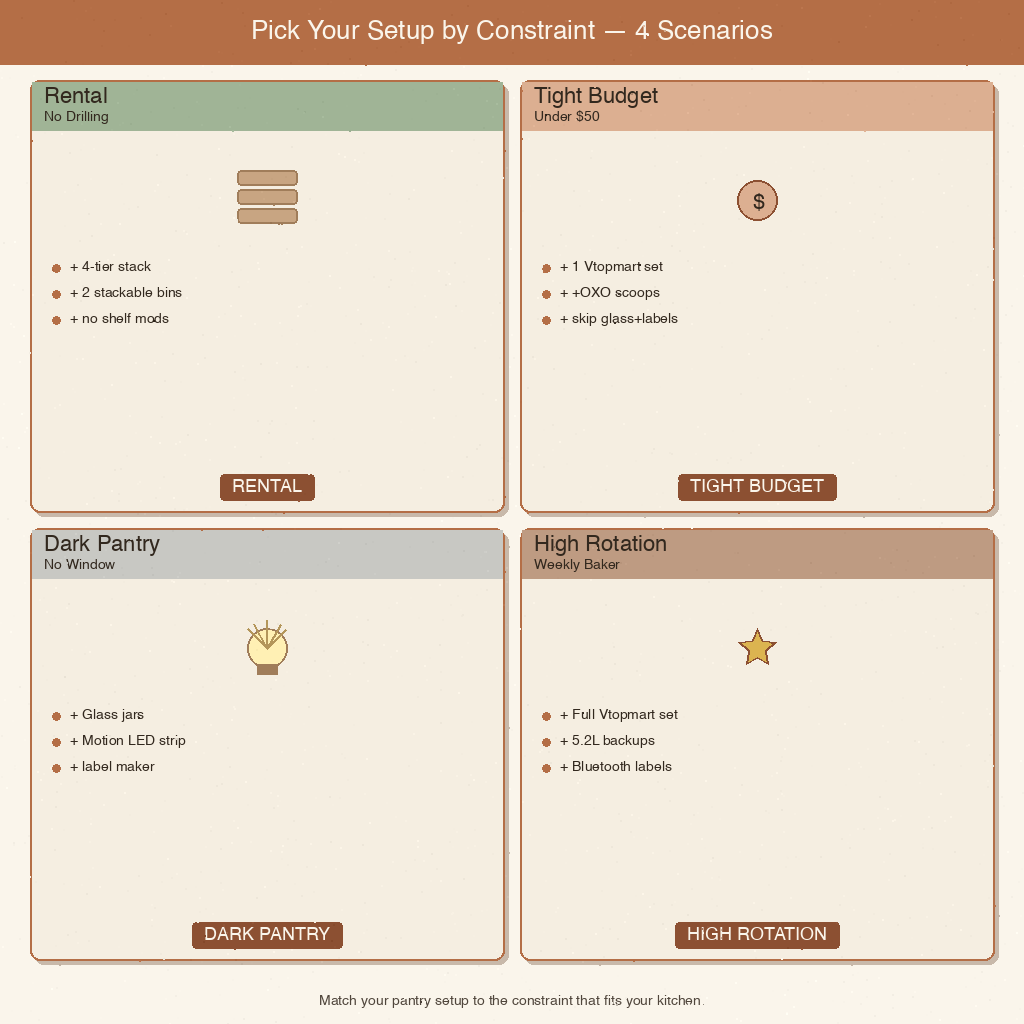
Constraint Guide by Scenario
If you rent (no drilling, no permanent shelf mods)
Stick to free-standing stackable bins — the Lifewit 4-tier for oats and cereal, the Vtopmart 8-pack bins for mixes. A Bluetooth label maker matters more because you can’t add shelf labels. See small kitchen organization for the rental-safe pattern.
If budget is tight (under $50 for the full zone)
Skip the glass jars and the label maker. Buy the Vtopmart 10-PCS — covers flour, sugar, and small-pack mixes. Add the OXO scoops as a single $11.95 add-on. Total: $44.94.
If your pantry is dark (no window, no overhead light)
Skip opaque bins. Go glass: the ComSaf 6-piece set shows contents in any light. Add a motion-activated LED strip under the eye-level shelf. The SUPVAN label maker helps — printed labels read in low light when handwritten markers wash out.
If you bake less than monthly (low rotation)
Skip the 5.2L backup container. Buy one Vtopmart 10-PCS set plus the OXO scoops. Total $44.94. Skip the label maker.
If you bake weekly (high rotation, multiple flour types)
AP flour in the 3L container from the Vtopmart 10-PCS set. Bread flour in the 5.2L 4-pack — bigger, used more than AP. A Bluetooth label maker is worth the $27.99 here.
If you have ants (common in warm climates)
Pre-cycle all baking goods through the freezer for 4 days before decanting — kills ant pheromone trails and moth eggs. Then store in the airtight container plus a bay leaf and a clove. Wipe the rim of the container with white vinegar weekly. The Vtopmart 10-PCS push-button seals keep ants out as long as the gasket is clean. The SUPVAN label maker is useful — printed labels survive weekly vinegar wipe-downs.
Common Mistakes
Five mistakes show up repeatedly in disorganized baking zones.
Mistake 1 — Storing flour in the original paper bag after opening
The paper bag is breathable by design — meant for shelf display, not long-term storage. Once opened, weevils enter within 48 hours, flour oxidizes within 2 weeks, and humidity clumping starts within a month. Transfer to airtight within 24 hours of opening. The Vtopmart push-button seals block all three failure modes.
Mistake 2 — Mixing new flour with old at refill
Sounds logical but spreads any contamination from old stock into fresh. Instead: finish old stock first, wash the container, then pour in fresh.
Mistake 3 — Skipping the “opened” date
Baking powder, baking soda, yeast, and whole-wheat flour all lose potency within 6 months of opening. A Sharpie-marked sticker prevents $8 of wasted ingredients per quarter. Upgrade to a Bluetooth label maker when you have more than 6 containers in rotation.
Mistake 4 — Buying in bulk just because it’s on sale
25 lb of flour at $18 vs 5 lb at $6 sounds like a deal until you cycle through 8 lb in 4 months and the remaining 17 lb goes stale. Bulk only works if your household bakes enough to use the working stock within the shelf-life window.
Mistake 5 — Ignoring pantry moths until you see webbing
Indianmeal moths lay eggs in opened grain products — flour, oats, cereal. The webbing you see on the surface is the late stage; by then larvae have spread to every grain product within 6 feet. We learned this the hard way — a single moth sighting means full-pantry quarantine.
What You’ll Need
Build in two passes: start with the flour and sugar airtight containers, then add zones as budget allows.
Product callout grid at a glance
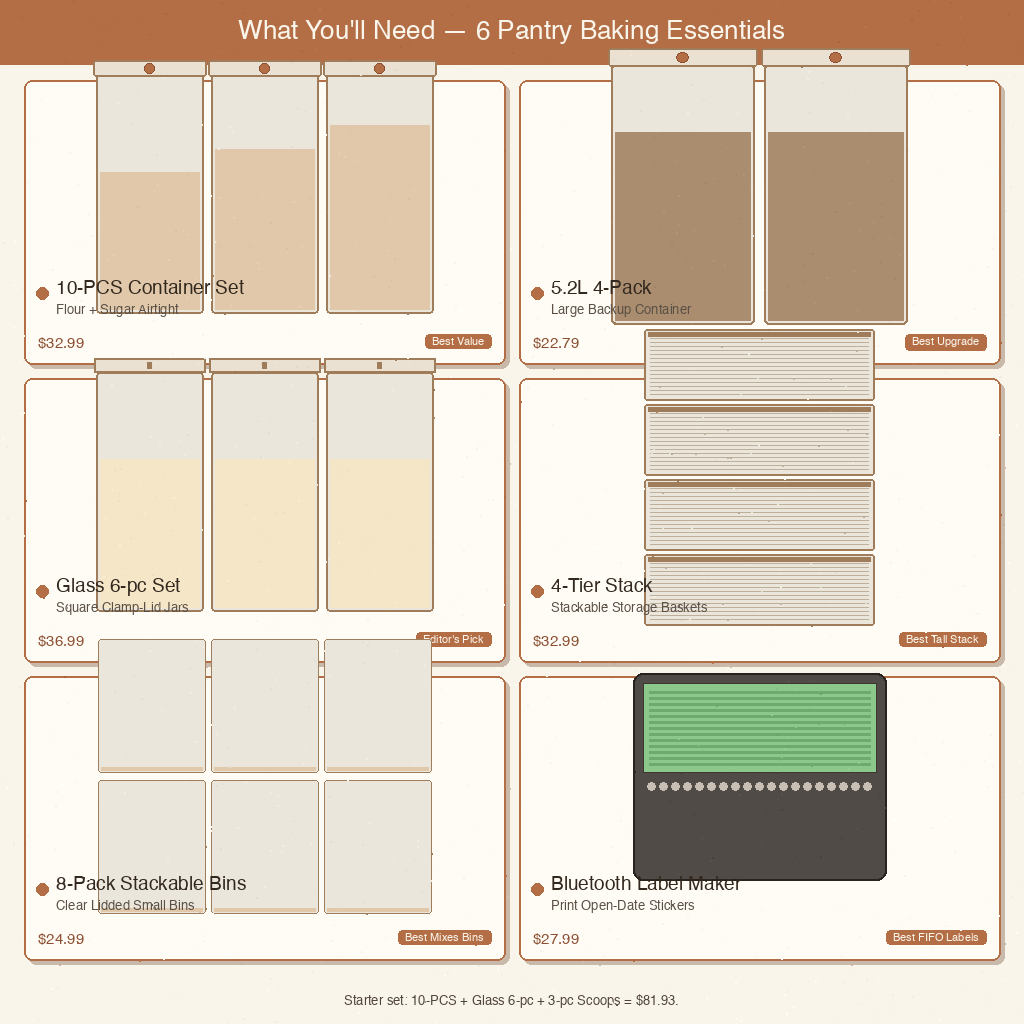
- P1 (Hero) — Vtopmart 10 PCS Flour/Sugar Container Set ($32.99) — three sizes cover AP/bread/cake flour plus granulated and powdered sugar. Airtight push-button seals block weevils, moths, and humidity. View on Amazon
- P2 — Vtopmart 5.2L Flour Sugar Containers 4-Pack Black ($22.79) — backup stock for a 10-lb flour or sugar bag. View on Amazon
- P3 — ComSaf Glass Pantry Storage Containers 6-pc Set ($36.99) — glass alternative for sugar, honey, and sweeteners. View on Amazon
- P4 — Lifewit Plastic Stackable Storage Baskets 4 Tier ($32.99) — vertical stack for oats, cereal, and granola. View on Amazon
- P5 — Vtopmart 8pcs Clear Stackable Storage Bins with Lids ($24.99) — small-pack zone for cake mixes, baking powder, and baking soda. View on Amazon
- P6 — SUPVAN T50M Pro Bluetooth Label Maker ($27.99) — print open-date labels in 5 seconds. View on Amazon
- P7 — OXO Good Grips POP Container Accessories 3-Piece Scoop Set ($11.95) — three graduated scoops fit any standard container mouth. View on Amazon
Starter set: P1 + P3 + P7 = $81.93 covers the core 4-zone setup. Add P4, P5, P6 as you expand.
Related Guides
- Pantry organization hub — 5-zone system overview.
- Kitchen pantry organization — 5-step kitchen pantry walkthrough.
- Pantry declutter checklist — purge pass before you organize.
- Pantry storage solutions — container-to-shelf-depth match.
- Pantry inventory method — FIFO rotation + restock cadence.
- Spice organization — adjacent zone for spices, oils, vinegars.
- Small kitchen organization — small-space pantry layouts.
- How to choose storage bins — bin materials guide.
- Clear bins vs opaque bins — dark-pantry trade-offs.
- How to label anything — label types for pantry, closet, garage.
- Declutter fast — purge pass upstream of the zone system.
- KonMari method — category-not-location applied to baking zones.