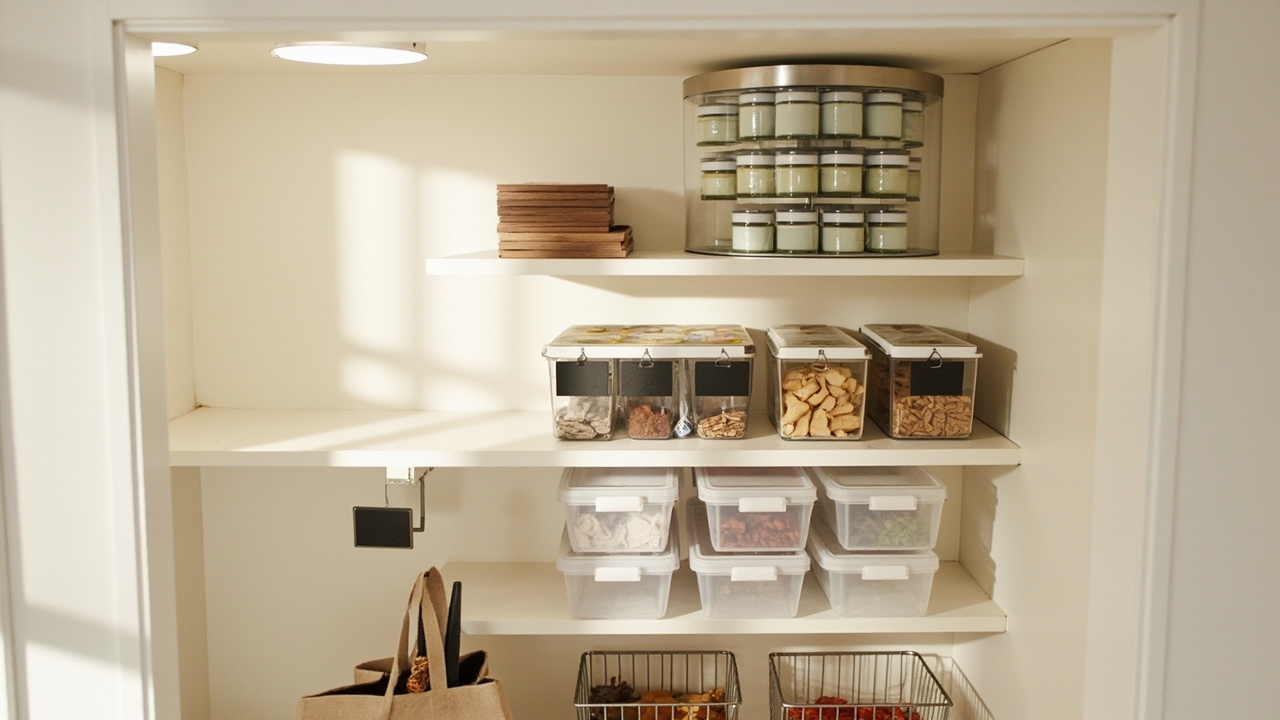
A 1-day pantry reset is a time-bound whole-pantry makeover: empty every shelf, sort items into keep / donate / discard, deep-clean shelves, restock into a 5-zone system, and rebuild maintenance. It works whether you have a small reach-in, a mid-size built-in, or a large walk-in. Total time: 6-8 hours including cleanup. Best done before a grocery run so you only buy what you need.
Pre-Reset Prep: Set Yourself Up to Win
A pantry reset fails before it starts when you walk in unprepared. Spend 30-45 minutes on prep the night before.
Clear Your Schedule and Inventory the Empty Space
Block out 6-8 hours on a weekend morning. Saturday works best because grocery stores are open for the restock trip. Empty the countertops around your pantry landing zone — you need staging room for the 4-quadrant sort piles. Measure the inside dimensions of every shelf. Photograph the empty pantry so you remember the starting state.
Gather Supplies in One Trip
The reset supply kit: contractor trash bags, 2-3 reusable donation totes, all-purpose cleaner, microfiber cloths, rubber gloves, shelf liner if needed, chalkboard labels, and a permanent marker. Pre-stage these so you aren’t running back to the store mid-reset. Skipping this step is the most common reason pantry resets fail. The storage bins decision guide and the kitchen pantry layout guide help you pick the right containers before you buy.
The 1-Day Reset Schedule: A Time-Bound Framework
Most pantry resets fail because they have no time budget. Spread across 2-4 weekends, you lose momentum and the staging zone becomes a permanent mess. The 1-day method forces decisiveness.
8:00 AM — Morning Block: Empty + Sort (2 hours)
Pull everything out. Place like-items on the counter in 4 quadrants (see Sort and Categorize below). Don’t stop to read every can label — move fast. Goal: bare shelves by 10 AM.
10:00 AM — Mid-Morning Block: Expiry Audit + Clean (2 hours)
Run the expiry audit (see below). Wipe down every shelf with all-purpose cleaner and microfiber cloths. Lay fresh shelf liner if your pantry has wire shelves that allow crumbs through. Allow shelves to dry before restock.
12:00 PM — Afternoon Block: Zone Reset + Restock (2 hours)
Restock using the 5-zone system (see Layout by Pantry Zone below). Each zone has dedicated shelf space and product type. Apply chalkboard labels with zone name plus category. The pantry organization guide has the full product-selection matrix.
2:00 PM — Late Afternoon Block: Build Maintenance System + Grocery Run (1-2 hours)
Build the post-reset maintenance routine (see below). Drive to the grocery store — only buy what your zones need. Don’t over-buy.
Sort and Categorize: The 4-Quadrant Method
The 4-quadrant method is borrowed from professional organizers. It forces a single decision per item. The method is the foundation of the pantry declutter checklist rotation rule.
Visual overview of the 4-quadrant counter layout
The four-pile layout makes decisions fast — the counter becomes your decision surface.
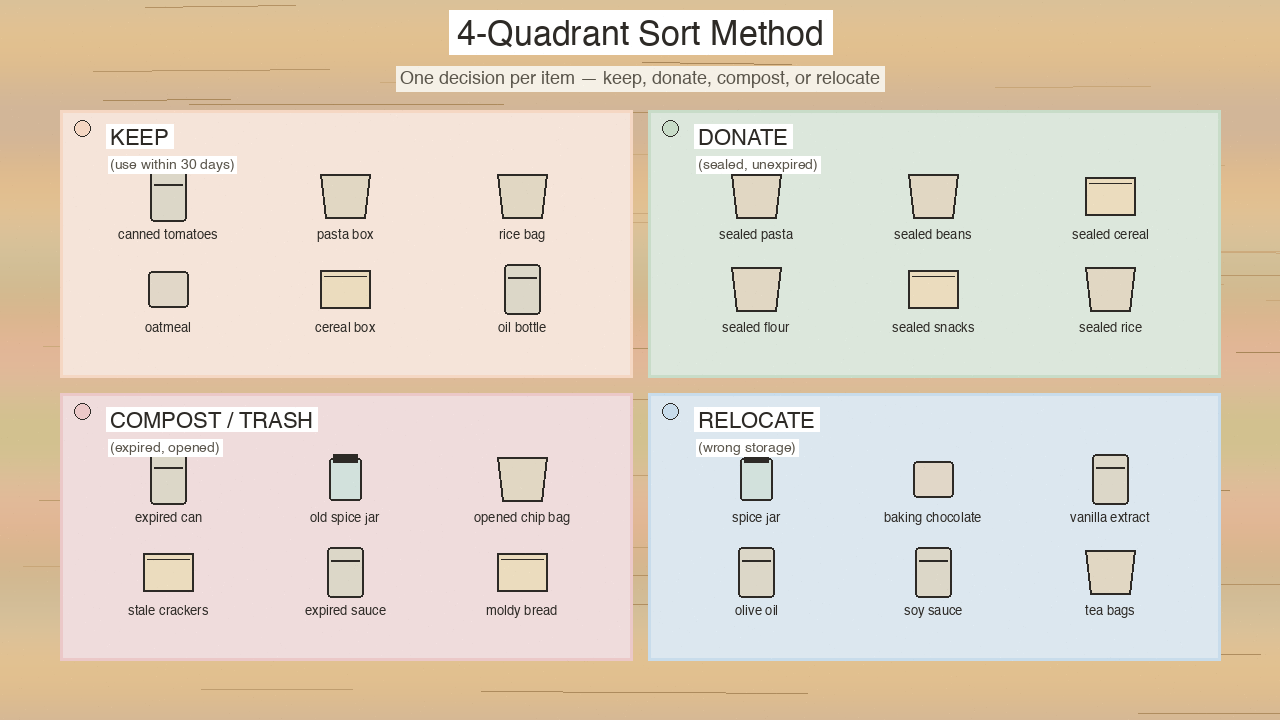
Quadrant 1 — KEEP (use within 30 days)
Food you actively cook with. Cans and dry goods you use weekly belong here.
Quadrant 2 — DONATE (sealed, unexpired, unused)
Unopened cans, sealed pasta, sealed baking supplies you won’t realistically use. Drop them at a local food bank within the week — don’t let piles sit. A DURASACK 22-gallon tote keeps them contained for transport.
Quadrant 3 — COMPOST or TRASH (expired, opened, spoiled)
Expired anything goes in trash or compost. Opened packages past their window also go in trash. Don’t rationalize “I might use this” — if it expired 6+ months ago, you won’t. Hefty 13-gallon lavender bags handle leaky cans without tears.
Quadrant 4 — RELOCATE (wrong storage location)
Spices, baking-only items, or specialty ingredients that belong elsewhere. They re-enter the keep pile at their proper home. The spice organization guide has a parallel framework.
Expiry Audit and Waste Reduction
Most households end up tossing expired or duplicate pantry items every year. The 1-day reset is your chance to break that cycle.
Visual reference for the expiry audit workflow
A staged counter with three sorting piles, a trash bag, and a donation tote shows the audit flow.
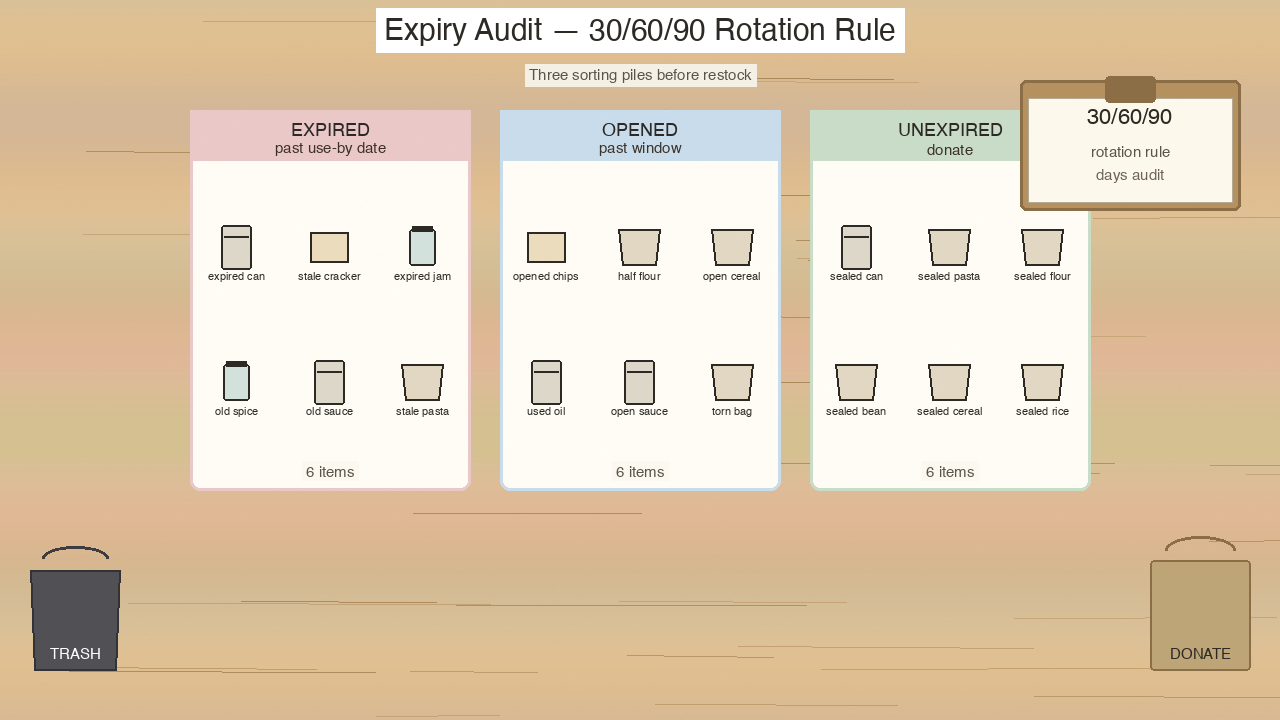
First Pass — Date-Based Purge
Group like items together. Check every date. “Best by” is a quality guideline, not a safety cutoff for unopened low-acid cans — most last 1-3 years past. “Use by” is harder — flavor drops once past. Open anything within 6 months of “use by” or bin it.
Second Pass — The 30/60/90 Rotation Rule
This rule from the pantry declutter checklist powers ongoing waste reduction. Audit quarterly: not used in 30 days = weekly rotation. Not used in 60 days = monthly. Not used in 90 days = donate or trash. Apply this rule mentally during restock: if it wouldn’t be used in 90 days, don’t buy it again.
Layout by Pantry Zone: Restock the 5-Zone System
The 5-zone system is the restock backbone. Each zone has a fixed shelf location and product type. You never mix zones on the same shelf.
Visual map of the 5-zone shelf layout
An annotated shelf diagram shows each zone top to bottom — baking, canned goods, breakfast, snacks, condiments. Chalkboard labels anchor each shelf.
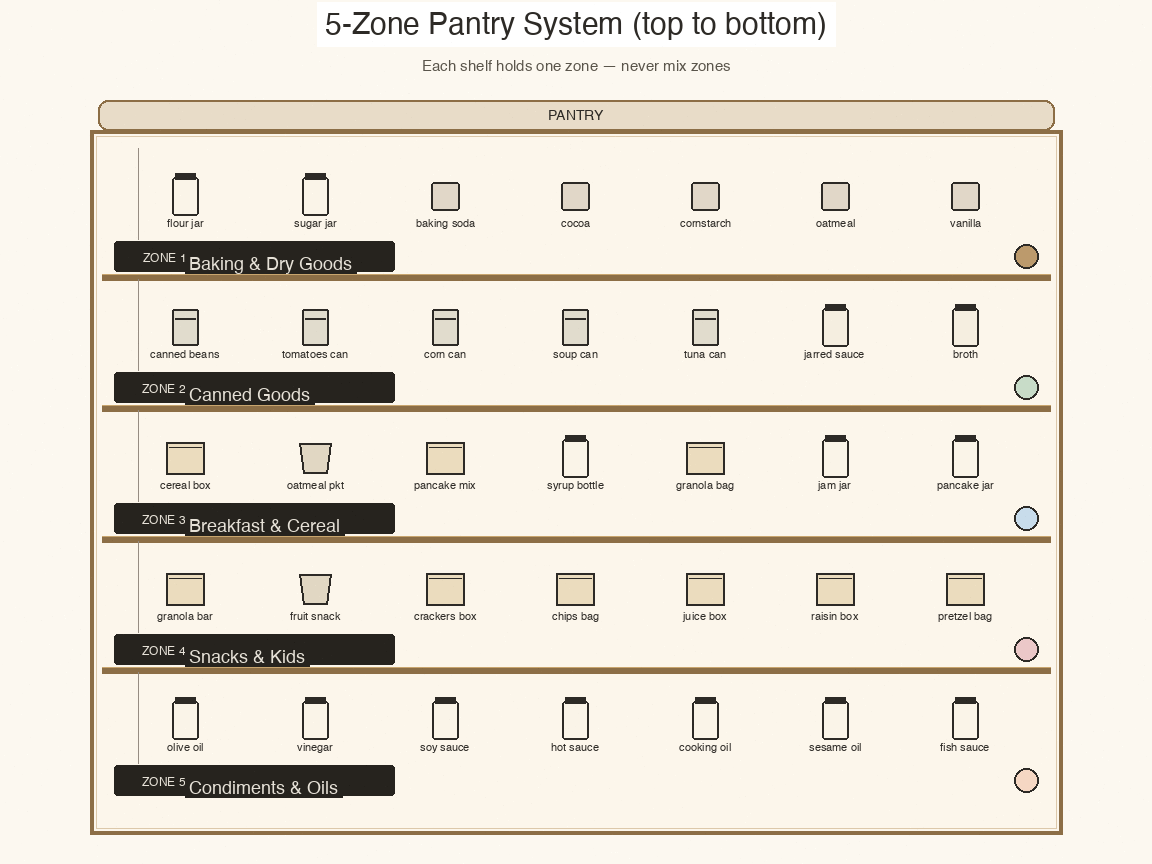
Zone 1 — Baking and Dry Goods (top shelf)
Flour, sugar, baking soda, baking powder, cornstarch, cocoa, vanilla. Airtight containers extend shelf life 3-6x and prevent weevil and moth infestation. The PRAKI 24-piece airtight set is the right pick — multiple sizes for flour, sugar, spices. See the pantry baking zone guide for baking-only pantries.
Zone 2 — Canned Goods and Jarred Items (middle shelf)
Canned vegetables, beans, tomatoes, jarred sauces. A CiWiVOKi 4-pack lazy susan turntable rotates back-row cans forward — FIFO built in. For wider shelves, the Amazon Basics wire baskets let you see all cans at a glance.
Zone 3 — Breakfast and Cereal (middle shelf)
Cereal boxes, oatmeal packets, pancake mix, syrup. Open boxes get poured into airtight containers to stay fresh. Zone 3 sits below Zone 2 — kids can reach without climbing. The Kempshott chalkboard labels work on every cereal container for date tracking.
Zone 4 — Snacks and Kids Items (lower shelf)
Granola bars, fruit snacks, crackers, chips, juice boxes. The Amazon Basics wire baskets work great for oddly-shaped chip bags so kids see all options.
Zone 5 — Condiments, Oils, and Specialty (door or top shelf)
Cooking oils, vinegars, soy sauce, hot sauce, specialty sauces. The CiWiVOKi lazy susan turntable rotates tall bottles to the front. If Zone 5 spills into small bottles, the spice organization guide has a parallel framework.
Build the Maintenance System
A pantry reset without a maintenance system resets itself in 90 days. The system is built from three rituals.
Weekly 10-Minute Visual Audit
Every Sunday while coffee brews, scan the pantry for out-of-place items. Return them to the correct zone. Toss any new expired item. 10 minutes is enough — the goal is catching drift, not deep cleaning.
Quarterly Mini-Reset
Every 3 months, spend 30-45 minutes running a quick sort. Pull everything past expiry. Restock the donation tote. Wipe down shelf fronts. The same 30/60/90 rotation rule from the bedroom declutter checklist carries over to pantries and closets.
Annual Deep Clean
Mark your calendar for the same weekend next year. The 1-day reset is an annual event, not a one-time fix. By then, your zones may need adjustment — kids grow up, diet changes, cooking styles evolve.
What You’ll Need: Product Plan
Six products cover the full reset.
Product Reference Legend
| Code | Product | Price | Zone / Use |
|---|---|---|---|
| P1 | PRAKI 24-piece Airtight Containers | $29.99 | Zone 1 (Baking and Dry Goods) |
| P2 | Kempshott Chalkboard Labels (162 pcs) | $5.77 | All zones (zone and date labels) |
| P3 | CiWiVOKi Lazy Susan 4-Pack | $18.04 | Zone 2 and Zone 5 (FIFO rotation) |
| P4 | Amazon Basics Stackable Wire Baskets | $20.99 | Zone 4 (Snacks) |
| P5 | Hefty 13 Gal Kitchen Trash Bags | $15.47 | Quadrant 3 (expired food disposal) |
| P6 | DURASACK 22-Gallon Storage Tote | $13.49 | Quadrant 2 (donation transport) |
Total Reset Budget
Six products totaling $103.75. Skip the donation tote (P6) and it drops to $90.26 for five products. See the storage bins decision guide for an alternative container set. Label with the Kempshott chalkboard labels — see the how to label anything guide.
Constraint Guide by Scenario
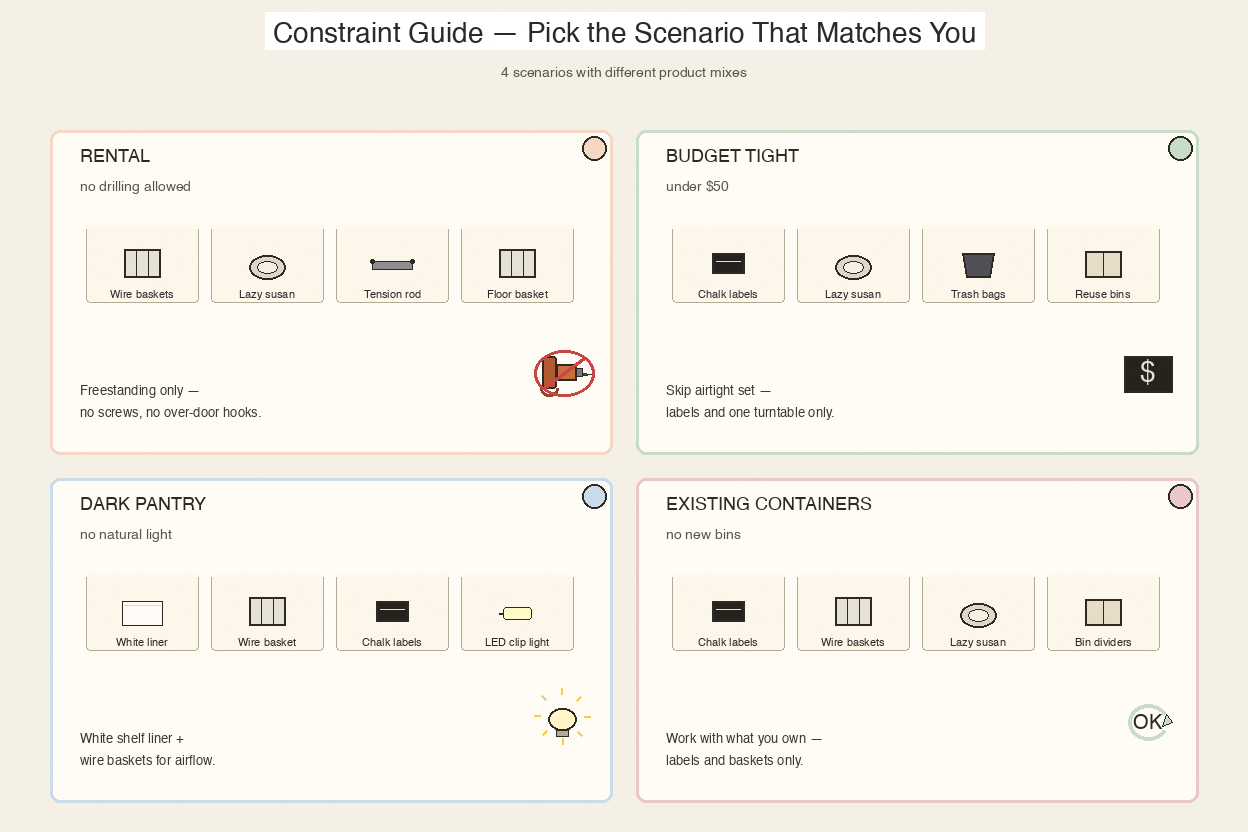
Four common constraints change the product mix.
Visual grid of the 4 pantry constraint scenarios
A 4-panel grid shows the four common constraints — Rental uses freestanding baskets only, Budget Tight uses minimal products under $50, Dark Pantry adds white shelf liner, Existing Containers uses labels and baskets only.
If Rental (no drilling)
Skip over-the-door organizers that need screws. Use freestanding Amazon Basics wire baskets and CiWiVOKi lazy susan on existing shelves. No tools needed.
If Budget Tight (under $50)
Drop the airtight set (PRAKI 24-piece, $29.99) and reuse containers. Focus on Kempshott labels ($5.77) plus CiWiVOKi lazy susan ($18.04) plus Hefty trash bags ($15.47). Total under $40.
If Dark Pantry (no windows, low light)
Chalkboard labels need a flashlight to read. Add bright white shelf liner as contrast — labels read better on white than on bare wood. The Amazon Basics wire baskets keep airflow visible in low light, and the Kempshott chalkboard labels need a clear background.
If Existing Containers (don’t need new bins)
Skip the PRAKI airtight containers. Spend the budget on Kempshott labels plus Amazon Basics wire baskets plus CiWiVOKi lazy susan to organize what you own.
Common Mistakes
Five mistakes that derail the 1-day pantry reset.
Mistake 1 — Buying Products Before Decluttering
Organizing a cluttered pantry makes organized clutter. Run the 4-quadrant sort FIRST, then buy only what your surviving items need. The pantry declutter checklist 30/60/90 rule should run before any purchase. Most pantries reorganize well with $50-80 of products AFTER removing roughly a third of expired or duplicate items first.
Mistake 2 — Spreading the Reset Across Multiple Weekends
Momentum drops and the staging zone becomes a permanent mess. The 1-day method forces decisiveness. Block a full Saturday — don’t say “I’ll do it over the next few weekends.”
Mistake 3 — Mixing Zones on the Same Shelf
Zone 1 baking plus Zone 5 oils on the same shelf = chaos. Strict zone separation: 1 shelf = 1 zone. Use shelf risers to expand capacity. The kitchen cabinet organization guide uses the same principle.
Mistake 4 — Skipping the Expiry Audit
Reorganizing expired items is a waste of time. The 30/60/90 rule is non-negotiable. Audit before restock or you’re just shuffling garbage. The bedroom declutter checklist uses the same logic across rooms.
Mistake 5 — Not Building the Maintenance System
A pantry reset without maintenance resets itself in 90 days. The 10-minute weekly audit plus quarterly mini-reset plus annual deep clean triad is the difference between a reset that lasts a year and one that lasts a month.
Related Articles
Start with the kitchen organization hub, then the kitchen pantry layout guide. The pantry declutter checklist powers the 30/60/90 rotation rule referenced throughout. For the 5-zone product picks after the reset, see the pantry organization guide. For baking-only sub-zone, see the pantry baking zone. For Zone 5 alt-coverage, see the spice organization guide. For the parallel pantry collection hub, see the pantry hub guide. The rotation rhythm lives in the bedroom declutter checklist. For product selection criteria, see the storage bins decision guide and the how to label anything guide.