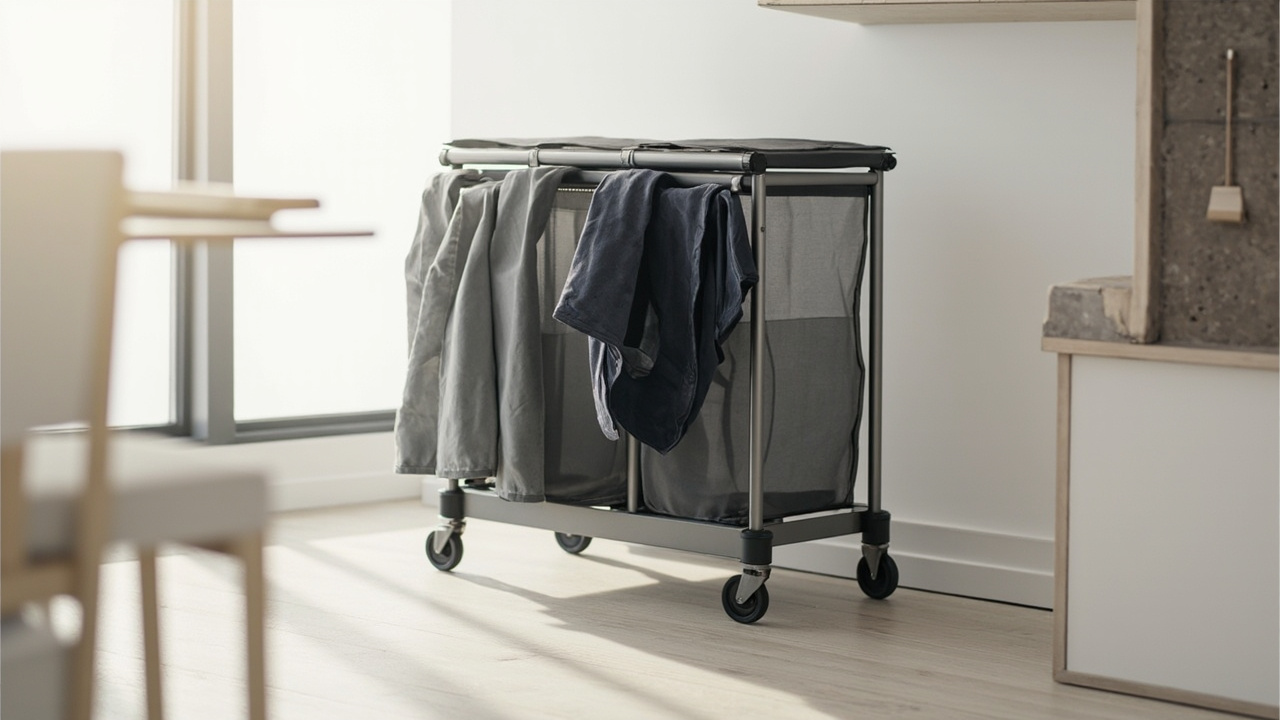
A laundry sorting system splits dirty clothes at drop-off so wash day starts already sorted. This guide starts with the sort itself — the four passes that decide which bin a garment lands in — then covers section count, sorter types, and household layouts. It is not the full room method, which lives in our 5-stage laundry room organization companion. Browse the laundry guides hub for the full map.
Why Laundry Piles Survive Without a Sort System
A single mixed pile forces a 15-minute hand-sort every wash day. Lights bleed into darks, brights get crushed under towels, and an overfull basket spills onto the floor.
If you want the full Sort → Store → Dry → Fold → Iron room method, start with 5-stage laundry room organization. This article deepens only the dirty-in layer.
The cost of wash-day-only sorting
Hand-sorting once a week costs about 15 minutes per load and creates three failure modes: color-bleed from a misplaced red sock, skipped delicates because the pile feels too mixed, and towel overload that turns a lights load into “do it tomorrow.”
What pre-sort changes
Pre-sort turns a batch decision into a per-garment decision. Each item lands in a labeled bin at the moment it comes off.
What a Laundry Sorting System Actually Is
A laundry sorting system is a multi-compartment dirty-clothes intake — not clean linen storage. Removable bags or fixed bins map to load types, with wheels, a hanging bar, a lid, and labels as options. Pick one drop point per floor.
The simplest test: one open basket is storage. Two or more labeled sections is a system.
System vs single hamper
A single basket forces a hand-sort every wash day. A labeled two-bin sorter kills the most common mistake — lights bleeding into darks — and costs about the same as one premium basket. The upgrade is the label, not the cart.
Dirty-in zone ownership
Two drop points on one floor compete and create orphan piles.
What You’ll Need: 8 Sorter Archetypes
You don’t need eight carts. Pick the archetype that matches household size, drop-off floor, and air-dry load.
3-section rolling default (P1 STORAGE MANIAC)
The STORAGE MANIAC 3-section rolling sorter ($37.99) covers lights, darks, and delicates for a 3–4 person household.
4-section rolling (P2 Simple Houseware 4-bag)
The Simple Houseware 4-bag heavy-duty rolling cart ($41.87) adds a fourth bag for towels or linens when those are a separate weekly load.
Hanging-bar sorter (P3 Simple Houseware bar)
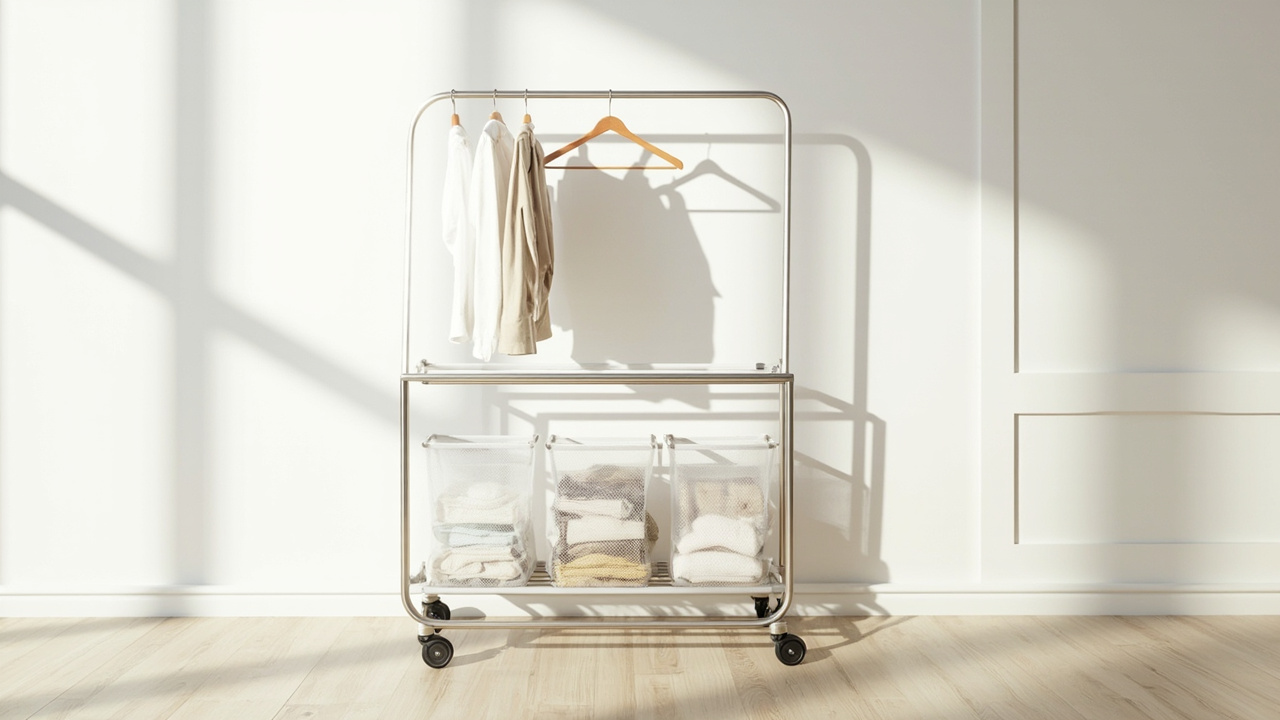
The Simple Houseware 3-bag sorter with extensible hanging rod ($50.97) puts a metal rod above three sort bags. See hooks and racks for vertical storage for other vertical options.
2-section rolling (P4 STO STO)
The STO STO 2-section rolling sorter ($39.99) keeps it simple: lights and darks only.
Freestanding lidded triple (P5 SOLEDI)
The SOLEDI 180L lidded 3-section hamper ($33.98) sits flat on the bedroom floor without wheels — pair as an upper-floor drop-off. For bin materials, see how to choose storage bins.
Budget high-capacity rolling (P6 YUELAN)
The YUELAN 240L 3-section rolling cart ($28.05) is the cheapest 3-section rolling cart with capacity for a large family.
Collapsible pair (P7 Lifewit 2-pack)
The Lifewit collapsible 2-pack hamper ($11.99) folds flat when empty. Use for tiny closets, travel, or as a temporary second-floor pair.
Classic heavy-duty triple mesh (P8 Simple Houseware 3-bag)
The Simple Houseware heavy-duty 3-bag rolling cart ($38.87) is the steel-frame workhorse.
Choose Your Section Count: 2 vs 3 vs 4
Section count is a household-size decision, not a brand decision. Two sections fit solo or couple wardrobes. Three is the family default. Four work only when towels or linens are a separate weekly load. More bins than real load types means abandoned compartments.
| Sections | Best for | Typical labels | Risk if wrong |
|---|---|---|---|
| 2 | Solo / couple, simple wardrobe | Lights / Darks | Delicates get lost or overwashed |
| 3 | Family of 3–4, mixed fabrics | Lights / Darks / Delicates | Towels may need a 4th or separate bag |
| 4 | Family of 4+ or heavy towel/linen load | Lights / Darks / Delicates / Towels | Over-sorting → abandoned bins |
Load-type labels that stick
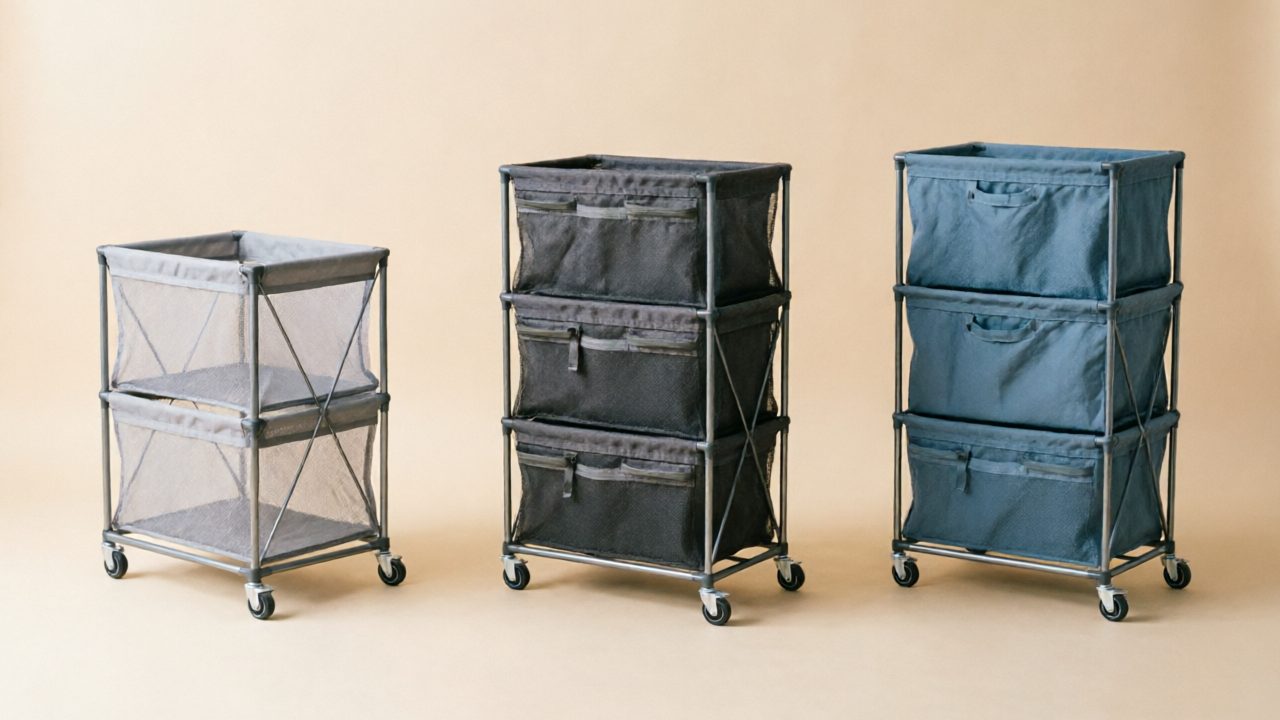
Color-first labels (Lights / Darks / Delicates) work for most households. Fabric-first (Towels / Sheets / Everyday / Delicates) works when linens dominate. Person-first labels only work when each person empties their own bag. Pick one house-wide taxonomy. For formats that survive humidity, see how to label anything.
When 4 sections backfire
Four sections feel thorough and turn into abandoned bins — the fourth becomes a “miscellaneous” pile nobody empties. If towels or sheets aren’t a real weekly split, drop the fourth bag and run a separate towel wash day.
Layout by Household Size
Match products to your layout: people count, floor count, drop-off point.
Solo or couple (1–2 people)
A STO STO 2-section rolling sorter ($39.99) in the bedroom corner or laundry closet handles lights and darks for two. Add a Lifewit collapsible pair ($11.99) for guest overflow.
Family of three to four
A STORAGE MANIAC 3-section rolling cart ($37.99) at the laundry-room intake is the default. If kids undress upstairs, add a SOLEDI lidded freestanding triple ($33.98) in the master bedroom.
Multi-floor home
One freestanding or collapsible bin per upper floor (SOLEDI or Lifewit pair) plus one rolling cart at the laundry (STORAGE MANIAC or Simple Houseware 4-bag). Bags travel down on wash day.
Kids chore households
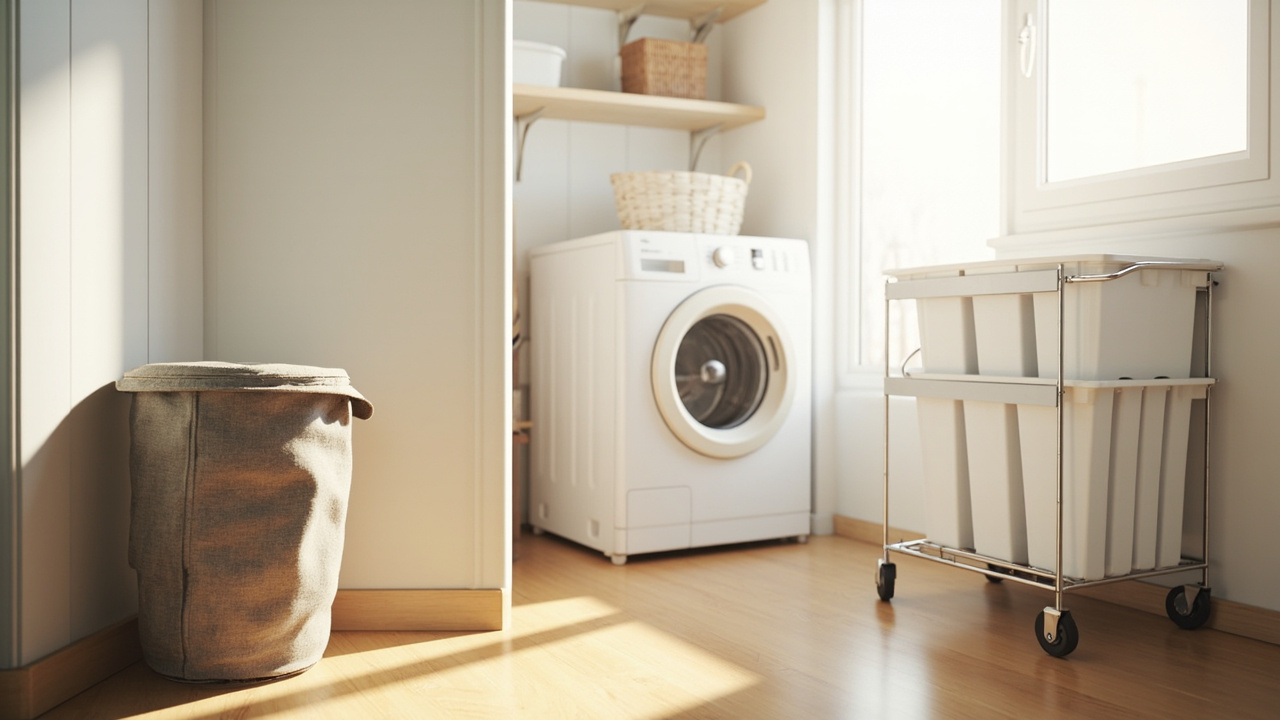
Person-labeled bags only work when kids empty their own bag. If a parent empties everyone’s load, use color labels and a transfer rule — kid dumps in lights or darks, parent finishes the delicates split at the cart. Prefer a rolling cart kids can push (STORAGE MANIAC or YUELAN).
No dedicated laundry room (closet or hallway machines)
Skip wide 4-bag carts in 24-inch closets. Use the Lifewit collapsible pair ($11.99) or a SOLEDI lidded freestanding ($33.98). See small laundry room organization.
Constraint Guide
Layer 2 covers non-physical constraints. Each scenario reuses picks from the archetype list.
If rental and you cannot drill
Stick with a freestanding rolling cart or lidded bin — no wall-mount hardware. The STORAGE MANIAC 3-section cart ($37.99) or STO STO 2-section ($39.99) lock the wheels and roll out when you move.
If the laundry closet is under 28 inches wide
Skip wide 4-bag frames — measure the door swing first. Use the Lifewit collapsible pair ($11.99) or a slim SOLEDI freestanding triple ($33.98). See small laundry room organization.
If kids under 6 share the drop zone
Lower bag openings kids can reach, use large color labels, and skip the hanging bar at toddler head height unsupervised. The SOLEDI lidded freestanding ($33.98) keeps the pile out of sight, and the STO STO 2-section ($39.99) limits the choices a toddler can make wrong.
If you have no laundry room (apartment hallway machines)
Bedroom freestanding SOLEDI ($33.98) or collapsible Lifewit pair ($11.99); use a wheeled cart only if the elevator allows. See laundry supplies organization.
If budget starter kit must stay under $40
Start with the YUELAN budget rolling cart ($28.05) or Lifewit collapsible pair ($11.99). Upgrade to the Simple Houseware hanging-bar sorter ($50.97) only when air-dry volume grows.
If you hang many delicates or button-downs
Prioritize the Simple Houseware hanging-bar sorter ($50.97), paired with a SOLEDI lidded freestanding ($33.98) upstairs. See hooks and racks for vertical storage.
Drop-Off Pre-Sort vs Wash-Day Sort
The timing of when you sort decides whether the system survives a busy week.
Sort at drop-off (recommended default)
Each garment chooses a bin once, at the moment it comes off. Wash day becomes pull-bag-and-load — no decisions under time pressure.
Sort on wash day (when it still works)
A single hamper works for a solo capsule wardrobe with one weekly load and no color-bleed risk. Add a second person or fabric type and it collapses into a 15-minute untangling session.
Hybrid multi-floor rule
Run a coarse 2-bin station upstairs (lights and darks) and finish the delicates split at the laundry-room cart.
How to Sort Laundry: The 4-Pass Method
Bins are the last step, not the first. Sorting usually fails because people buy a sorter, then dump everything into the nearest open section. Run these four passes in order and the bin count makes itself.
Pass 1: Empty every pocket
Do this at the hamper, every time. Lip balm, pens, receipts, and earbuds cause most “I washed my keys” and red-ink disasters. A pocket check belongs at drop-off, not at bag pull.
Pass 2: Sort by color first
Whites and pale colors together. Dark colors together. Anything that might bleed — new denim, dark jeans, red, navy — goes in the dark bin from day one, even before its first wash. Unsure if a color counts as light? Wet it. A damp fabric shows bleed risk a dry one hides.
Pass 3: Split by fabric and care label
Read the care label before the bin, not in the washer. Delicates, activewear, and anything marked “dry clean only” get their own section. Activewear belongs with delicates, not lights — elastic and moisture-wicking finishes wear out faster on a hot, slow load.
Pass 4: Assign to bins and watch capacity
Now count your real load types. Most households land on three: lights, darks, delicates. Towels and sheets get a separate wash day or their own section, but only if they’re genuinely a weekly load. Empty any section that hits three-quarters full — a stuffed bag is what makes people quit the system.
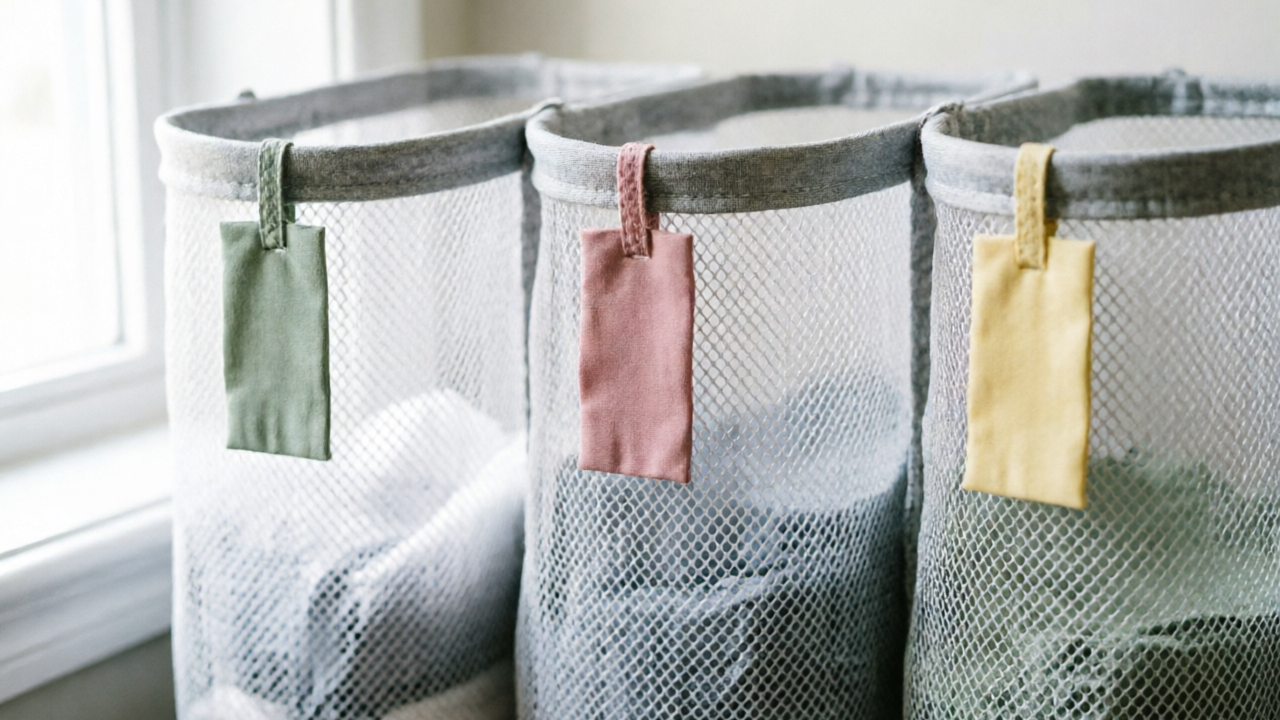
Labels that survive humidity
Clip-on or stitched tags beat paper sticky notes — a damp laundry room peels paper by week three. For label formats that survive steam and splashes, see how to label anything.
Common Mistakes
- Buying a 4-section cart before measuring door width. Wide frames fail in closet laundry. When the cart can’t reach the washer, every bag has to be carried by hand.
- Running one mixed hamper “until it’s full.” That’s the failure mode pre-sort exists to prevent. If you can’t pre-sort at drop-off, move to at least a two-bin split.
- Labeling bins by person when nobody empties their own bag. Person labels work only if each person empties their own. If a parent does the transfer, use load-type labels. See how to label anything.
- Skipping removable bags so the whole frame must be carried. The frame stays put and the bag goes to the washer. Without removable bags you’re lifting a 25-pound frame over a 12-inch drum.
- Leaving wheels free to roll near stairs or toddlers. Lock casters after parking — a drifting cart is a tipping hazard. In kid bedrooms prefer a freestanding lidded bin like the SOLEDI ($33.98).
Maintenance: Weekly Empty Cadence
A sorting system fails when bags stay past three-quarters full. Empty any bag that hits 75 percent — don’t wait for stuffed overflow. Wash mesh bags monthly, and relabel if the family stops complying.
If I had to pick one anchor, I’d use a recurring one: Sunday evening, trash day, anything you don’t already skip. The maintenance loop that anchors bigger routines is in our declutter maintenance routine. For towel and sheet quota limits that stop 4th-bin overflow before it starts, see linen closet organization.
Related Guides
Laundry hub: laundry guides. Method sister (full 5-stage Sort → Store → Dry → Fold → Iron): laundry room organization. Supplies sister (detergent, pods, bleach storage): laundry supplies organization. Small-space sister (closet and stacked geometry): small laundry room organization. Essentials: how to choose storage bins · hooks and racks for vertical storage · how to label anything. Learn: declutter maintenance routine · linen closet organization · declutter fast. Drop-zone handoffs: bedroom organization · small entryway organization.