| Storage type | Best for | Footprint it takes | Install |
|---|---|---|---|
| Rolling cart | The gap between machines; overflow from the bathroom | Floor, 8-20 in wide | None, castors only |
| Cabinet | Hiding dirty laundry in a room you look at | Floor or wall, 24-40 in wide | Assembly, often anchored |
| Shelf | The dead space above the machines | Wall band, 12 in clearance | Drilling, studs preferred |
| Folding table | A fold surface that disappears between loads | Folds flat to ~8 in | Wall mounting, one-time |
| Wall rail | Hang-dry space with no floor to give up | Wall segment, above head height | Drilling, one-time |
| Hamper | Splitting dirty clothes by household or color | Floor corner, 15-20 in wide | None |
Laundry room storage solutions are the containers and fixtures a load moves through; a room gets crowded because most people buy them before deciding what job each one does. Three extra bins won’t make the room work better — they take 8 inches off the aisle and the pile is back next Sunday. Pick the type first, then the capacity.
- The gap between your machines decides whether a rolling cart can enter at all. Measure it, then check the castor width, since castors add to the listed footprint.
- Clearance above the machines decides whether a shelf or rail goes up, and whether the washer lid still opens under a loaded shelf.
- More than three people sharing the laundry means one hamper tub mixes colors. Compartment count beats volume.
Why Laundry Room Storage Solutions Fail Without a Type Decision
Storage quantity is almost never the first problem. Type is. Buy two bins that fit on the floor and you have less aisle than before, plus the same pile at a higher level. Buy a cabinet in a rented flat and you own furniture you cannot move or resell.
This page is a type decision, not a decluttering method. If laundry never gets put away, the 5-stage laundry room organization method owns Sort through Iron. If you already have a working system and the question is where pieces sit, the 5-zone laundry room blueprint covers placement. Which of the six types earns its footprint in your room is the narrower question.
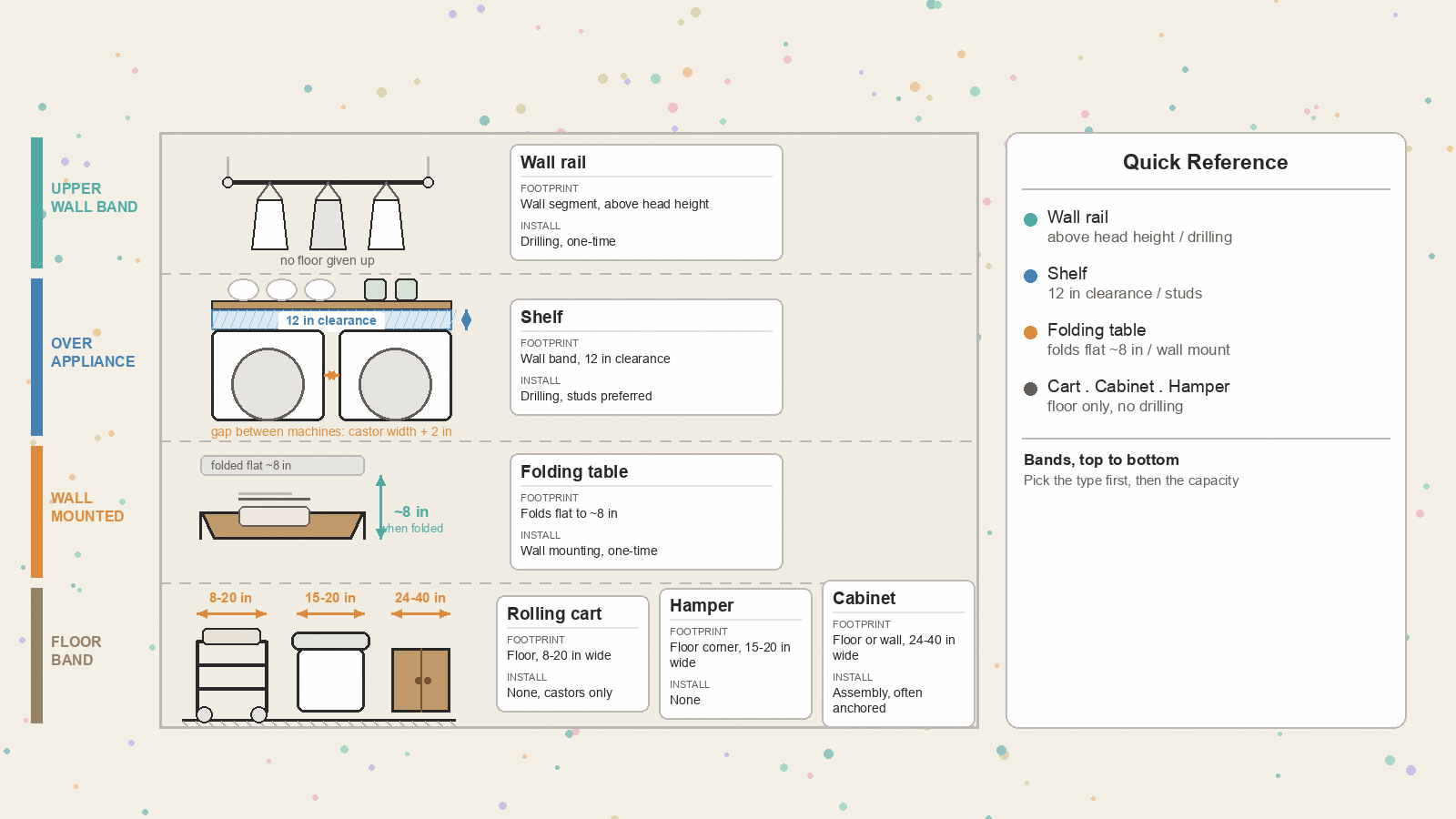
The 6 Storage Types and What Each One Is For
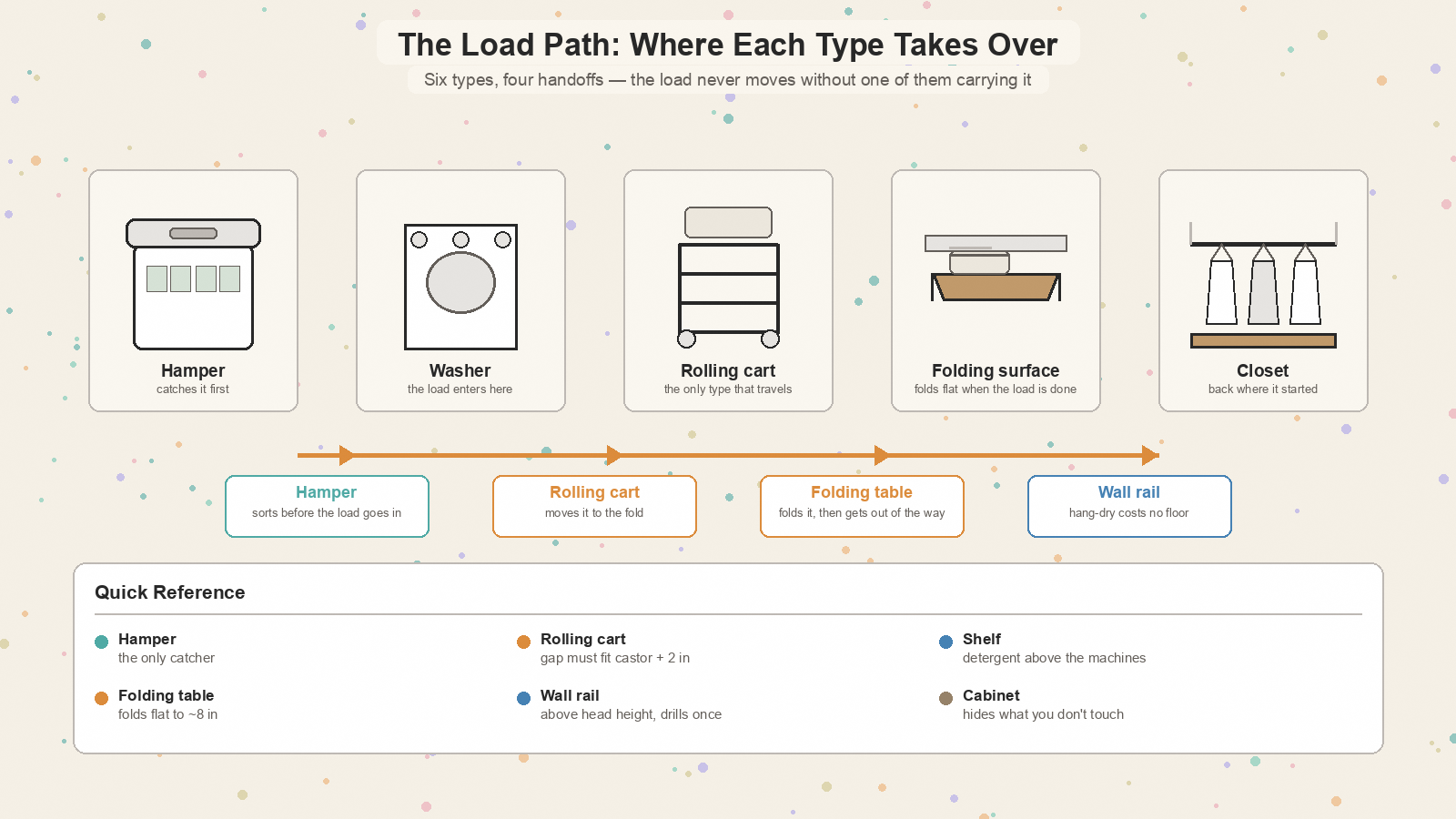
Six types cover nearly every room: cart, cabinet, shelf, folding table, wall rail, and hamper. The split that matters is movement — does the load roll, get closed up, hang, fold flat, or land somewhere on the way to the machine?
Rolling cart
It is the only type that travels with you, from washer to folding surface. Laundry gets abandoned at the handoff between machines.
Skip the cart if the gap is narrower than the castor width plus 2 inches. You will fight it every load, and a cart you have to yank ends up parked in the doorway.
Cabinet
The only type that hides the dirty pile, and the reason a shared laundry room ever looks tidy.
Skip the cabinet if you rent, can’t drill, or have no floor or wall space to give up. Both cabinets here need assembly and anchoring, and one owner reports the panel wood is “very soft” with no torque specs. Soft board under detergent jugs is a slow sag.
Shelf
The answer to the dead band above the machines, where nothing fits but everything gets stored.
Skip the deep over-appliance shelf if overhead clearance is under 12 inches. At that height you need a step stool for every bottle, and anything needing a step stool gets used once.
Folding table
Turns folding into a wall instead of a permanent island, so the aisle comes back the moment the load is done.
Skip it if you already have 24 inches of continuous counter. A wall-mounted surface adds nothing you lack, and it locks you to one wall for the life of the room. Our laundry folding station setup covers sizing a permanent surface instead.
Wall rail
Hang-dry capacity that costs no floor, since it folds back into the wall between loads.
Skip the rail as a permanent drying spot. Owner complaints cluster around sagging rods and usable length running shorter than advertised — fine for one shirt, wrong for a clothesline. For the vertical logic behind it, see hooks and racks for vertical storage.
Hamper
The intake point — everything else here moves laundry, but only the hamper catches it.
Skip the single tub if three or more people share the laundry. One tub mixes a red sock into the whites, and re-sorting at the machine defeats the point. For compartment-count logic, use the multi-bin hamper sorting guide.
Detergent and stain products have their own rules on weight and child access — where detergent and stain products should live covers that, and how to choose shelf organizers covers the shelf.
Which Laundry Room Storage Solutions Fit Your Room Shape and Household Size
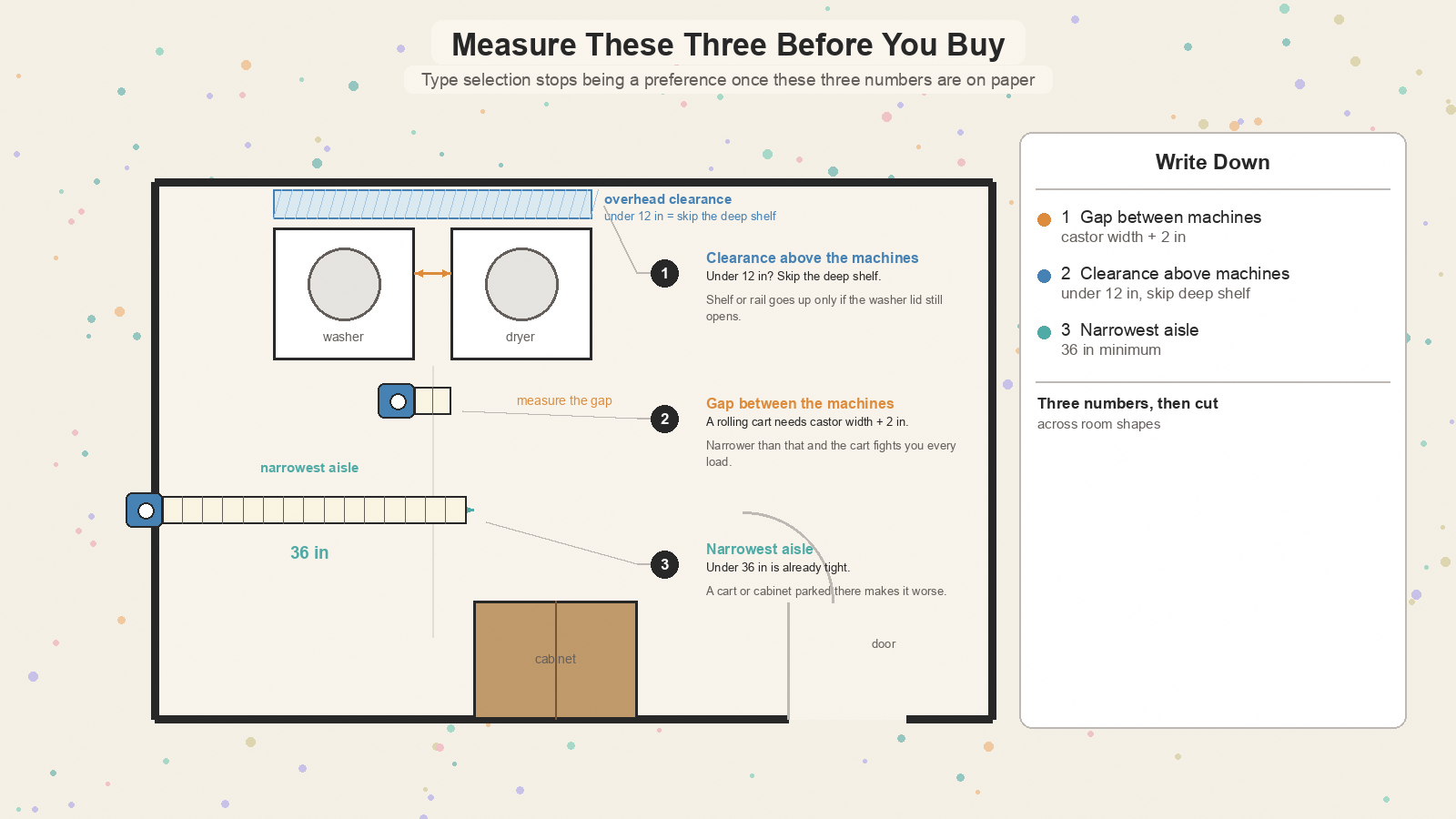
Type selection stops being a preference once you measure. Three numbers decide it.
Measure the three constraints. Write down the gap between machines, the clearance above them, and the narrowest point of your aisle. Anything under 36 inches of aisle is already tight, and a cart parked there makes it worse.
Count the people doing the laundry. One or two can share a single hamper. Three or four need two compartments. Five or more need three, because volume without compartments just delays the mixing.
Commit to the install. No-drilling rooms are limited to cart, hamper, and freestanding shelves. Everything else — cabinets, folding tables, wall rails — needs a stud or an anchor you trust.
Then cut across room shapes. If the machines fill the entire wall, go overhead and skip the floor. In a dedicated room with a spare wall, a cabinet and folding table are both affordable. In a bathroom where machines share the space, the cart doubles as overflow. In a closet with no room, a wall rail plus one lidded hamper is all that fits.
ENERGY STAR lists certified washers in stackable, under-the-counter, and combination designs for smaller spaces — the same room-shape logic that picks the storage type.
For stacked machines or a genuinely narrow closet, small laundry room layouts covers the fit.
Four Head-to-Head Verdicts
Buying the wrong pair of types is the expensive mistake. Four comparisons settle it.
Laundry hamper vs rolling cart
The hamper wins at the door, the cart wins everywhere after. One unit trying to do both is the most common reason a laundry room stays messy — dirty clothes land in the cart, clean clothes go back in the hamper, and neither is ever empty.
Laundry cabinets vs open shelving
The cabinet wins for anything you don’t want to look at; open shelving wins for anything you touch daily. Flipped around, you get a closed door hiding the detergent you use twice a week and an open shelf holding the lint bin nobody moves.
Wire vs plastic laundry shelving
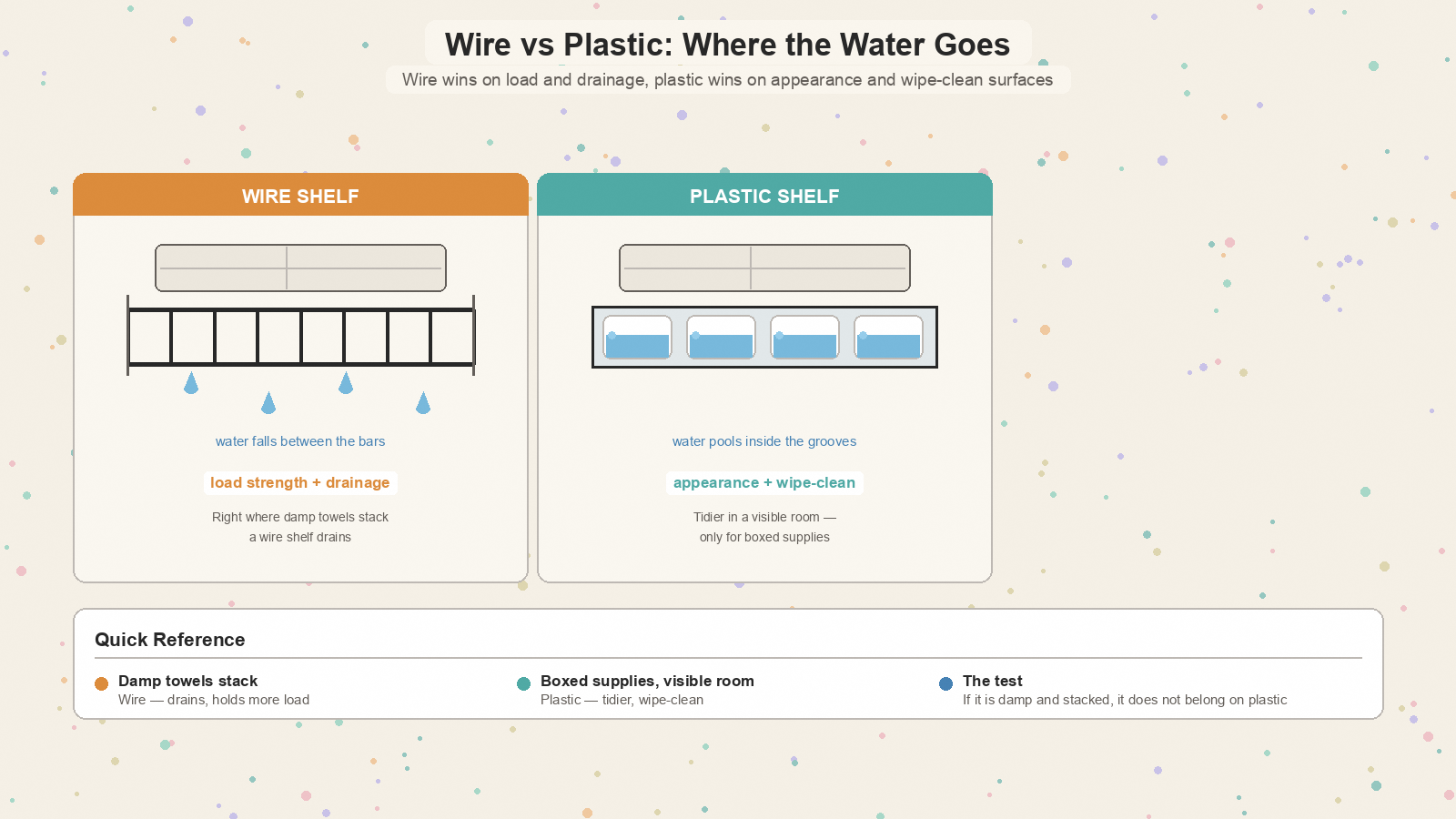
Wire wins on load and drainage, plastic wins on appearance and wipe-clean surfaces. Where damp towels stack, wire is right — plastic holds water in the grooves. For boxed supplies in a visible room, plastic looks tidier.
Collapsible hamper vs fixed hamper
Fixed wins for five or more people, collapsible wins for one person who moves it between rooms. A soft-sided hamper that folds flat solves a one-apartment problem. In a house where the hamper never moves, soft walls eventually sag under a wet load.
What You’ll Buy: 10 Picks Across the 6 Types
Ten options, grouped by the six types above. Prices move, so check the current listing.
| # | Product | Key feature | Best For |
|---|---|---|---|
| 1 | OKZEST Slim Laundry Cart | 8.2 in frame, metal hub castors | The narrow gap between machines |
| 2 | SPACEKEEPER 3 Tier Rolling Cart | 3 tiers, entry-tier price | Bathroom overflow parked beside the machines |
| 3 | Fenghua Lizhi 4-Door Cabinet | 4 doors, adjustable shelves | A dedicated room with wall space to give up |
| 4 | Homykic Bamboo Tilt-Out Cabinet | 2 tilt-out bags behind one front | Hiding the hamper without a second piece |
| 5 | ClosetMaid 18-In Utility Hanger Shelf | Shelf plus integrated rod | Shallow wall space, entry-tier |
| 6 | Golpart Over-Washer Shelves | Full-depth shelves over both machines | Bulk detergent where a short shelf fails |
| 7 | koretech 40 x 20 Wall Mount Folding Table | Folds flat, 20 in deep surface | One wall, no permanent counter |
| 8 | Vikaqi 40 Inch Foldable Wall Rail | Swings down, folds flat | Hang-dry with no floor rack |
| 9 | Lifewit 105L Lidded Hamper | Lid plus removable inner bag | One person or a studio |
| 10 | Simple Houseware Double Hamper | Two removable bags under one lid | 3+ people splitting by color |
Cart picks
The OKZEST slim cart is the only frame narrow enough for a tight gap; owners confirm it “fits perfectly between my washer and dryer” and call it “very neat and handy.” The catch: one buyer received “1 wrong wheel out of the 4” — a five-minute fix, but a delivery-day annoyance. Check Price on Amazon →
The SPACEKEEPER 3 tier cart is the wider, value pick; buyers call it “sturdy” with quick assembly. It suits wet loads less — one owner hunting for between-machine storage found it “not so great for laundry things” and moved it to the bathroom. Check Price on Amazon →
Cabinet picks
The Fenghua Lizhi 4-door cabinet suits a dedicated room — owners praise the hinges and call the doors “sleek.” The complaint: the panel is “very soft,” with no torque specs, so you set screws by feel. Treat it as a light-load zone. Check Price on Amazon →
The Homykic bamboo tilt-out hides two sorted bags behind one front. One buyer called it “sturdier and more attractive than I’d imagined” and built it in 15 minutes; the same owner found the hamper cavity “smaller than I expected,” so check it against your basket. Check Price on Amazon →
Shelf picks
The ClosetMaid 18-inch hanger shelf is the cheapest way to use a shallow wall — one owner mounted it into poured concrete without a stud and called it “well made as described.” The catch: “installation hardware/screws were not included,” so budget for anchors. Check Price on Amazon →
The Golpart over-appliance shelves cover the full band above both machines and owners rate them for bulk supplies. Assembly is the problem — one buyer found “plastic clips that do not snap together” and needed packing tape, plus a hanging bar that did not fit. Check Price on Amazon →
Folding table pick
The koretech wall-mount folding table is the only option here, and owners call it “very stable when locked in.” Mounting is the weak point — one reviewer says the instructions point at drywall and to screw into studs instead. Check Price on Amazon →
Wall rail pick
The Vikaqi foldable wall rail needs no assembly, and one owner praises the install template for leaving “literally no room for error.” It is also “an absolute beast” that “feels like it weighs 30 pounds,” and usable length runs shorter than listed. Check Price on Amazon →
Hamper picks
The Lifewit lidded hamper holds a lot for its footprint and owners like the removable bag. The complaint: it’s “much flimsier than it looks in the picture,” with a thin, awkward lid. Fine for one person. Check Price on Amazon →
The Simple Houseware double hamper is the split-sort answer for 3+ people; owners like that it “separates my color clothes from my white ones.” It isn’t sturdy — one reviewer says “dont expect anything sturdy” and that what arrived differed from the listing. Check Price on Amazon →
Three tiers, no price column
| Tier | What you get | Where it stops |
|---|---|---|
| Entry-tier | Cart plus lidded hamper, both no-drill | One room, no hang-dry |
| Mid-tier | Adds an over-appliance shelf and wall rail | Still nowhere to close the dirty pile |
| Premium-tier | Adds a cabinet plus folding table | Only worth it in a room you look at |
Constraint Guide: Five If-Then Rules
✅ marks the branch that holds up; ❌ marks the one to skip.
✅ If you rent and can’t drill, cart and hamper are the only two types left standing. Cabinets, folding tables, and wall rails all need a hole you can’t patch.
✅ If the gap between machines is under 18 inches, drop the cart and take the overhead route with a shelf instead.
✅ If the whole budget is under the price of one cabinet, buy a cart and a hamper. Those two cover intake and transfer, where most piles form.
✅ If 5+ people share the laundry, buy a hamper with at least 2 compartments and leave the wall rail as same-day only.
✅ If you have no laundry room at all, one wall rail plus one lidded hamper. Anything bigger fights the closet doors.
Common Mistakes and the 30-Minute Reset
- ❌ Buying containers before picking a type. The bin was never the problem. The aisle is.
- ❌ Shelving without checking lid clearance. Measure the washer with the lid up, not the body.
- ❌ Letting one unit do two jobs. A cart holding dirty clothes is not a hamper, and a hamper holding clean clothes is not a shelf.
- ❌ Skipping anchors on drywall-mounted hardware. Every screw into drywall is a future failure. Find a stud.
The 30-minute reset, in order:
- Pull everything off the shelf.
- Sort it into keep, relocate, or drop.
- Put back only what has a named type behind it.
The weekly version is in the laundry weekly reset.
Related Guides
Hub: laundry guides. Method: laundry room organization. Essentials: how to choose storage bins. Maintenance: declutter maintenance routine · linen closet organization.