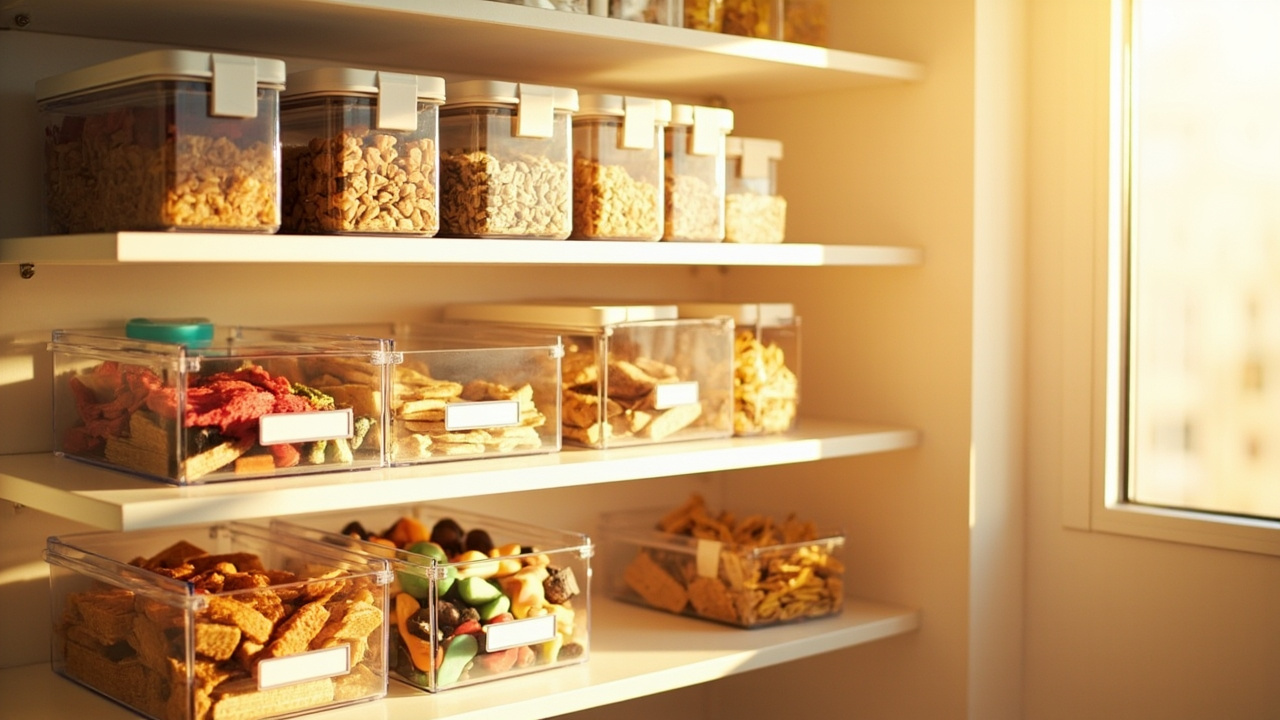
A snack zone works when the bins are kid-reachable (lower shelf), the cereal is airtight (mid-shelf, sealed), and the labels are uniform across both. Use clear stackable bins for grab-and-go snacks, an airtight cereal container with a flip lid for breakfast, and a 3-4 tier lazy susan for the back-row reach. The whole setup takes 45-60 minutes and costs $80-$120 for a complete Zone 3 + Zone 4 system.
Why a Dedicated Snack Zone Matters
Three failure patterns hit every pantry without a snack zone.
Kid-reachability is broken. Snacks land on whatever shelf has space — top shelf, behind cereal, next to the baking flour. Kids can’t reach them; parents become full-time vending machines. Moving snacks to lower shelves (24-32 inches from floor) plus a kid-safe handle bin turns snack time into self-service without breaking the 5-zone system.
Cereal goes stale in the box. Most cereal boxes open at the seam and never reseal. Air gets in, humidity cycles, and the printed “best by” becomes meaningless after 4-6 weeks. An airtight cereal container (rubber gasket + flip spout) blocks oxygen and humidity, slows staling past the printed best-by date, and lets you see the level through the clear side.
The afternoon hunt is daily friction. No one can find the granola bars. Crackers migrate to the back of the top shelf. The pantry becomes an obstacle course. A dedicated Zone 3 (snacks) + Zone 4 (breakfast) eliminates the daily “where’s the [X]?” question. The pantry zone system guide walks through the 5-zone framework this snack zone sits inside, and the pantry declutter reset covers the deep-clean to run before you build it.
A clear snack zone also stops duplicates: when you can see what you have, you don’t keep buying a third box of fruit snacks because the first one is buried behind the peanut butter.
The Kid-Reachable Layout: Zone 3 (Snacks)
Zone 3 lives on the lower-middle shelf of the pantry — 24-32 inches from the floor for adult reach, 16-24 inches for kid-reachable snack bins. Three sub-zones stack vertically.
Bottom-shelf kid-reachable snack bins (16-24 inches)
This is where grab-and-go snacks live: granola bars, fruit snacks, single-serve crackers, mini bags of pretzels. Use clear stackable bins with handles so kids can pull a bin, take one item, and push it back without toppling the stack. The Vtopmart 4-Pack Food Storage Organizer Bins (P1) — clear plastic with 4 compartments and built-in handles — fits the standard 12-16 inch shelf depth and lets kids self-serve. Pair with the Munchkin Snack Catcher (P2) for younger toddlers who need a spill-proof cup; the Snack Catcher doubles as a car/couch snack vessel.
Kid-height reach at a glance
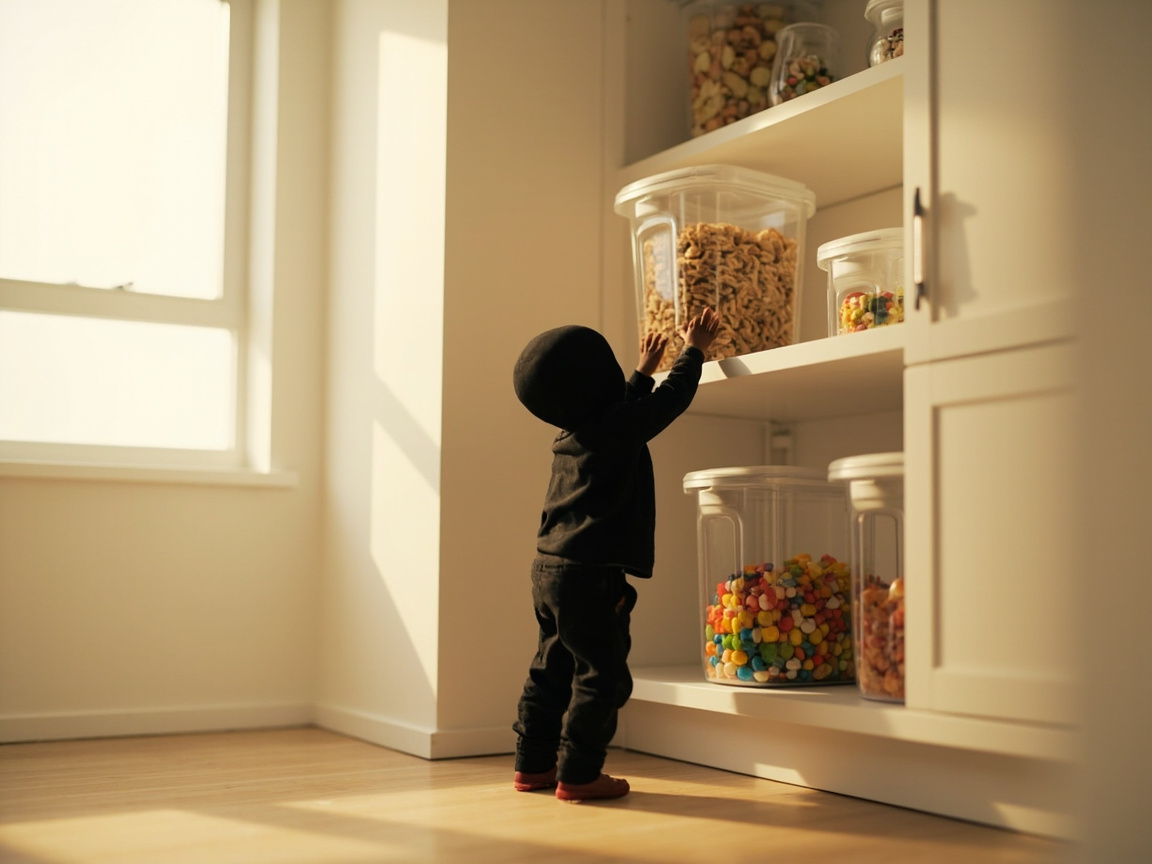
Place the heaviest or largest snacks on this shelf so a small pull does not topple the stack when kids help themselves. Adjust the shelf height to match what your child can actually reach without a stool.
Mid-shelf open-front snack organizer (24-32 inches)
The “open-front” design (tilted forward, open at the bottom) means kids can see all snacks at once without unstacking. The Vtopmart 4-Pack (P1) covers this with its built-in tilt feature when you stack 2 bins vertically. The compartment dividers also stop different snack types from mixing into one bin.
Zone 3 sub-zones at a glance
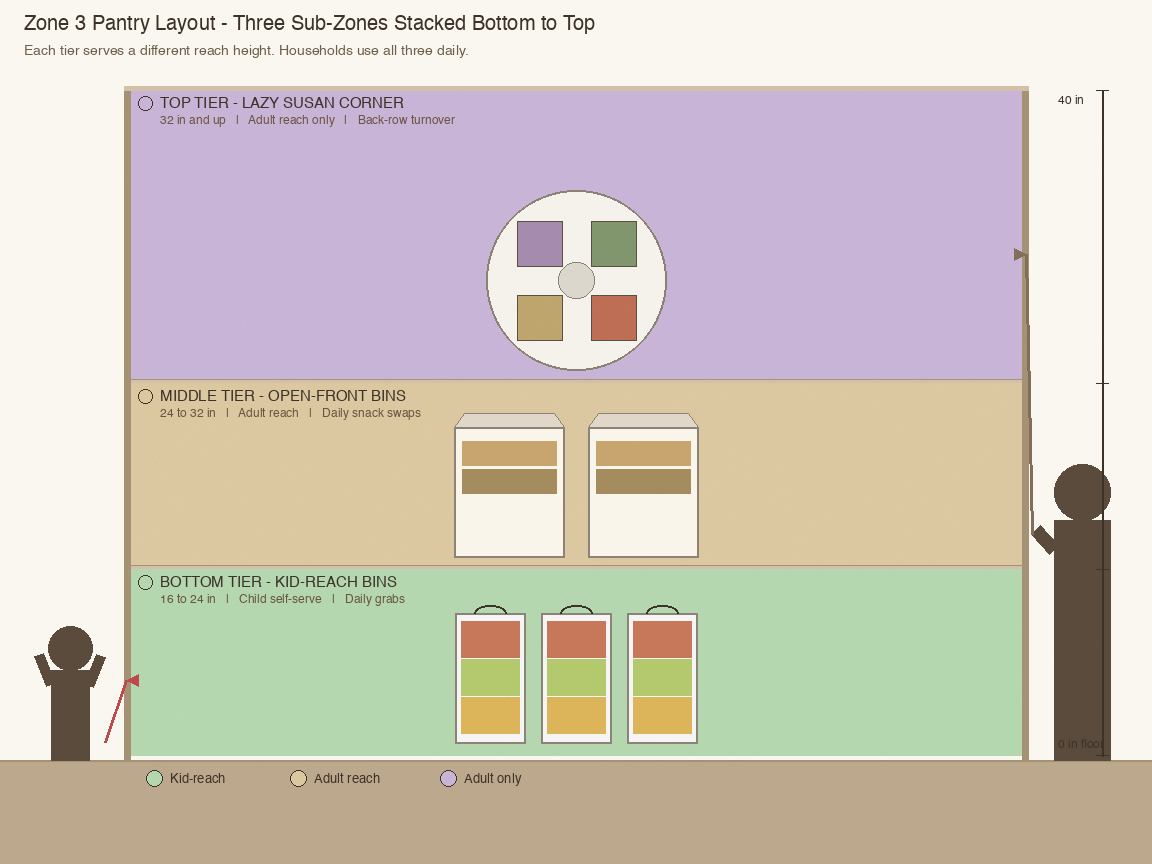
The bottom 16-24 inches is the kid-reach shelf, the 24-32 inch tier is the open-front row, and the corner shelf holds the lazy susan. Stacking the three sub-zones vertically uses the full 18-24 inch shelf height without losing the lower-shelf principle.
Lazy-susan corner for back-row reach
The deepest part of any pantry is the corner — if your pantry has a 90-degree turn, that’s where snacks disappear. A 12-inch lazy susan turntable on the bottom shelf turns “out of reach” into “rotate to reach.” Place taller items (cereal boxes, snack towers) on the lazy susan so rotating brings the next item to the front. The lazy susan also solves the “kids can only reach the front row” problem — they spin the turntable to access snacks at the back without climbing.
The Breakfast Zone: Zone 4 (Cereal + Granola)
Zone 4 sits on the mid-shelf (32-44 inches) — adult-eye-level for cereal access, directly above the kid-reachable Zone 3 below. Three container formats cover most households.
Airtight cereal containers with flip lids
The biggest cereal-storage upgrade is moving from “open box on shelf” to “sealed clear container with flip lid.” The Rubbermaid Brilliance Airtight Cereal Container (P3) — 32oz capacity, shatterproof BPA-free plastic — holds a standard 12-18oz cereal box with room for the inner bag. The hinged lid flips up for refilling and seals airtight for storage. The clear sides let you see the level so you stop buying duplicates.
Multi-pack airtight cereal set for variety households
If your household runs 3-4 cereal types (kid cereal + adult cereal + granola + oatmeal), a 4-pack airtight set covers all at once. The FOOYOO 4-Piece Cereal Containers (P4) — 135.2oz total capacity, BPA-free — holds four standard cereal boxes with the inner bags transferred in. Each container is identical in size, so the row stays uniform on the shelf.
OXO POP containers for cereal backup + granola
For smaller-quantity items (granola, trail mix, single-serve oatmeal packets), the OXO Good Grips POP Small Square (P7) — 3-piece airtight set with the signature push-button seal — gives you stackable backup containers. The POP button audibly clicks when sealed, which solves the “is this container actually closed?” problem that plagues most flip-lid containers.
Airtight vs open-box side by side
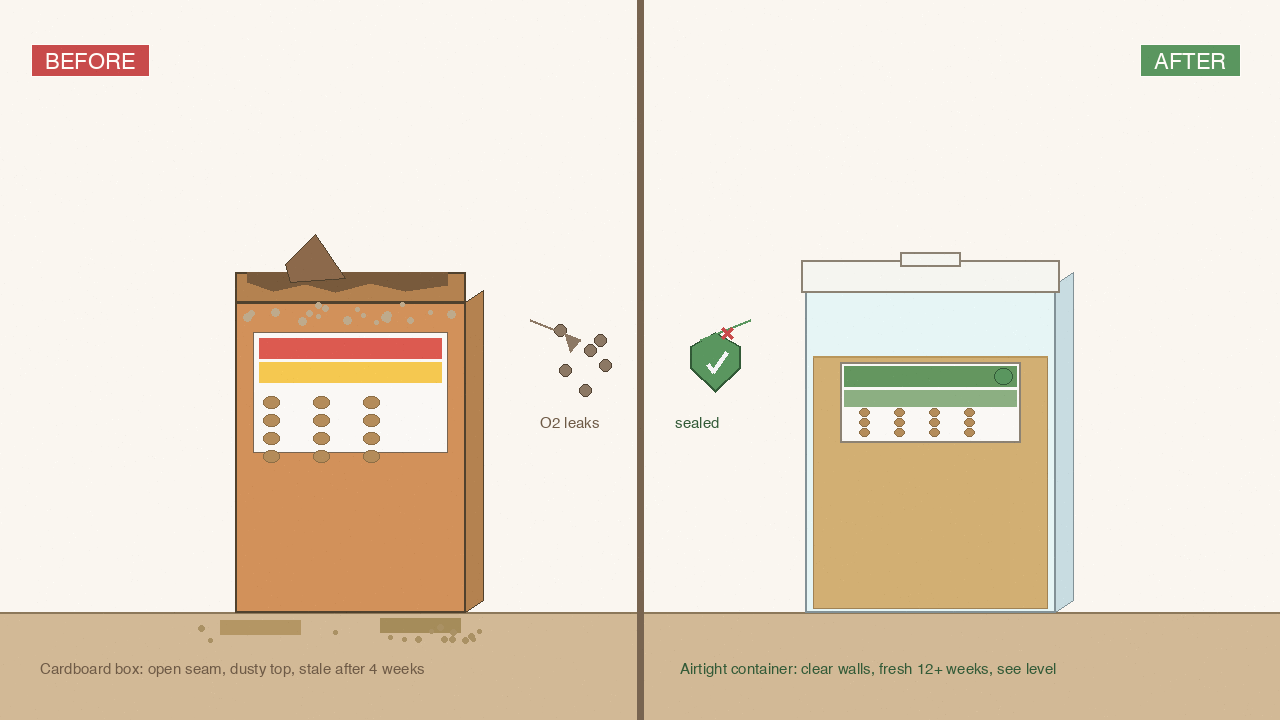
Open boxes leak air at the inner-bag seam and absorb humidity. Sealed containers block oxygen and humidity cycles and slow staling, so the cereal lasts past the printed best-by date. Clear sides also show the level, so you avoid running out mid-week.
Layout by Pantry Size
Different pantry sizes demand different snack zone setups. The four common scenarios map to the products above, so you can scale up or down without rebuilding the framework.
If you have a full pantry (24+ inches wide, 4+ shelves)
Use all three sub-zones in Zone 3: bottom-shelf kid bins (2-3 bins of the Vtopmart 4-Pack), mid-shelf open-front (2 bins), lazy susan corner (1). Zone 4 gets the full FOOYOO 4-pack cereal set plus 3-4 OXO POP backups for granola and oatmeal packets. Total cost: $100-$150. The pantry storage solutions guide covers broader pantry layouts for 24+ inch widths.
If you have a half-pantry (12-24 inches wide, 2-3 shelves)
Compress to two sub-zones: bottom-shelf kid bins only (skip the lazy susan — no corner space), mid-shelf cereal set. Skip the open-front organizer — you don’t have the vertical space. The Vtopmart 4-Pack handles the kid-reach shelf and the Rubbermaid Brilliance handles cereal for one main household type. Total cost: $50-$80. The small pantry organization guide covers 12-24 inch pantry layouts in detail.
If you have a snack cupboard (not a pantry)
A snack cupboard (linen-closet-height cabinet repurposed for snacks) uses the same Zone 3 logic but with over-door storage instead of shelf bins. The Moforoco 9-Tier Over-The-Door Pantry Organizer (P8) hangs on the back of a cupboard door and gives 9 tiers of basket storage — perfect for vertical-only space. Add 1-2 Vtopmart bins on the cupboard shelf for cereal and granola. Total cost: $40-$60 for the rack + 1-2 small bins. The small kitchen organization guide covers snack-cupboard layouts in cabinet-only kitchens.
If you have no pantry (cabinets only)
Use countertop-only solutions: the Munchkin Snack Catcher (P2) on the counter for daily kid snacks, the Rubbermaid Brilliance Cereal (P3) on the counter for breakfast cereal. Skip the lazy susan — counter space is at a premium. Total cost: $25-$40. The pantry can organization guide covers FIFO rotation patterns that also work in a small cabinet.
Pantry-size scenarios at a glance
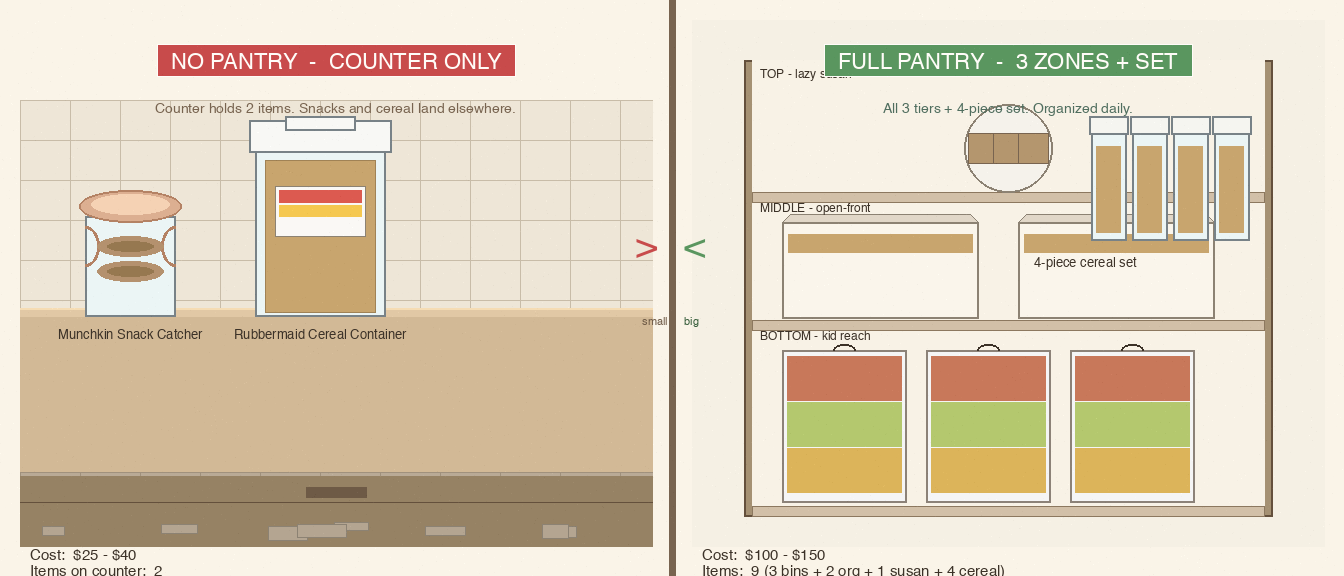
The left side shows a no-pantry household with the Snack Catcher + Rubbermaid on the counter. The right side shows a full pantry with the Vtopmart bins + FOOYOO set + lazy susan. Both work — the framework adapts to the space, not the other way around.
Safety + Labels: The Two Non-Negotiables
A snack zone with kids requires two systems: safety for the rest of the pantry, and labels so anyone (including a sleep-deprived parent at 6am) can find what they need.
Child-proof the upper shelves
Zone 3 is the kid-reachable zone; everything above (cereal bulk, baking supplies, oils) needs a child-proof barrier. The Suniry 12-Pack Invisible Baby Proofing Locks (P5) — no-drill adhesive latches — install in 30 seconds per latch and survive daily adult use. Apply to all upper-shelf cabinet doors and the pantry door if it’s a separate cabinet. This step happens before you open Zone 3 to kids, not after.
Label every container
Zone 3 + Zone 4 work when labels are uniform. The SUPVAN T50M Pro Bluetooth Label Maker (P6) prints labels from your phone via Bluetooth — perfect for printing matching labels across the whole snack zone in one session. Use one font, one size, one color scheme. The label goes on the front face of the container (not the lid), so you can read it when stacked.
Common Mistakes
Buying “kid-friendly” bins that don’t actually open easily
Many stackable bins have lids that snap shut and require two hands to open — defeating the purpose of a kid-reachable zone. Test any bin with a 3-year-old before buying. The Vtopmart 4-Pack passes this test — handles let kids grip and lids are removable, not snap-closed.
Putting the cereal back in its original box
The original cardboard box is the worst cereal container: it tears at the seam, absorbs humidity, and never reseals. Decanting into the Rubbermaid Brilliance or FOOYOO 4-pack slows staling past the printed best-by date and lets you see the level through the clear plastic.
Mixing kid snacks with baking supplies
Kids pull every bag off the shelf looking for fruit snacks. If the snack zone is mixed with flour, sugar, or other baking supplies (a 5-zone violation), you’ll have a flour explosion weekly. The pantry baking zone guide covers Zone 1 (baking ingredients) separately from Zone 3 (snacks) — keep them on different shelves with different containers.
Skipping the labels
Without labels, the snack zone becomes a guessing game: which bin has the crackers vs pretzels? When kids can’t read and parents are half-asleep, labels are the only reliable system. The SUPVAN T50M takes 15 minutes to label the whole zone — well worth the time.
Buying a snack zone before child-proofing
The leading mistake: installing the kid-reachable snack zone without first child-proofing the upper shelves. A 2-year-old who can reach the snack bin can also reach the cleaning supplies shelf two feet above. The Suniry 12-Pack child locks are non-negotiable before the snack zone goes live.
Maintenance: 30-Second Daily + Weekly Reset
A snack zone requires a tiny daily + weekly rhythm to stay organized.
Daily (30 seconds): Return any snack bin that got pulled to its shelf slot. Wipe the front face of the cereal containers — sticky fingers leave residue that attracts ants.
Weekly (5 minutes): Check Zone 3 expiration on fruit snacks + granola bars. Rotate the lazy susan to bring back-row items forward. Wipe the inside of any bin that had a leak or crumbs.
Monthly (15 minutes): Re-label any label that peeled. Refill cereal containers from the backup box. Reassess kid-reachability — we check whether our kid outgrew the bottom shelf, and if so, we move Zone 3 up one tier and re-child-proof the new bottom shelf.
Related Articles
- Kitchen organization hub — the main kitchen hub this snack zone connects to
- Pantry organization hub — the 5-zone system this snack zone sits inside
- KonMari method — the category-not-location principle that makes zone organization stick
- Pantry declutter reset — the deep-clean method to use before building the snack zone