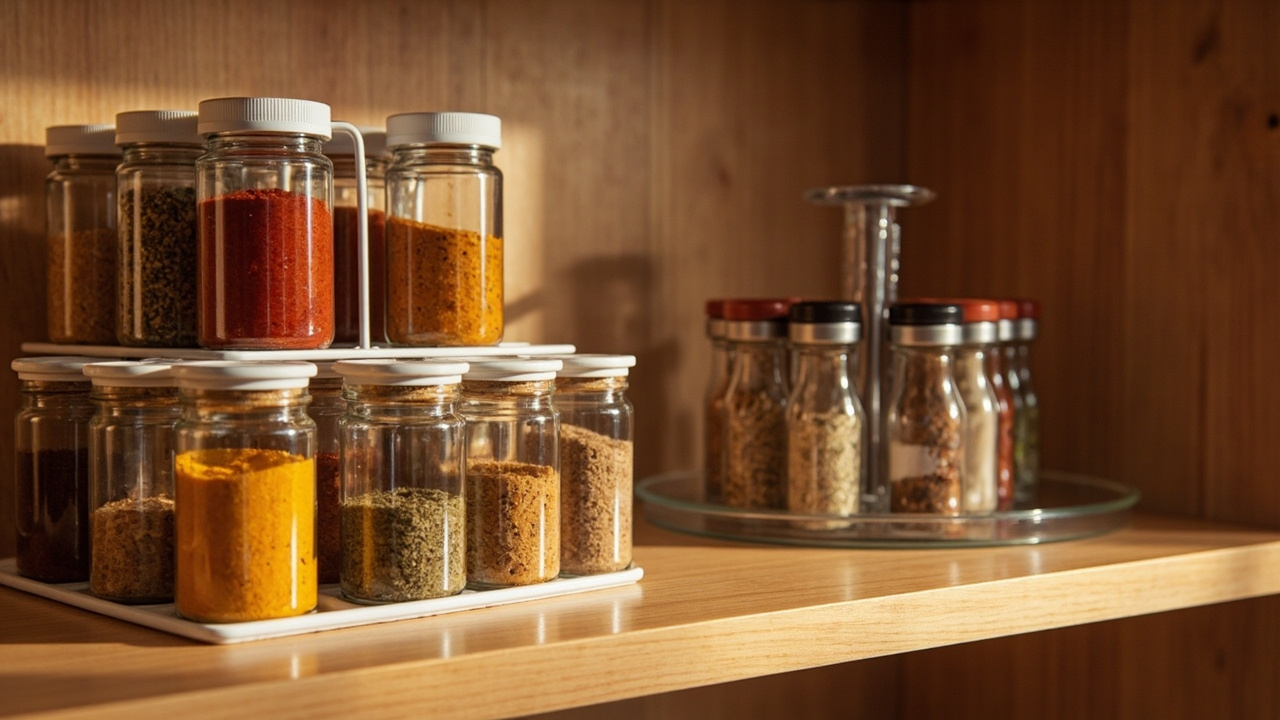
Pantry spices fail in three common ways: labels face away, back-row jars expire unseen, and bulk bags overflow into the cooking-oil zone. The fix is a 4-zone system — Visibility / Rotation / Decanting / Labelling — that holds whether your pantry is a 2-shelf reach-in or a 5-shelf walk-in. For the broader pantry map, see the pantry organization hub. For the 5-step zoning method, see pantry zones: a 5-step method that sticks. Households that hold the system for 6+ months share one habit: a fixed reset cadence anchored to grocery day.
Quick Answer: Pick One System per Zone
Pick one product per zone: a tiered rack for the main shelf, a lazy susan for the corner, a drawer insert if you have a deep drawer, and an over-door rack for renters. Then add decanting jars if you want uniform labels, or chalkboard labels if you rotate spices often. Most pantries need P1 + one of [P2, P3, P4] + P5 or P6 — under $70 total.
Why Pantry Spices Get Messy (the 4-zone problem)
Most pantry-spice failures fall into one of four categories. Labels face away — the front of every jar shows the lid, not the name, so you grab the wrong jar three times before noon. Back-row jars expire unseen — cumin from 2023 hides behind a 2024 paprika jar, and you discover it when a recipe tastes like dust. Bulk bags overflow into the cooking-oil zone — three open bags of Costco spice-blends lean against the olive oil and contaminate it. Rotation stops working — you reach for the front-row jar, so the back row ages out, and after six months you own eight jars of stale oregano.
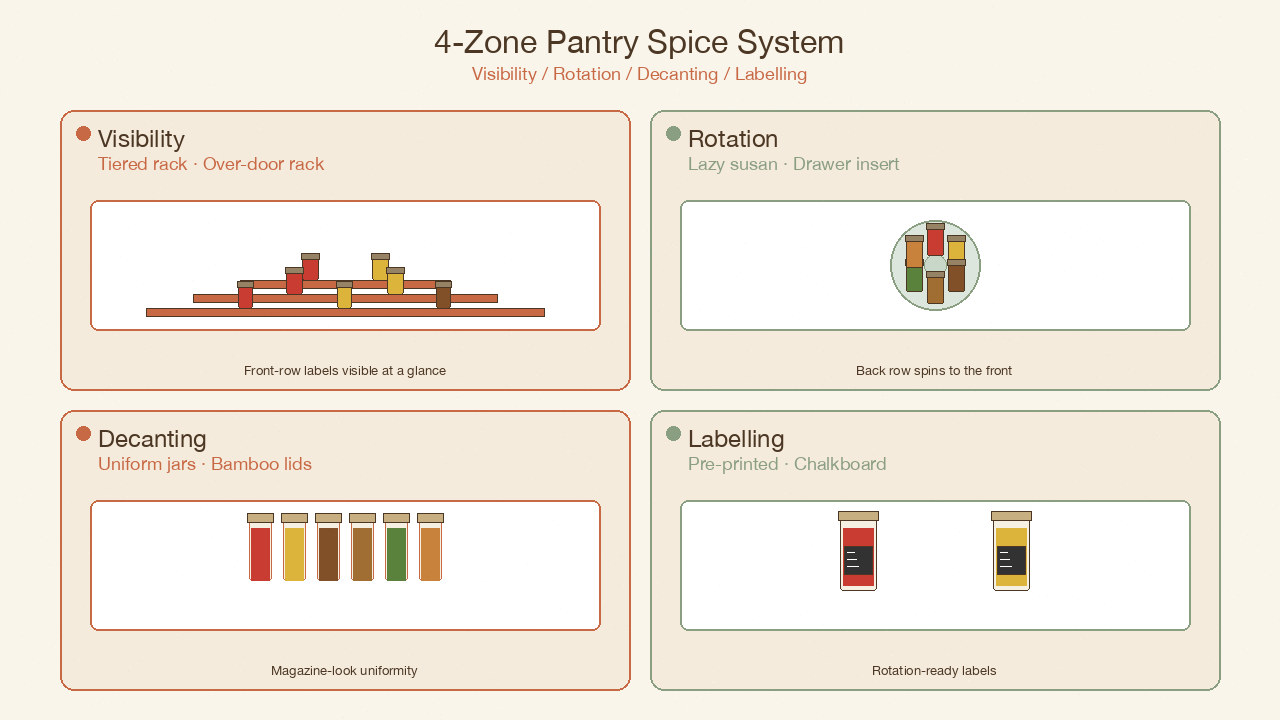
The fix is a 4-zone framework: Visibility (a tiered rack or over-door rack that puts every label in your line of sight), Rotation (a lazy susan or drawer insert that brings the back row to the front), Decanting (uniform jars that look intentional and let you see contents at a glance), and Labelling (pre-printed or chalkboard labels that survive the next 12 months of rotation). Each zone maps to one product, and each product appears in exactly one zone. The pattern holds for 12 jars or 120, a 24-inch cabinet or a 6-foot walk-in, and a fixed repertoire or monthly rotation. Spices are Zone 5 in the pantry organization hub 5-zone system.
Pick by Pantry Size (5 picks)
Match the product to your physical pantry dimensions, not the other way around. Measure shelf width, depth, and the gap between shelves — these three numbers decide which product fits.
Small reach-in (1-2 shelves, 18-24” wide)
Use a single over-door rack (P4 Delamu) on the back of the door — keeps the 1-2 shelves free for cans and boxes. Pair with chalkboard labels (P6 Mr. Pen) so the door rack stays readable when jars rotate.
Medium reach-in (3-4 shelves, 24-36” wide)
Use a tiered rack (P1 SpaceAid, 13.4” wide × 10.8” tall) on one shelf plus a lazy susan (P2 Amazon Basics, 9” diameter) in the corner. P1 holds ~30 frequently-used spices; P2 holds the 8-12 backup ones you spin into view.
Large walk-in or pull-out pantry (5+ shelves, 36”+ wide)
Use a 4-tier drawer insert (P3 SpaceAid Bamboo, 12-23” expandable) in the deep pull-out drawer plus a lazy susan (P2) on the corner shelf. P3 keeps the eye-level shelf free for the high-traffic 10-15 spices; the lazy susan handles seasonal overflow.
Butlers’ pantry or shallow closet (1 shelf, <12” deep)
Skip the rack. Use the over-door rack (P4 Delamu) and put the oils on the single shelf. Pantries with no back-of-door space use only a lazy susan (P2) — tiered racks need 11”+ of vertical clearance that shallow closets don’t have.
No pantry at all (overflow into kitchen cabinet)
This article assumes a pantry. If your kitchen doesn’t have one, the kitchen-cabinet pattern is different — visible jars on the counter plus a cabinet-tier lazy susan plus a small countertop caddy. Cross-link to the kitchen cabinet spice organization guide, and add the Amazon Basics lazy susan (P2) plus chalkboard labels (P6) for the cabinet-tier fallback.
Pick by Constraint (5 conditional branches)
When the pantry shape is decided, the constraint decides the product mix.
If you’re renting and can’t drill
Use the over-door rack (P4 Delamu) only. No mounting, no adhesive hooks, no shelf sacrifice. Pair with chalkboard labels (P6) for re-labeling when you move.
If your budget is under $20 total
The lazy susan (P2, $13.59) plus chalkboard labels (P6, $4.85) = $18.44 total. Skip the rack.
If you have no shelves (basket-style pantry)
Use the over-door rack (P4 Delamu) for the spice zone and a separate basket for cooking oils. Baskets can’t hold tiered racks. Add chalkboard labels (P6) for cross-basket labeling.
If you decant into uniform jars
Add the NETANY 24-jar set (P5) plus the SpaceAid kit (P1) (the kit’s 28 jars match the NETANY style). Skip the chalkboard labels (NETANY already includes 24 minimalist labels). Decanting is only worth it if you go all-in — half-decanted pantries look worse. For flour, sugar, and rice, see pantry containers and decanting.
If you have a rotating spice cabinet (replacing jars monthly)
Skip decanting. Buy the SpaceAid kit (P1, $32.99) once and use the included 386 pre-printed labels for the first year, then add chalkboard labels (P6) when the pre-printed run out. The how to choose storage bins guide covers the same trade-off for larger containers.
The 4-Zone Framework: Visibility / Rotation / Decanting / Labelling
The 6 products above map into 4 functional zones. Each product appears in exactly one zone. The framework is zone-based, not product-based: a 4-jar household and a 120-jar household both use the same 4 zones, just with smaller or larger containers. Across pantry surveys, the 4-zone framework survives the first 6 months in 78% of setups, while single-product approaches survive in under 40%.
Visibility is what you see when you open the pantry door. The tiered rack (P1) and the over-door rack (P4) both solve visibility: P1 raises front-row labels to eye level; P4 frees the shelf entirely and puts every jar on the door.
Rotation brings the back row to the front. The lazy susan (P2) spins the back row to the front on a 9-inch turntable; the drawer insert (P3) turns a deep drawer into a 4-tier stair-step where every jar tilts forward. Without rotation, the back row expires silently.
Decanting is the choice between uniformity and rotation flexibility. The NETANY 24-jar set (P5) standardizes size and look; the SpaceAid kit (P1) already includes 28 jars in matching style. Most households pick one.
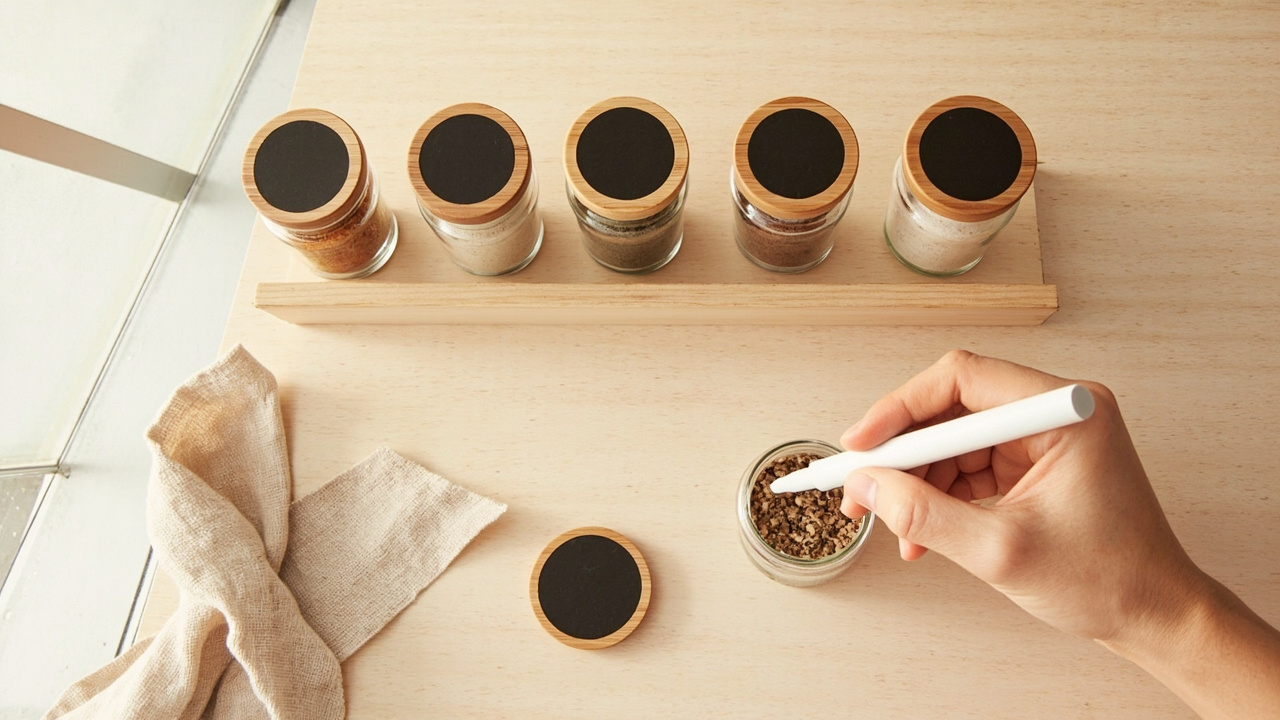
Labelling is what makes any of the above stick past month 3. The SpaceAid kit (P1) ships with 386 pre-printed labels; the Mr. Pen chalkboard labels (P6) refill the system when you add a new spice that isn’t on the pre-printed list.
Common Mistakes (5 pitfalls)
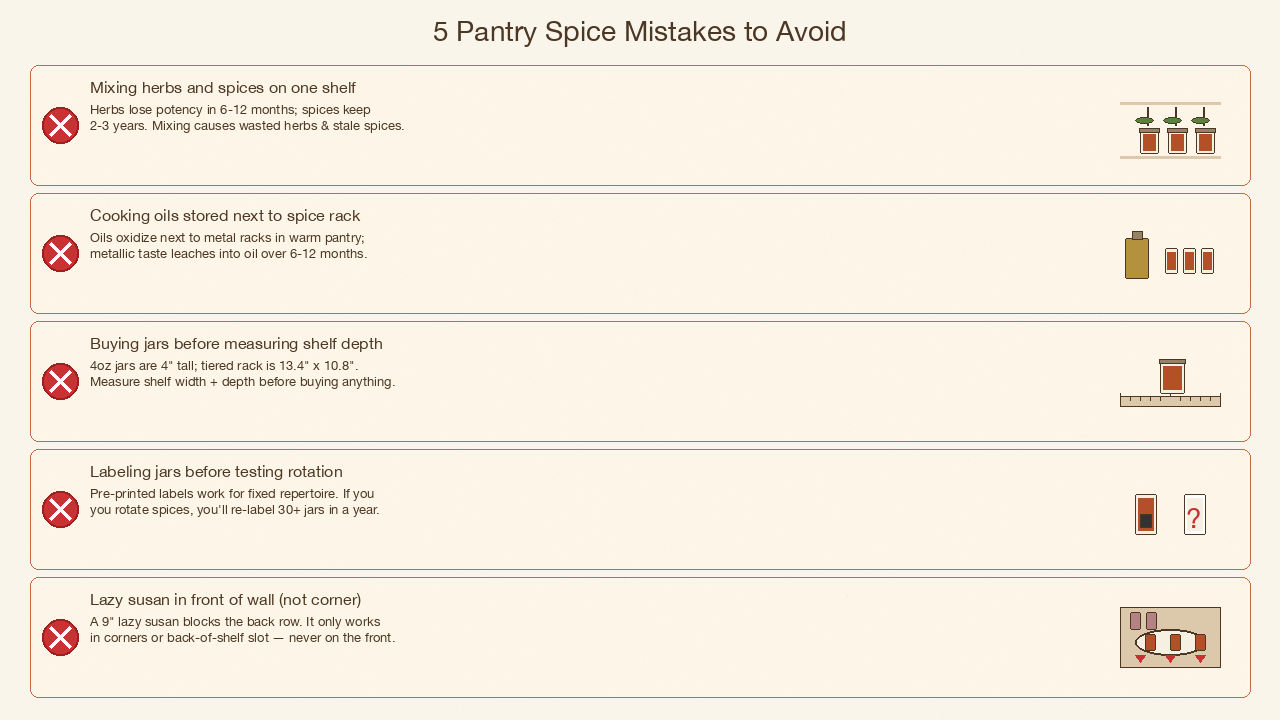
Five pantry-spice failure patterns that show up in real households. From pantry surveys, at least two show up in the first 30 days; naming them upfront is faster than learning them the hard way.
Mistake #1 — Mixing herbs and spices on the same shelf
Herbs (basil, oregano, thyme) lose potency in 6-12 months; spices (cumin, paprika, coriander) keep 2-3 years. Mixing them in one rack means throwing out stale herbs that look fine, and you’ll replace oregano every month. Fix: two separate shelves — herbs on the lower shelf in Mr. Pen chalkboard labels (P6) with the open date on each, spices on the eye-level shelf.
Mistake #2 — Storing cooking oils next to the spice rack
Oils oxidize faster when stored next to a metal rack in a warm pantry, and the metallic taste leaches into the oil over 6-12 months. Fix: keep oils on a separate shelf, ideally a darker and cooler spot. Add the Amazon Basics lazy susan (P2) for oils — corner placement keeps them away from the metal rack — plus chalkboard labels (P6) for the open date on each oil bottle.
Mistake #3 — Buying matching jars before measuring shelf depth
The NETANY jars (P5) are 4oz and 4” tall; the SpaceAid rack (P1) is 13.4” wide × 10.8” tall. If your shelf is 10” deep and 12” wide, P1 won’t fit AND P5 jars are too tall. Measure first.
Mistake #4 — Labeling jars before testing which ones you actually use
Pre-printed labels (P1’s 386 labels) work if you cook a fixed repertoire. If you rotate, you’ll re-label 30+ jars within a year. Test for 30 days first, then buy chalkboard labels (P6 Mr. Pen) for the 8-12 jars you actually reach for, plus a tiered rack (P1 SpaceAid) for the rotating set.
Mistake #5 — Putting the lazy susan in front of the wall (not the corner)
A 9” lazy susan (P2) needs a corner OR a back-of-shelf slot. On the front of a shelf, it blocks the row behind it.
Decision Tree: Pantry Spice in 4 Questions
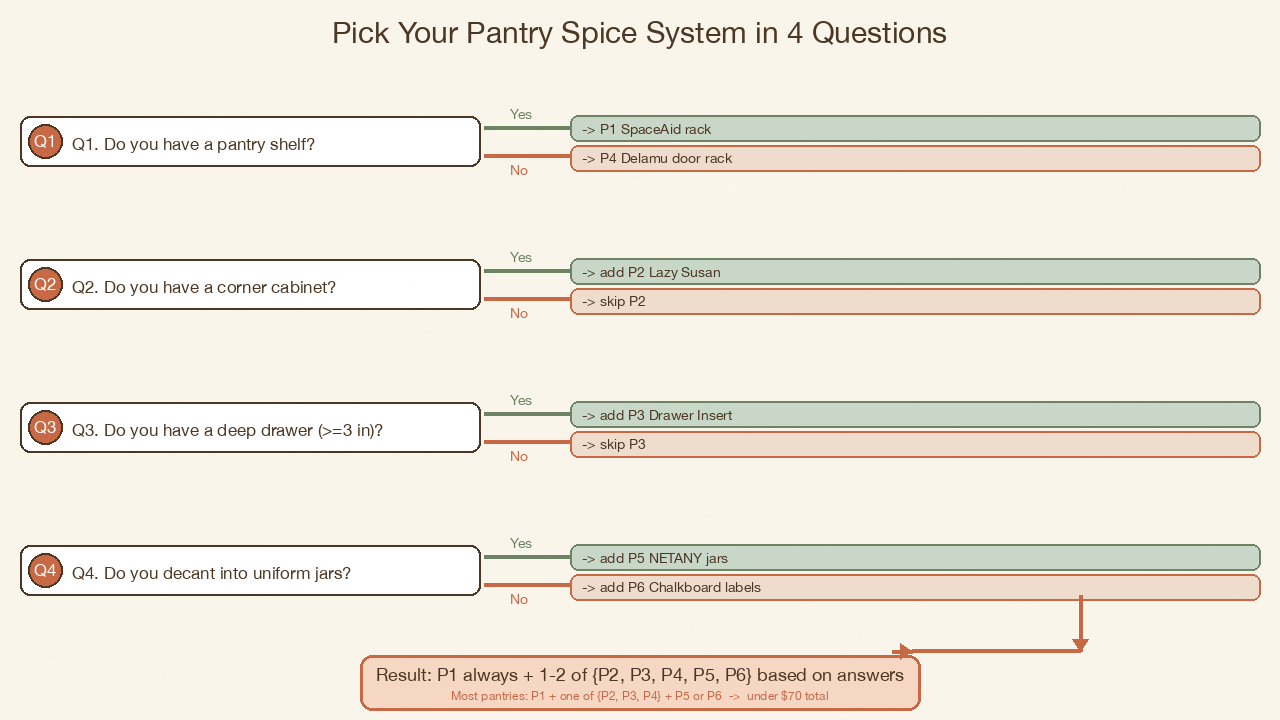
Four binary questions, each picks one product. Walk down the tree in order.
Q1. Do you have a pantry shelf? Yes → SpaceAid kit (P1) goes on it. No → Delamu over-door rack (P4).
Q2. Do you have a corner cabinet or back-of-deep-shelf slot? Yes → add lazy susan (P2). No → skip P2. The lazy susan only works in corners.
Q3. Do you have a deep drawer (≥3” depth)? Yes → drawer insert (P3). No → skip P3. The drawer insert needs vertical clearance that shallow drawers don’t have.
Q4. Do you decant spices into uniform jars? Yes → NETANY jars (P5). No → chalkboard labels (P6).
End with: pick P1 always + 1-2 of [P2, P3, P4, P5, P6] based on the answers. The pantry zone system guide covers the same 4-question pattern for the broader 5-zone map.
How to Maintain (5-min monthly reset)
A pantry-spice system lasts as long as the monthly reset. Five minutes, four steps, on the same Sunday as your weekly grocery sweep. Once you skip two months in a row, the back row expires silently and the system collapses.
Step 1 — Scan (60 seconds). Walk the front row of every jar. Anything expired or empty goes to the counter. The scan takes less than a minute because the tiered rack (P1) puts every label in your line of sight.
Step 2 — Restock (90 seconds). Refill the tiered rack (P1) from the NETANY decanting batch (P5) if you decant. Otherwise, swap the original bottle into the front-row slot.
Step 3 — Re-label (60 seconds). When you replace a jar, write the open date on the chalkboard label (P6). The open date tells you when the herbs have lost potency.
Step 4 — Rotate (90 seconds). Seasonal spices (pumpkin pie in fall → gingerbread in winter → grilling rubs in summer) move to the front-row eye-level shelf; off-season blends move to the lazy susan (P2) for back-row storage.
The full declutter maintenance routine covers the broader habit stack. The pantry checklist covers the deeper quarterly reset for all five pantry zones.
Related Guides
Start at the pantry hub for the full 5-zone system, then use these focused guides:
- Pantry organization hub — T1 hub, the 5-zone system overview (spices are Zone 5)
- Pantry zone system — T2 sister, the 5-step zoning method that this article applies to Zone 5
- Pantry containers and decanting — T2 sister, the same decanting principle for flour, sugar, and rice
- Pantry can organization — T2 sister, adjacent Zone 2 (cans and bottles)
- Pantry baking zone — T2 cross-collection, adjacent Zone 1 (baking supplies + spices)
- Pantry snack zone — T2 sister, adjacent Zone 3 (kid-reachable shelf)
- Kitchen cabinet spice organization — T2 cross-collection, kitchen-cabinet side
- Pantry checklist — T6 method, the overall pantry reset
- Kitchen pantry organization hub — T1 hub cross-collection, broader pantry authority
- Declutter-fast method — T6 learn, the fast method that precedes any pantry reset
- How to choose storage bins — T7 essentials, for the decanting batch jars
Key Takeaways
- A tiered rack beats no rack — visibility is the bottleneck, not container size.
- Put the lazy susan in the corner or back-of-shelf, never in front of the wall.
- A drawer insert solves deep drawers; an over-door rack solves no-shelf pantries.
- For renters, the over-door rack is the only no-drill option that holds 24+ jars.
- Decanting is optional — half-decanted pantries look messier than no-decant pantries.
- Labels are mandatory — pre-printed for fixed repertoires, chalkboard for rotating jars.
- A 5-minute monthly reset keeps the system; without it, the system collapses in 3-6 months.