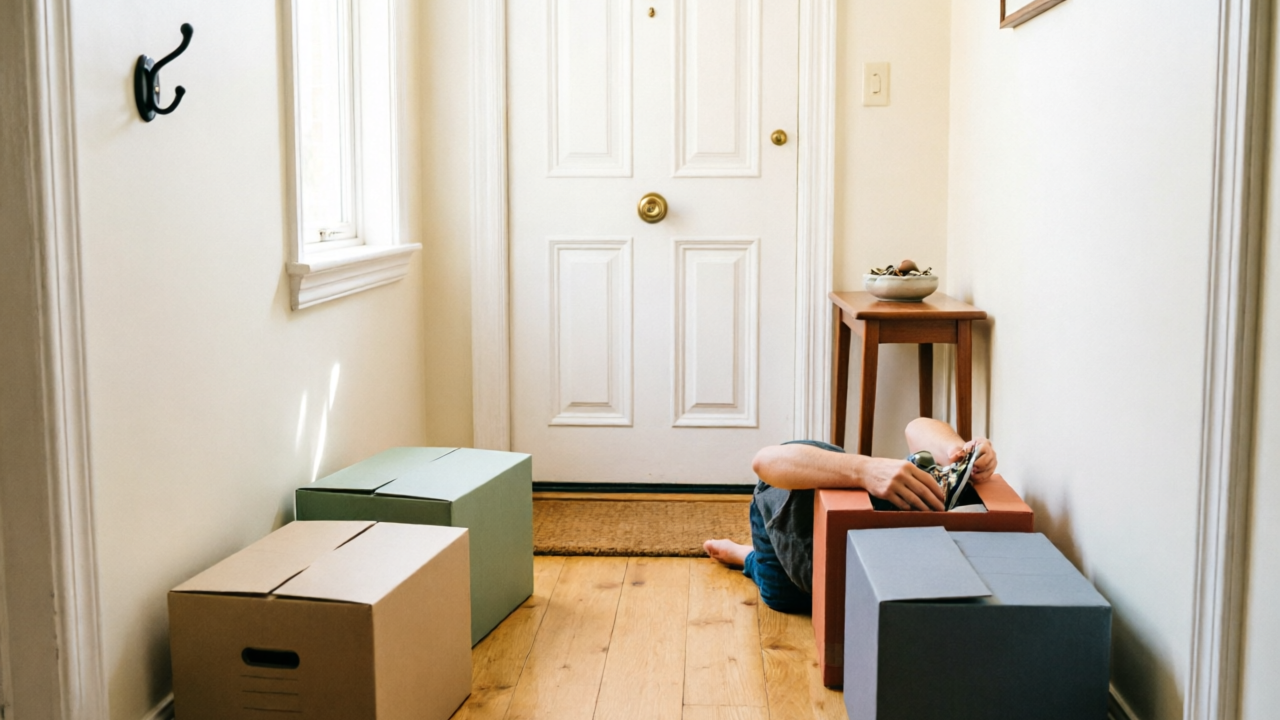
The entryway is the highest-traffic zone in the house, and it backslides faster than any other room because every departure and arrival cycles through it. Most households treat it as a 2-minute drop zone: keys, mail, bag, shoes, jacket — all in 30 seconds before leaving. The fix isn’t more hooks or more baskets. The fix is to declutter first, then build a 4-zone system that holds what survives. This article walks through a 5-step method (15-minute to weekend variants), 5 if-then constraint scenarios, and a maintenance rhythm.
If you haven’t done a whole-home declutter, start with the 7-day declutter sprint. For the broader system context, see the entryway organization hub and the entryway hub.
Why Entryways Get Cluttered
The 2-Minute Drop-Off Problem
Most entryways weren’t designed to absorb 5+ decision categories in 30 seconds. Keys, mail, bags, shoes, jackets, leashes all need a home within arm’s reach, but the home doesn’t exist yet. The pile forms on the nearest flat surface. The problem isn’t laziness — it’s that no one has emptied the entryway and asked, “what actually needs to live here?”
The “Just a Hook” Trap
Adding hooks or baskets without first decluttering is the most common failure on r/declutter. The pile moves; the clutter doesn’t. Storage bought before decluttering never fits the post-declutter volume. Reverse the order: declutter first, then buy the 4-zone system.
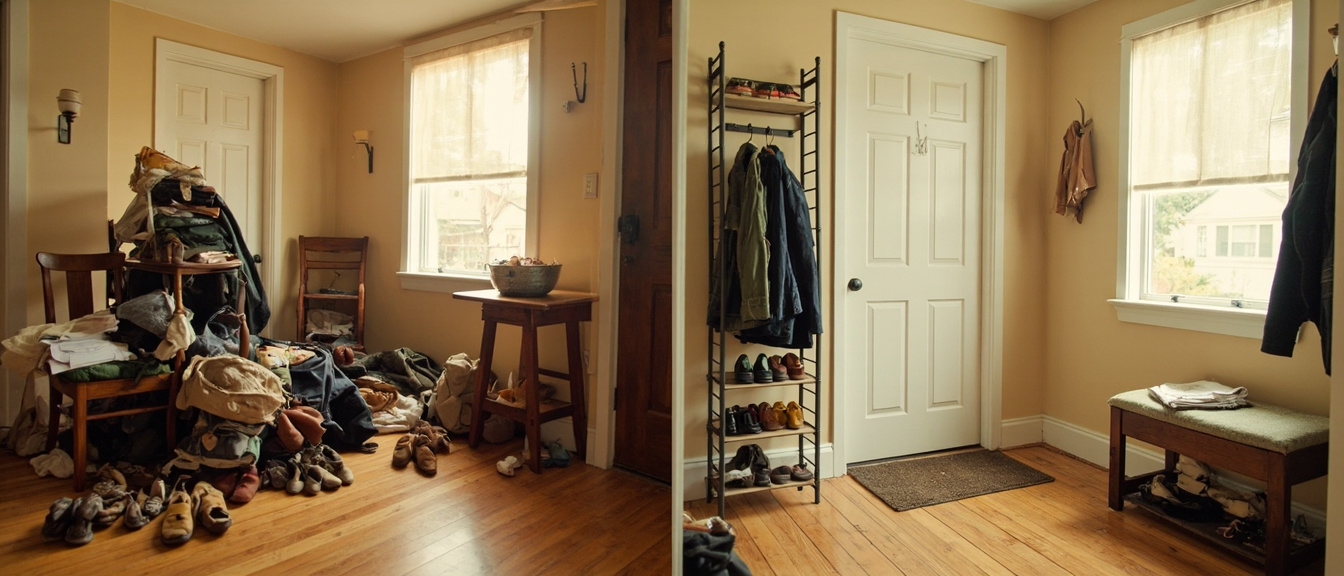
The 4-Zone Map You’ll Build Toward
The 4-zone system (Drop Zone, Shoe Zone, Coat Zone, Bench Zone) is the canonical layout for every entryway. It’s the destination for everything that survives the declutter.

What You’ll Need
These five products cover the 4 zones. Buy them only after Step 2 below — buying storage before decluttering is Mistake #1.
1 Console for the Drop Zone — HOOBRO 29.5” Narrow Console ($41.99)
The HOOBRO 29.5” Narrow Console gives you 2 fabric drawers plus 3-tier mesh shelves in a 29.5-inch footprint — mail, keys, wallet in one place.
1 Key Holder for the Drop Zone — Rebee Vision Farmhouse Key Holder ($18.98)
The Rebee Vision Farmhouse Key Holder is a wall-mounted 5-hook rack with a built-in mail slot. Best for sub-30-inch walls or renters.
1 Vertical Shoe Tower for the Shoe Zone — LANTEFUL 10-Tier ($16.99)
The LANTEFUL 10-Tier Shoe Tower holds 20-25 pairs in an 11.8-inch depth with side hooks for bag and leash.
1 Over-Door Hook for the Coat Zone — LYNK Professional Over-the-Door Hooks ($25.99)
The LYNK Professional Over-the-Door Hooks put 9 staggered hooks across 2 tiers — zero wall damage. Best for rentals.
1 Storage Bench for the Bench Zone — HOMSHO 4-Barn-Door Storage Bench ($119.99)
The HOMSHO 4-Barn-Door Storage Bench gives you a padded seat cushion plus 4 barn doors plus 8-12 pairs of hidden storage.
Total “What you’ll need” cost: $224.94 (after declutter, not before — Mistake #1 below explains why).
The 5-Step Entryway Declutter Method
Four entryway sister articles cover products, zones, or small-space. None cover process. Each step below is action-oriented with a time budget so you can pick your depth.
Step 1 — Empty the Entryway Completely (15 minutes)
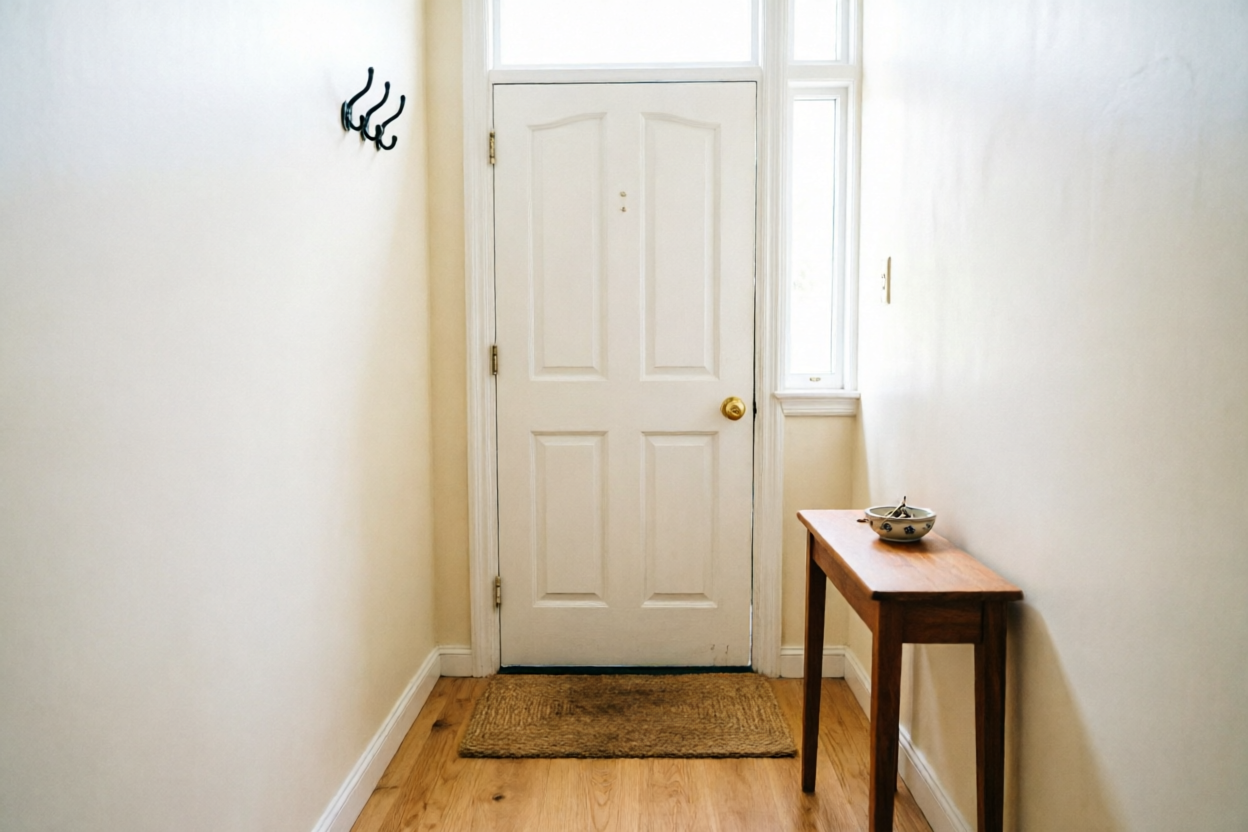
Move every item to the living room floor — coats, shoes, bags, mail, baskets, hooks, decorative items, the junk bowl, the lone glove, the umbrella stand. The empty entryway reveals the architecture: the wall color, the floor, the door swing arc. You can’t triage in a cluttered space because the clutter biases what you keep. Photograph the empty state for the before/after moment — many readers return to this photo 6 months later. Sweep and vacuum too; many entryways have 6+ months of grit under shoe piles.
Step 2 — Triage Into 4 Piles (15 minutes)
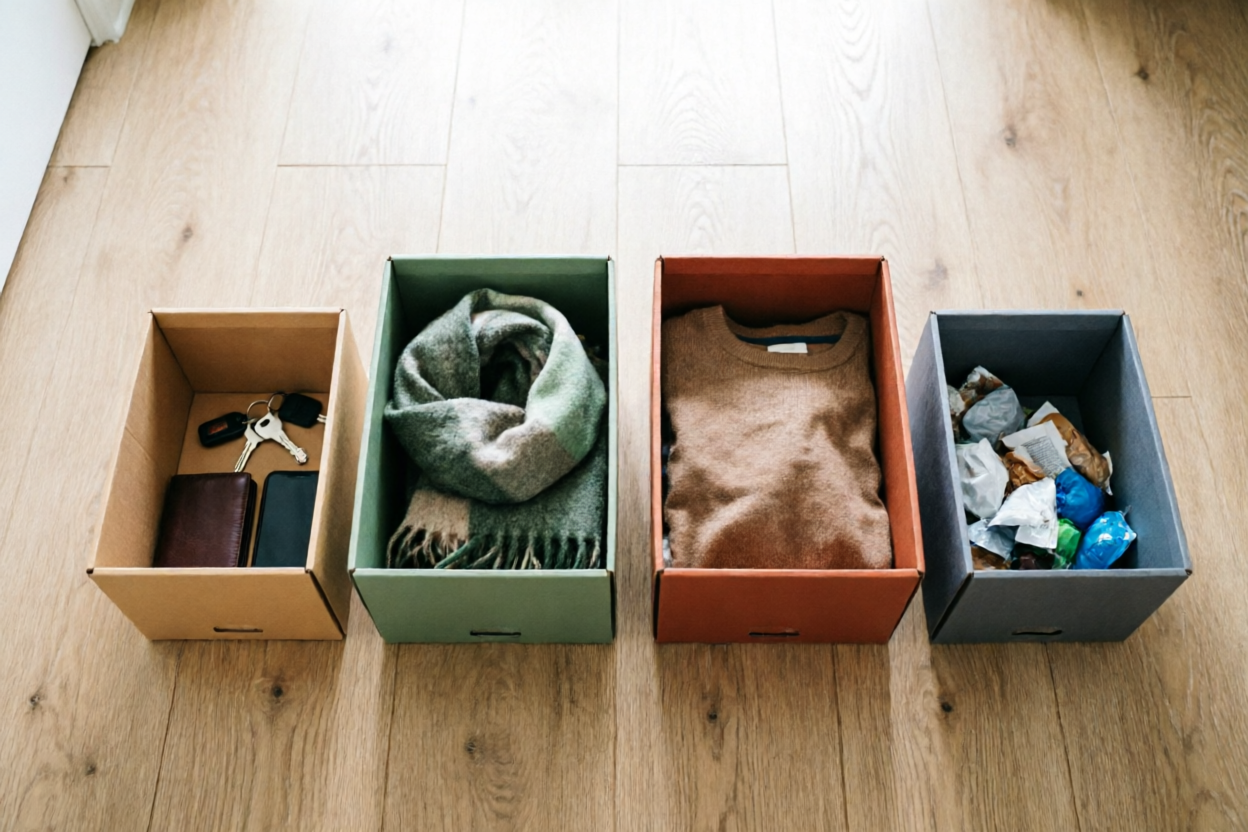
With the entryway empty, sort everything into four labeled boxes.
- Keep pile — used in the past 7 days. Your “daily rotation.” 90% of entryway volume lives here.
- Relocate pile — used weekly but not daily. Seasonal coats go to the bedroom closet, overflow shoes to the main wardrobe.
- Donate/Sell pile — good condition, not used in past 12 months. The “I might need this someday” pile — most of it, you won’t.
- Trash pile — broken, expired, single items. The lone glove, expired coupons, the pen that doesn’t write.
Triage moves fast. Don’t negotiate on each item yet — that’s Step 3. The goal is to separate the four categories visually. If you find yourself hesitating on more than 3 items in a row, you need the 12-month rule, which Step 3 provides.
Step 3 — Apply the KonMari Joy Check to Each Item (20 minutes)
Now the negotiation step. The KonMari Joy Check is the formal decision framework — pick up each item and ask, “Does this need to be HERE, or by my bed?” Keys and wallet by the door make sense. A stack of old mail does not.
For coats, bags, and shoes, apply the 12-month rule: have you worn or used this in the past 12 months? If not, it goes to Donate. The “but I might wear it next winter” exception only counts for items you actually wore in the last 12 months. For decorative items, ask whether it makes you smile or stress you. Many entryway decorations are inherited guilt — the wedding card, the unused vase, the framed photo you walk past without seeing. The entryway isn’t a museum.
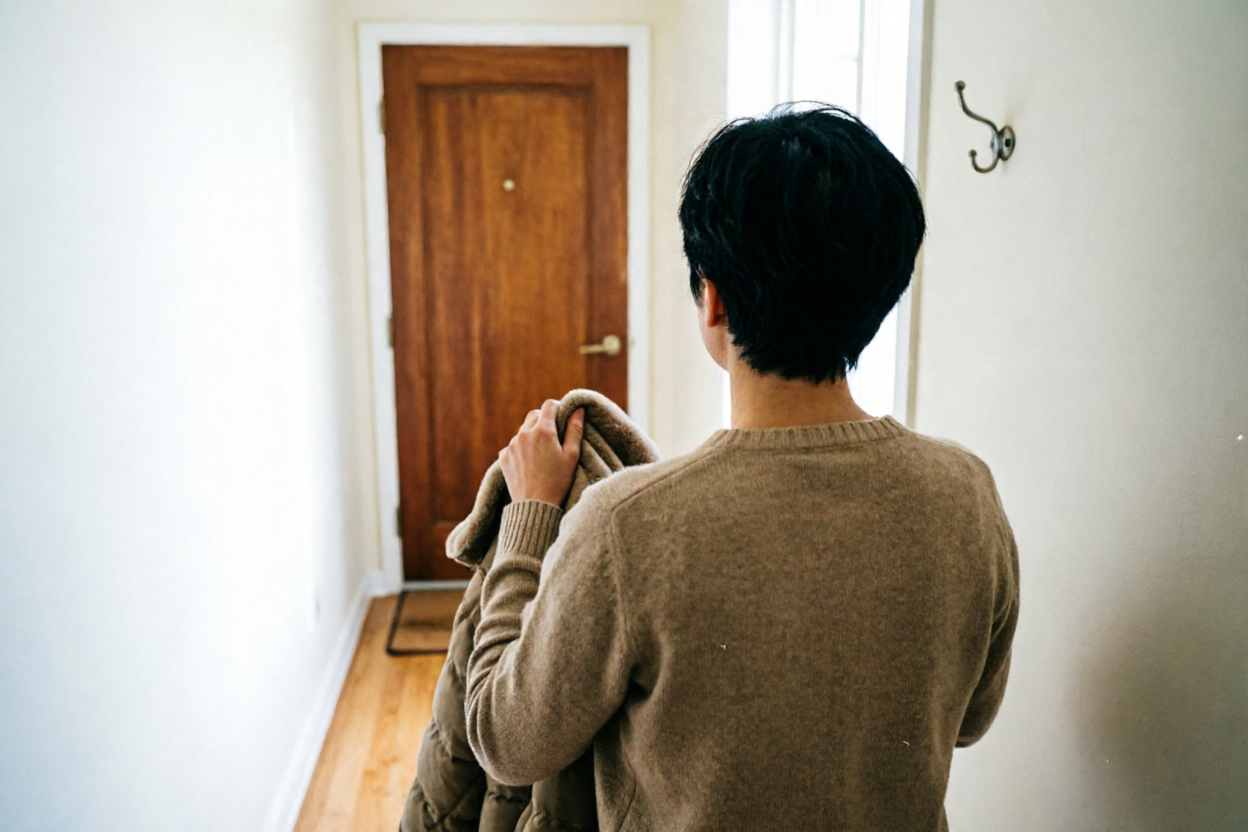
Step 4 — Return Items to the 4-Zone System (20 minutes)
The Keep pile now has a destination for each item. Map it to the 4-zone layout.
- Drop Zone — keys, mail, wallet, phone. Use the Rebee Vision key holder for wall-only or the HOOBRO console for floor-standing.
- Shoe Zone — daily footwear only, 3-5 pairs per person. Use the LANTEFUL tower or see entryway storage solutions.
- Coat Zone — jackets, hats, scarves, leashes. Use the LYNK over-door for rentals or wall hooks for owned. See entryway shoes + coats organization for combos.
- Bench Zone — seasonal overflow, slippers, kid shoes. Use the HOMSHO 4-barn-door bench for seating + storage.
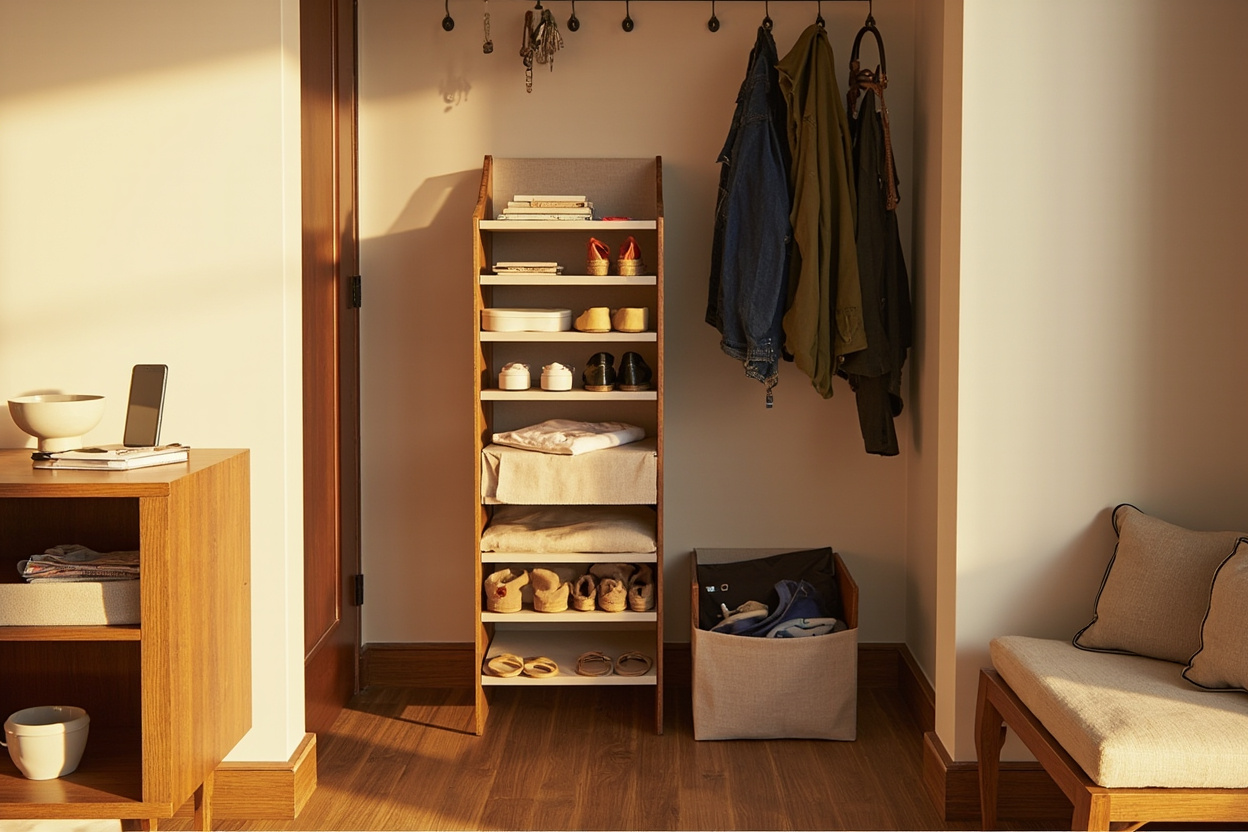
Step 5 — Set a Maintenance Rhythm (10 minutes setup)
The declutter is half the work. The other half is keeping it. KonMari’s principle “maintenance is the method” applies most to the entryway because it’s the highest-traffic zone.
- Daily Reset (2 minutes before bed) — keys on the hook, shoes in the rack, mail sorted. Single highest-ROI 2 minutes in the day.
- Weekly Tidy (Saturday 10 minutes) — clear surfaces, vacuum under the shoe rack, check the LANTEFUL tower for overflow. See the declutter maintenance routine.
- Monthly Audit (first Sunday) — relocate items that drifted back. The 30-day rule: anything still in the entryway after 30 days is permanent.
Choose Your Timeline: 15-Minute / 1-Hour / Weekend Variants
Pick the depth that matches your situation.
- 15-Minute Micro — skip Step 3, triage fast, return to 4-zone. Best for daily-reset mode or post-vacation pickup.
- 1-Hour Focused — full 5 steps but skip the 4-zone audit. Best for monthly tune-up.
- Weekend Deep — full 5 steps + buy 1-2 new storage pieces + 30-day maintenance commitment. Best for first-time declutter.
Constraint Guide by Scenario
Real entryways don’t all look the same. Pick the scenario that matches yours — each path uses a different subset of the 5 products above.
If You Rent and Cannot Drill Walls
Use the LYNK over-door hooks plus a freestanding HOOBRO console plus the HOMSHO bench — no wall mount needed. Skip the Rebee Vision key holder unless your lease allows small nail holes. See entryway storage solutions.
If Your Entryway Is Under 36 Inches Wide
Wall-mounted only: Rebee Vision key holder plus LANTEFUL shoe tower plus LYNK over-door. Skip the HOOBRO console — too wide for a sub-36-inch lane. See the small entryway guide.
If You Have No Closet at All
Build all 4 zones with freestanding furniture: HOOBRO console, LANTEFUL shoe tower, LYNK hooks, HOMSHO bench. Total: $204-260. The entryway 4-zone system covers the framework.
If Kids Use the Entryway Daily
Add a kid-height hook row at 42-48 inches (use a second LYNK on the lower door) plus a low cubby for school bags. Use the HOMSHO bench for kid shoes and the LANTEFUL for adult shoes. The Daily Reset is non-negotiable.
If the Total Budget Is Under $50
Buy the LANTEFUL 10-tier ($16.99) plus Rebee Vision key holder ($18.98) = $35.97. Add 1 LYNK over-door ($25.99) = $61.96 — covers 3 of 4 zones. Defer the HOOBRO and HOMSHO — 2nd-phase. See declutter on a budget.
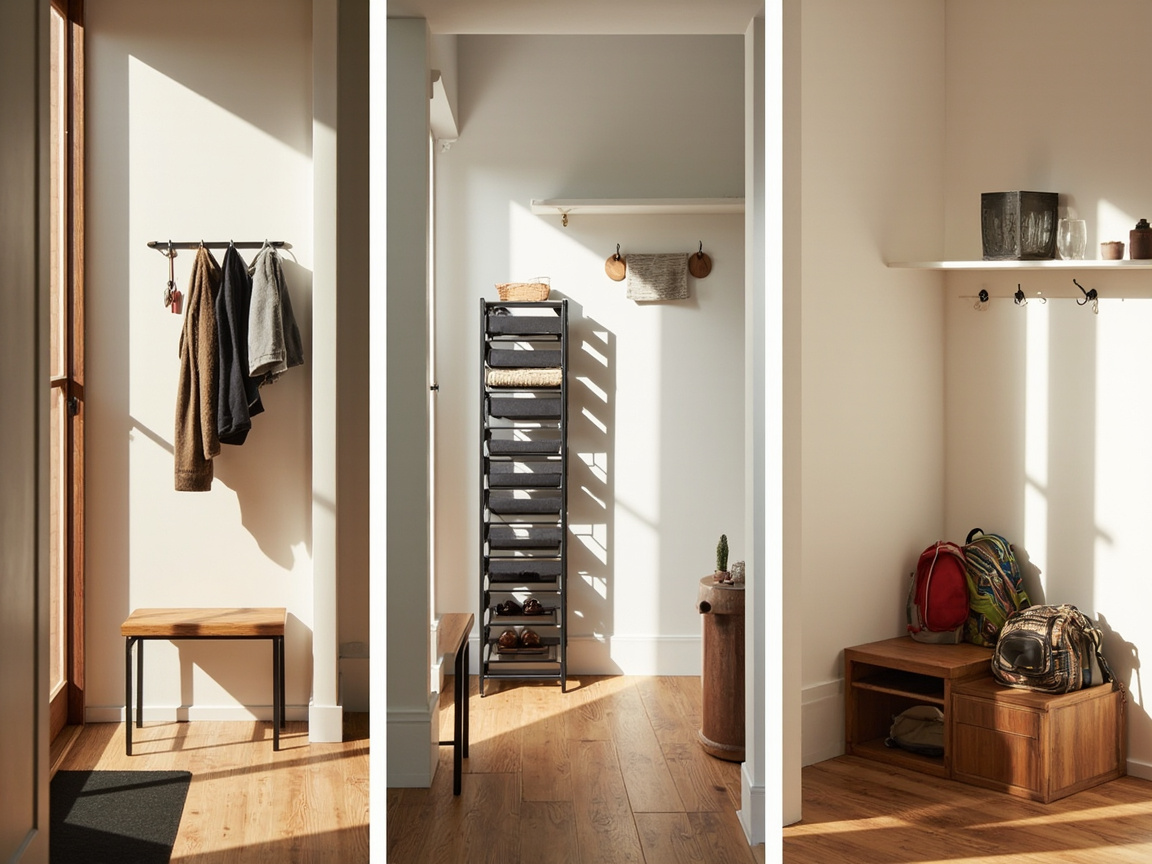
Common Mistakes
These failure patterns show up on r/declutter and r/organizing. Read them before you start.
- Buy storage furniture BEFORE decluttering. Most common error. Reddit pattern: “I bought a 30-pair shoe rack and I only have 12 pairs after I decluttered.” Always declutter first, measure what survives, then buy.
- Treat entryway as long-term storage (not daily transition zone). The entryway is a 2-minute drop zone, not a coat closet. Anything that doesn’t earn daily use should be relocated to bedroom or main wardrobe.
- Skip the seasonal rotation step. A winter coat that lives in the entryway from November to March takes up daily-drop-zone space for the other 9 months. Rotate seasonal items out — see the Seasonal Refresh below and seasonal closet rotation.
- Forget the kids zone in family entryways. Default adult ergonomics ignore that kid-height hooks at 42-48 inches are the difference between “kids hang up their jacket” and “kids drop their jacket on the floor.”
- Declutter once and never maintain. The Daily Reset from Step 5 is non-optional — without it, you’ll be back to Step 1 within 3 months.
Seasonal Refresh
The entryway is the “front line” of seasonal clothing migration. Two resets per year keep the system from drifting back.
Spring Reset (mid-March)
Move winter coats to bedroom closet (or donate) — boots to mudroom or bedroom. Replace with light jackets and spring scarves. Sweep out winter salt and grit from under the LANTEFUL tower.
Fall Reset (mid-October)
Bring out heavy coats, hats, gloves, umbrellas. Add a boot tray (15-inch wide, $15-25) under the shoe tower. Move summer sandals to bedroom closet.
Cross-Pollination With Closet Rotation
The entryway is the visible end of the seasonal rotation pipeline; the bedroom closet is the hidden end. Use the seasonal closet rotation framework, then mirror the dates here. Stagger by one week.
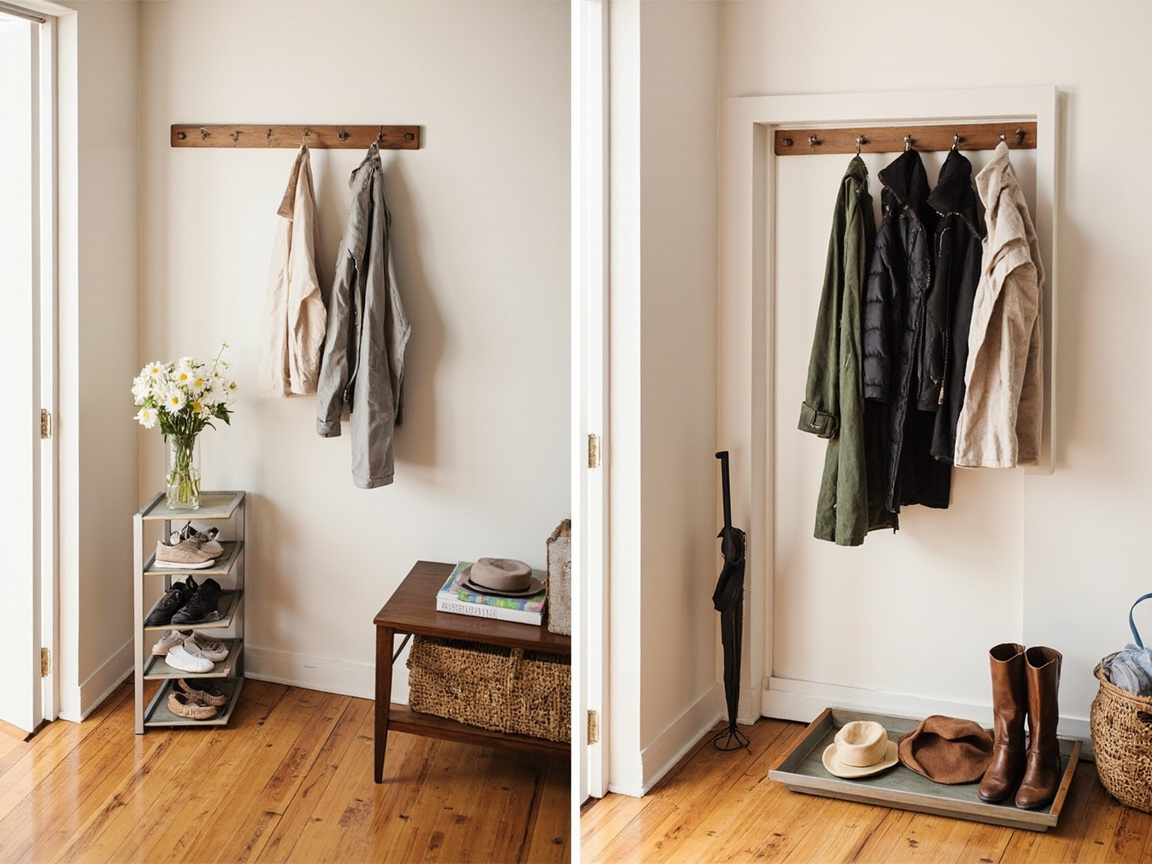
Keep It Clutter-Free: The Daily/Weekly/Monthly Rhythm
The entryway-specific version of the declutter maintenance routine and the zone cleaning method.
Daily Reset (2 minutes)
Before bed: keys on the hook, shoes in the rack, mail into recycle or file. Single highest-ROI 2 minutes in the day. Skip it once and you’ve started Mistake #5.
Weekly Tidy (Saturday 10 minutes)
Clear surfaces, vacuum under the shoe rack, wipe the console. Check the LANTEFUL tower — if a pair hasn’t moved in 2 weeks, it goes to the bedroom closet.
Monthly Audit (first Sunday)
Relocate anything that drifted back — kids’ backpacks, partner’s work bag, Amazon returns. The 30-day rule: anything still in the entryway after 30 days is permanent.
Reader Questions
How do you declutter an entryway with kids?
Add a kid-height hook row at 42-48 inches (a second LYNK over-door on the lower door) and a low cubby for school bags. The HOMSHO 4-barn-door bench stores kid shoes in the soft closed bin, and adult shoes go on the LANTEFUL vertical tower. The Daily Reset is non-negotiable in family entryways — kids don’t do 2-minute tidy themselves.
How often should you declutter your entryway?
The entryway is the highest-traffic zone in the house, so it backslides faster than any other room. Daily Reset + Weekly Tidy + Monthly Audit is the sustainable rhythm. Add a Spring and Fall Seasonal Refresh for coat and boot rotation. Most entryways need a full weekend-deep declutter every 6-12 months, with monthly audits catching drift in between.
Now Declutter — Your 5-Step Path Forward
The 5-step method above gives you a clutter-free entryway. The next step is choosing storage that fits the 4-zone system you just built — find the right storage for your entryway. If your entryway is small or narrow, the small entryway guide covers wall-mounted-only setups. For shoe + coat combo systems, see entryway shoes + coats organization. For a faster declutter session across the whole home, the 7-day declutter sprint is the method-level guide.