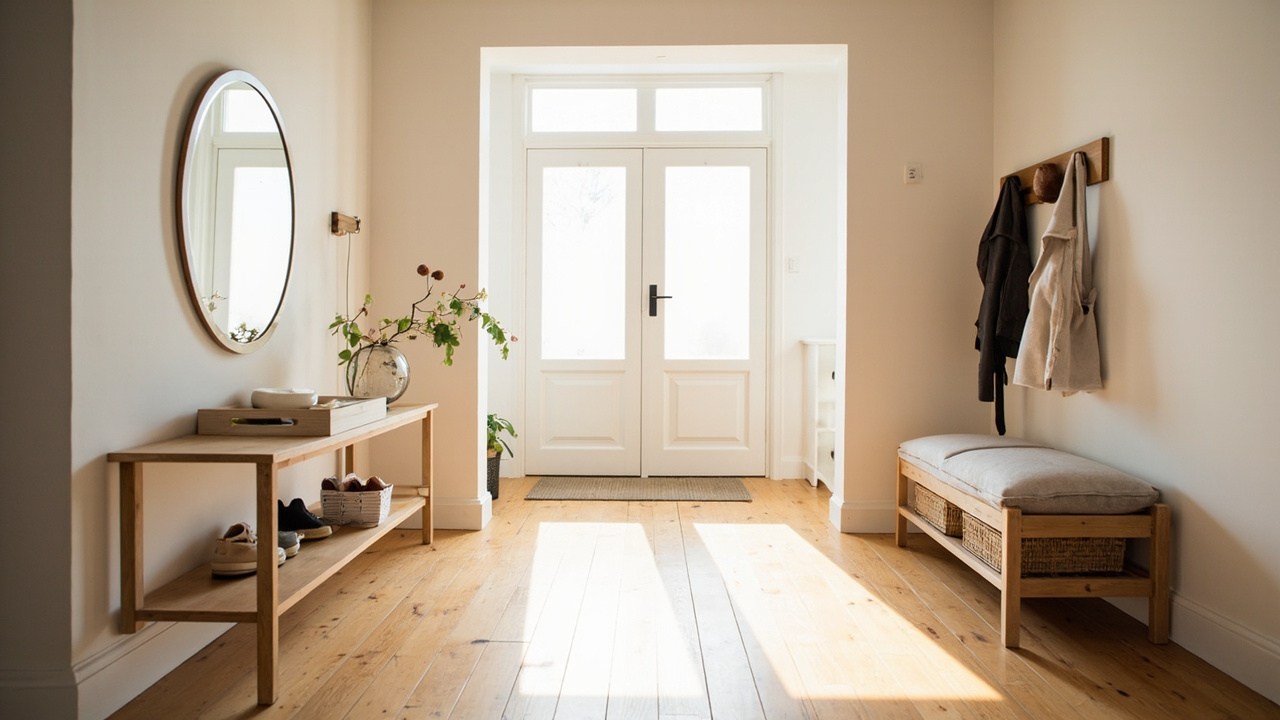
Why Entryway Organization Matters
You walk through it twice a day minimum, and so does everyone in your house. The entryway is the smallest room but the highest-traffic. When clutter piles there — shoes on the floor, keys vanished in a junk bowl, coats draped over the chair — every entry and exit turns into a scramble.
The fix isn’t a bigger entryway. It’s a zone-based system that gives every “greeting” item (keys, mail, shoes, coats, bags) a permanent home within arm’s reach. Before buying anything, apply the declutter-fast method to purge anything not worn in the past 12 months. A 4-zone system then turns a 4-foot-wide entryway into a functional drop zone in under a day.
This guide covers the 4 zones, seasonal rotation, and a constraint guide for rentals, narrow spaces, and families. You’ll get 8 product picks, a KonMari method framing, and a maintenance rhythm.
What the 4-Zone System Looks Like
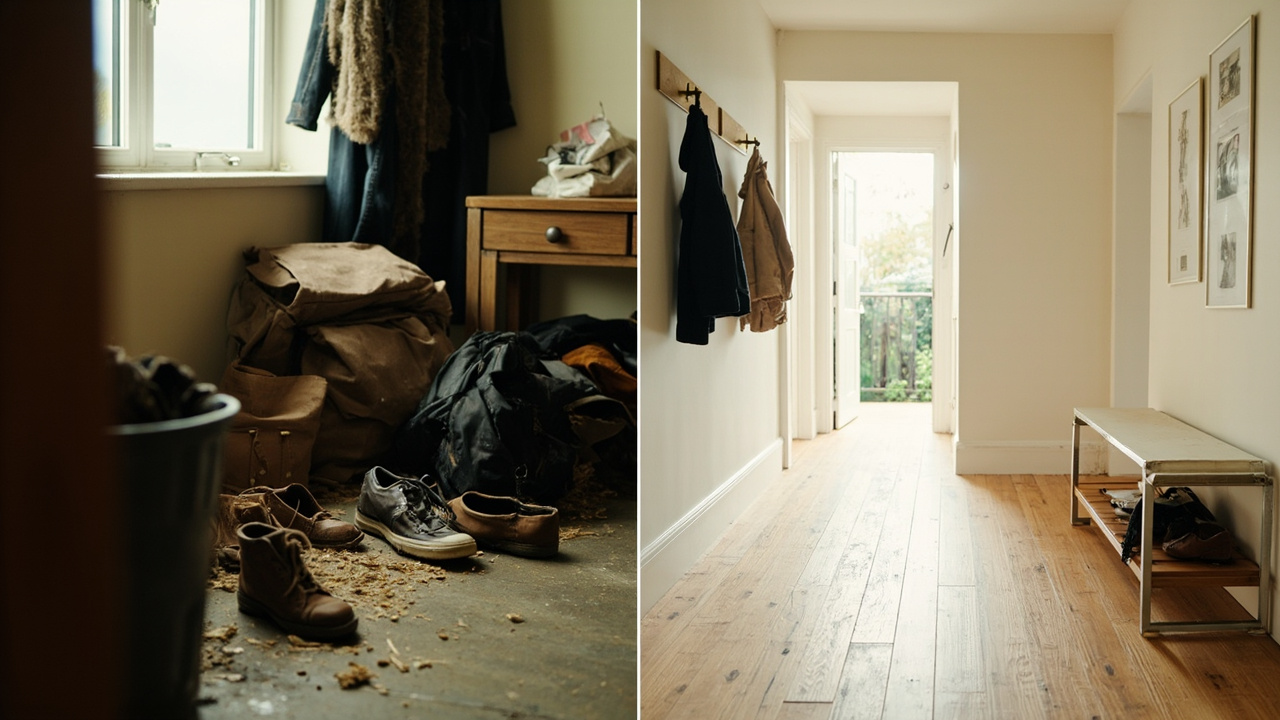
The visual difference between a chaotic entryway and a 4-zone system is dramatic. Piles of shoes, lost keys, and coats draped over chairs disappear when each item has a fixed home within arm’s reach of the door.
The 4-Zone Entryway System
Entryway organization works when you stop thinking about square feet and start thinking about workflow. Every person repeats the same sequence: drop keys, remove shoes, hang coat, sit to finish dressing. Each step deserves its own zone — not a shared pile.
The 4 zones are Drop Zone (keys, mail, wallet, sunglasses), Shoe Storage (daily-wear footwear, slippers, kids’ shoes), Coat Hooks (jackets, hats, scarves, dog leashes), and Bench Storage (seating plus hidden storage). This mirrors the zone cleaning method that breaks big spaces into manageable sections — the difference is that entryway zones are organized by daily action. The KonMari principle “make space for everyone’s needs” maps cleanly onto a shared entryway.
Visualizing the 4 Zones
A top-down view of the entryway shows how the 4 zones fit together. Each zone is roughly 25% of the available space, with traffic flow running from the door (zone 1) to the bench (zone 4).

How the 4 Zones Work Together
Each zone covers roughly 25% of entryway space. Sequential flow: drop keys (zone 1) → remove shoes (zone 2) → hang coat (zone 3) → sit and store (zone 4). One decision per zone, no backtracking. Order matters for habit formation: drop zone first (the first thing you touch when entering), bench storage last (items you only access on the way out).
Zone 1 — Drop Zone for Keys, Mail, and Daily Items
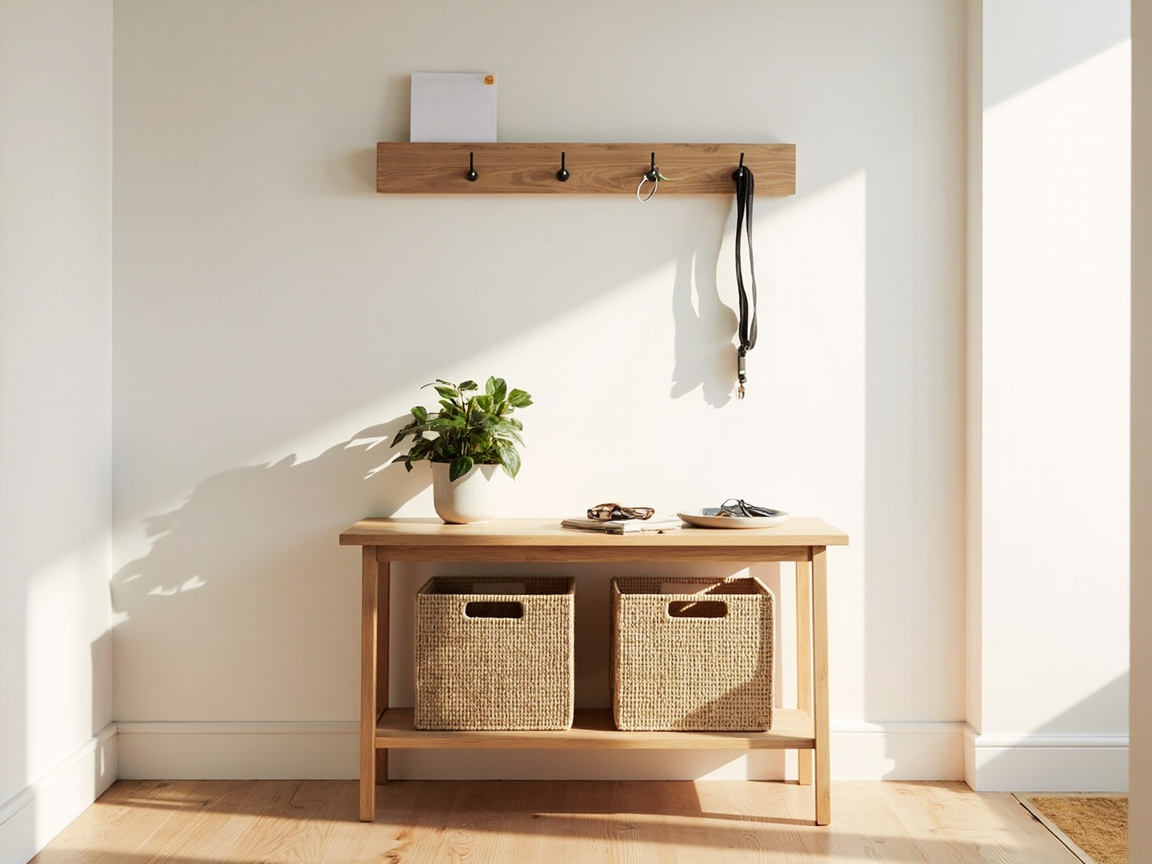
The drop zone sits within arm’s reach of the door you use most. It’s the highest-frequency zone — you’ll touch it 5 to 10 times a day. Its job is to hold items you grab or set down reflexively: keys, wallet, phone, sunglasses, mail, a reusable bag, the dog leash.
Two core pieces make a drop zone functional: a flat surface (console or wall-mounted shelf) and a wall-mounted key-and-mail holder that gives keys a vertical home. Without the vertical piece, keys migrate to the kitchen counter within three days. For basket materials in this zone, the storage bins guide and the clear versus opaque bins comparison break down the trade-offs. For durability, weigh plastic versus fabric bins.
Console Table vs Wall-Mounted Shelf
A console table works when you have at least 4 feet of wall width and want hidden storage plus a display surface. The HOOBRO 29.5” Narrow Console Table ($41.99) hits 29.5 inches wide with 2 fabric drawers and 3-tier mesh shelves — enough room for 3 people’s daily items in a footprint that fits narrow entryways.
A wall-mounted shelf with hooks underneath is the better pick when wall width drops under 3 feet. It uses vertical space and doubles as coat-hook storage for zone 3. Decision rule: ≥4 feet wide → console (more surface, hidden storage). Under 4 feet → wall-mounted shelf with hooks.
Mail Organizer and Key Holder
A wall-mounted key and mail holder solves 2 problems: keys have a permanent home, and incoming mail stops piling on the kitchen counter. The KISENG Wall Key & Mail Holder ($9.99) covers 10 inches of wall with 4 key hooks plus a mail slot — enough for a 2-to-4 person household.
Mount at 48 to 54 inches so the mail slot sits at adult eye level. The key hooks should sit 6 inches below at 42 inches so heavy keychains don’t swing into the wall.
Catch-All Basket Solutions
A decorative catch-all basket (12 to 15 inches diameter) handles items that don’t deserve a permanent hook or tray: dog leashes, scarves, reusable bags. One basket per family member keeps contents from becoming a tangled pile.
Place the basket below a console, on the lower shelf of a wall-mounted rack, or in a corner of the entryway closet. Keep contents limited to items used within a week.
Zone 2 — Shoe Storage Solutions
The shoe zone handles daily-wear footwear for everyone in the household. The average family has 6 to 12 pairs in active rotation, so the system must hold at least 8 pairs to feel useful — under-capacity zones overflow onto the floor within a week.
Two decisions shape this zone: open rack versus closed cabinet (visibility preference) and depth-fit for narrow entryways. Our closet shoe organization guide covers the closet side of the same problem, and our reach-in closet organization applies when your entryway closet is the typical narrow reach-in.
Shoe Rack vs Shoe Cabinet
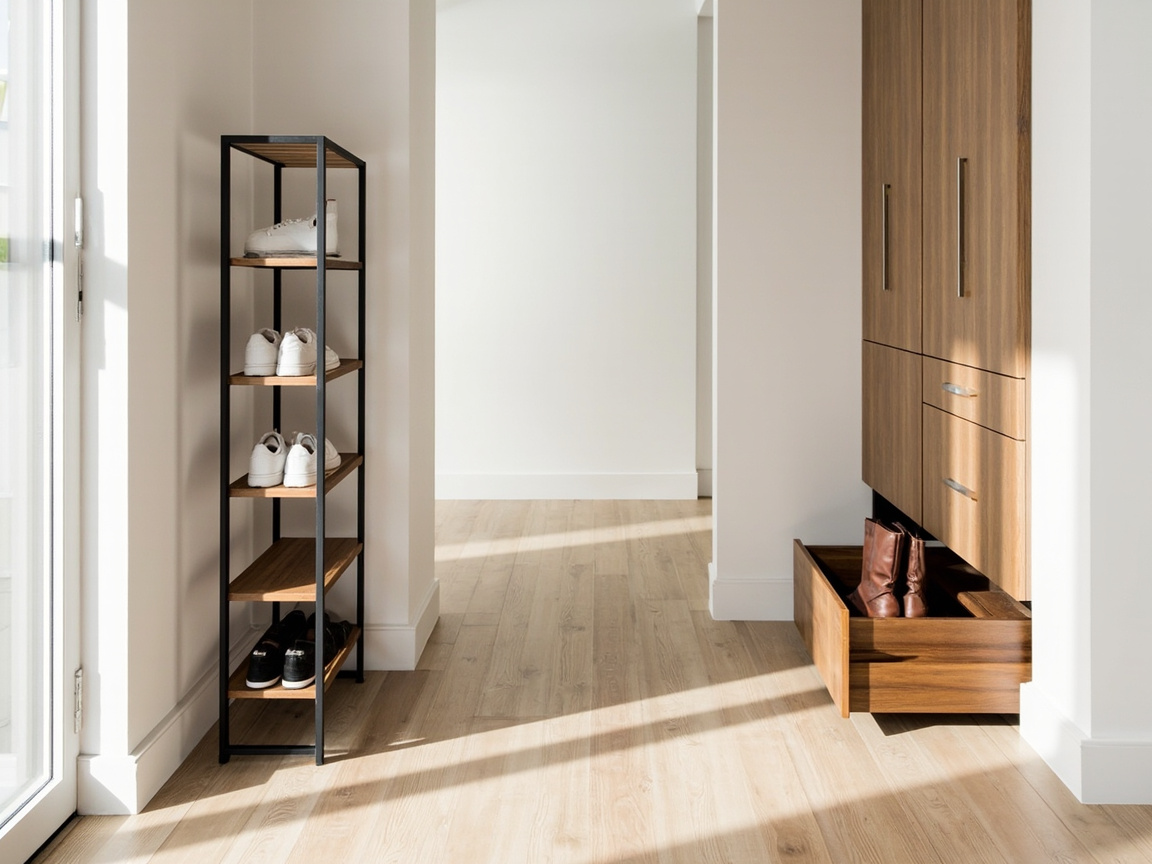
An open shoe rack like the CHOEZON 4-Tier Slanted Shoe Rack ($37.99) holds 9 to 12 pairs in an 8-inch depth that fits tight entryways. Open racks let air circulate, preventing the mildew smell closed cabinets trap. They’re faster to scan — find the right pair in 2 seconds.
A closed shoe cabinet hides clutter at the cost of ventilation. The QIVOMIX Flip-Drawer Shoe Cabinet ($84.98) holds 14 to 20 pairs in 9.4-inch depth with a walnut finish that blends into premium entryways. Flip drawers protect shoes from dust and UV — useful if your entryway gets afternoon sun.
Trade-off: visible organization (rack, faster access) versus hidden organization (cabinet, slower access, cleaner visual).
Boot Storage in Entryway
Tall boots need 16 to 18 inches of vertical space. Add a 15-inch wide boot tray at the entry point to catch snowmelt and salt. Limit boot storage to 2 to 3 current-season pairs — anything else belongs in the closet or garage.
Small Entryway Shoe Solutions
For entryways under 3 feet wide, slim vertical cabinets win on density. The HUANLEGO Slim Shoe Cabinet ($93.49) hits 9.4 inches deep, 30 inches wide, and holds 16 to 20 pairs in fluted flip drawers — the highest density available for a narrow footprint.
Over-door shoe organizers (12-pocket fabric style behind the door) add 12-pair capacity with zero floor footprint. Hide them behind the entry door, not on the front-facing side. Stackable racks (3-tier → 6-tier as your collection grows) also work for entryways that can spare vertical space but not horizontal.
Zone 3 — Coat Hooks and Storage
The coat zone handles daily-wear outerwear plus small hanging items (hats, scarves, dog leashes, umbrellas). A useful capacity rule: 2 hooks per adult, 2 hooks per kid. For a 4-person family, that’s 8 hooks minimum — most under-allocated entryways ship with 2 to 4.
Mount height matters. Adult hooks at 60 inches (eye level plus 4 inches), kid hooks at 42 inches. If you mount a shelf-hooks combo, install hooks at 60 inches and the shelf at 66 inches so keys don’t slide off when reaching up. For depth guidance, the hooks and racks vertical storage guide covers spacing, weight ratings, and stud-mounting.
Wall-Mounted Coat Hooks with Shelf
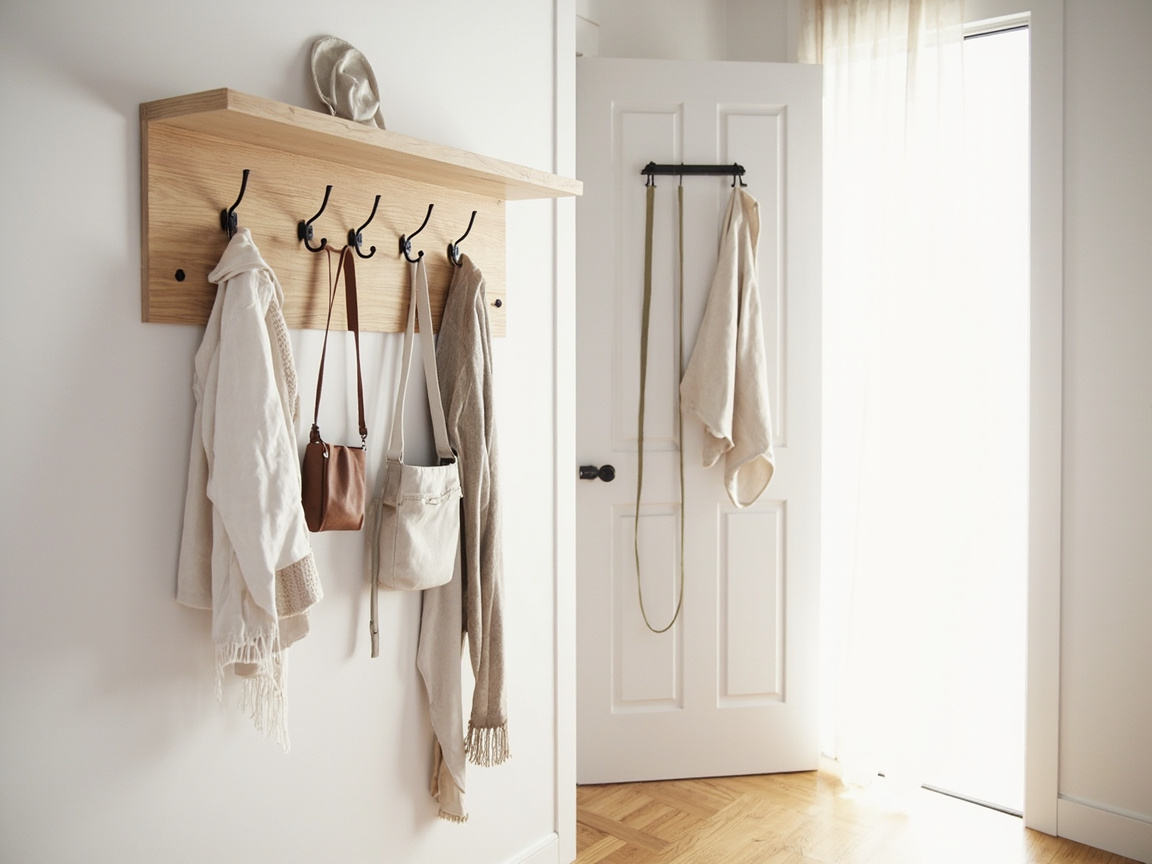
A wall-mounted rack with a shelf above combines zone 1 (drop zone for keys) and zone 3 (coat hooks) into one mount. The Homode Wall Hooks with Shelf ($17.95) ships with 5 metal hooks and a 4.5-inch deep shelf — large enough for a key tray, sunglasses, and a small plant. Install at 60-inch hook height and 66-inch shelf height.
The shelf doubles as a display surface (a small framed photo, fresh flowers) and a functional surface for daily-grab items (keys, wallet, work badge). One mount serving two zones is the densest layout for narrow entryways.
Over-the-Door Coat Organizer
Over-door racks are the answer for renters. The LYNK Professional Over-the-Door Hooks ($25.99) carries 9 staggered hooks across 2 tiers, fits standard doors up to 1-7/16 inches thick, and removes in 30 seconds without tools.
The staggered layout fits coats, hats, scarves, dog leashes, and umbrellas — the stagger prevents long coats from tangling with short jackets on adjacent hooks. Pair with a small wall-mounted key holder for a no-drill drop zone.
Freestanding Coat Rack
Freestanding racks work best when the entryway opens directly into a living room with no usable wall near the door. A 5-to-7-hook tree with a weighted base stands 65 to 70 inches tall and holds a family’s daily outerwear without permanent installation. Pair with an umbrella stand for complete weather prep.
Zone 4 — Bench Storage and Seating
Putting on shoes while standing puts strain on your lower back. The bench zone adds seating plus hidden storage in one footprint. 60% of entryway benches include hidden storage — pick one with a hinged door. A seat-only bench forces shoes elsewhere (closet, bedroom, garage), and the entryway shoe zone ends up under-capacity.
Storage Bench with Shoe Compartment
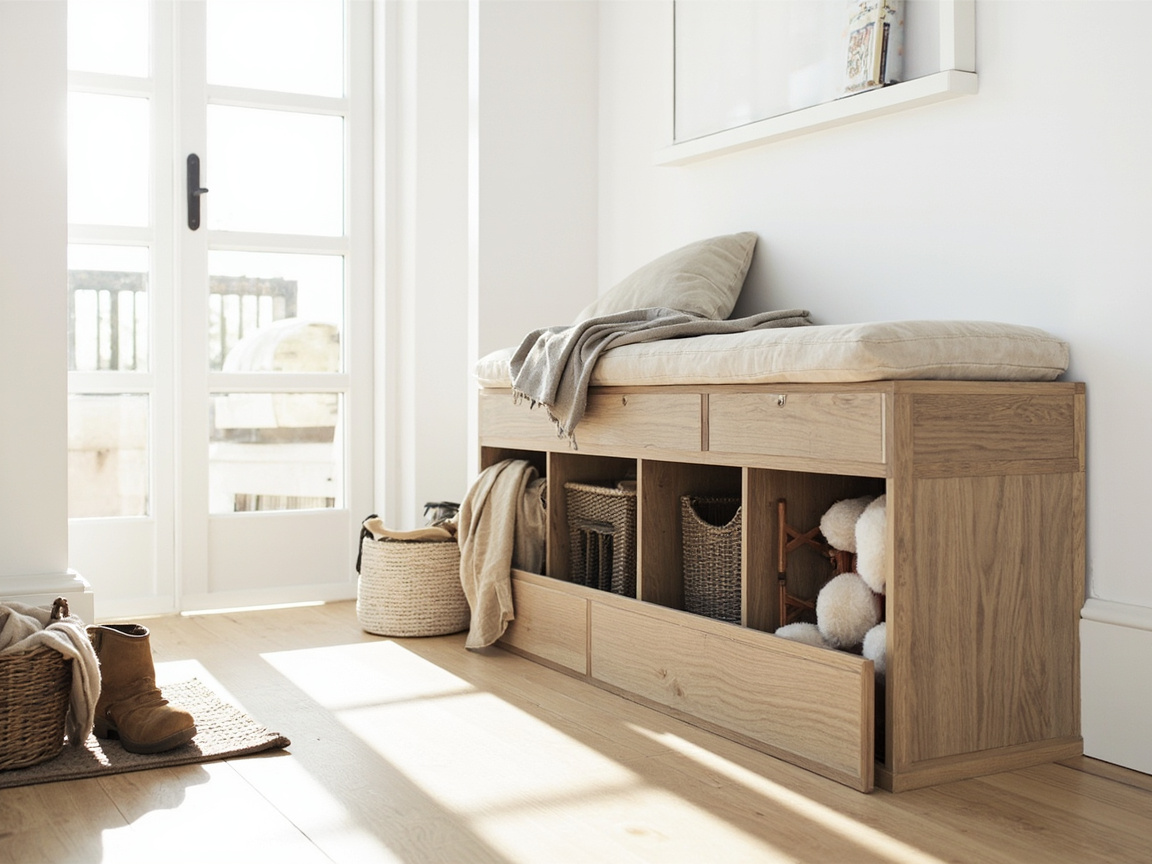
A 2-tier storage bench like the Homleke 2-Tier Storage Bench ($109.99) packs a 2-inch padded cushion, 4 doors, and an adjustable interior shelf into a 45-inch wide footprint. It holds 8 to 12 pairs plus seasonal accessories inside.
The padded cushion makes it usable as guest seating too — a second function that earns its 13.8-inch depth even when no shoes are being put on. Pairs naturally with the coat zone above (coat hanging height matches the seated adult’s reach).
Entryway Seating Without Storage
For entryways under 3 feet wide, a simple stool or small bench without storage is the only realistic option. An 18-inch wide cushioned bench runs $30 to $50 and seats one person — enough for single-adult or 2-person households where shoes fit elsewhere. Trade storage for footprint: a seat-only bench keeps the entryway visually open but pushes hidden storage elsewhere.
Cushioned Storage Ottoman
A cushioned storage ottoman doubles as guest seating, toy storage, and bench seating. A 24 to 30 inch square ottoman at $60 to $80 holds toys, scarves, gloves, or extra blankets. The ottoman is more flexible than a fixed bench — move it to the living room when guests arrive, return it when they leave. Skip the ottoman if your entryway gets heavy daily use; lift-tops wear out faster than hinged doors.
Seasonal Entryway Rotation
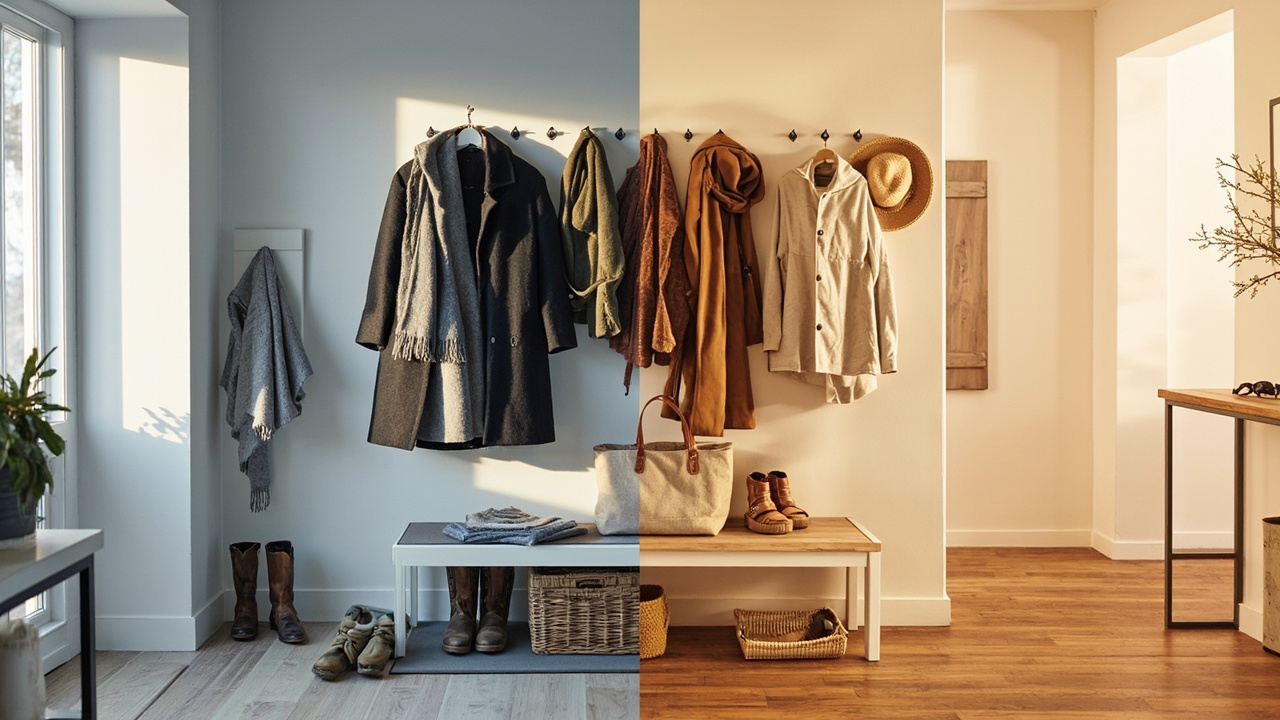
Entryways shift twice a year: heavy wool coats and snow boots in winter, light jackets and sandals in summer. The 4-zone system adapts by rotating contents — structure stays the same, inventory swaps.
Build rotation into your routine. A twice-yearly swap (spring + fall) keeps the entryway sized for current-season items. For the full methodology, see our seasonal closet rotation guide.
Winter to Summer Transition
A 1-week prep window in late spring: remove winter coats from hooks, swap to summer items, pack winter into labeled bins in the bedroom closet. Reverse in early fall. Label bins by season for fast swap: blue for winter, green for spring, orange for fall. Overflow can move to under-bed storage if the closet is full.
Accessory Storage by Season
Mittens and gloves belong in a bench drawer or basket on the console — small items that migrate get lost. Sun hats in summer, beanies in winter, and a year-round umbrella stand near the door. Scarves rotate via the wall hooks: leave only 2 to 3 in-use scarves on hooks, store the rest in a labeled bin.
Entryway for Small Spaces and Special Cases
The 4-zone system adapts to fit unusual entryways. The hardest cases are narrow entryways under 3 feet wide, no-closet entryways, rentals, and households with kids. The principles from our small space decluttering guide apply directly — small kitchens and bathrooms solved the same vertical-density problem. Our small kitchen organization and small bathroom organization guides show parallel strategies for tight layouts.
Narrow Entryway Solutions
Use 18 to 24 inches of floor depth at most per zone. Use a wall-mounted shelf with hooks instead of a console table — the wall does the work the floor can’t. Pick an 8-inch deep shoe rack over a 12-inch or 16-inch cabinet.
Stack zones vertically per wall: hooks at the top, mail holder or shelf in the middle, shoe rack at the bottom. One wall can serve 3 zones if each is allocated a 24-inch vertical strip.
No-Closet Entryway Solutions
All 4 zones go in freestanding or wall-mounted furniture: coat rack plus shoe cabinet plus console plus bench. A no-closet entryway needs 4 pieces instead of one closet rod. For parallel strategies, see our small closet organization guide.
Apartment-Friendly Options
Rental = no drilling. Use over-door hooks (LYNK at $25.99), a freestanding coat rack, and a console on furniture pads. Skip wall-mounted shelves. For lightweight wall items under 5 pounds (a small mirror, key holder), Command strips work without drilling. Apartments typically need 10 to 15% more floor space than owned-home entryways for the same capacity.
Family with Kids
Install kid-height hooks at 42 inches — adult hooks at 60 inches force kids to throw coats on the floor. A 12-inch tall low shoe rack (near the door) gives kids independence. Label baskets with kid names using waterproof labels (see how to label anything) — 1 basket per child. The KonMari “everyone’s needs” principle fits a family entryway.
Constraint Guide by Scenario
Pick the scenario that matches your situation, then build the 4 zones with the products that fit. For wall-mounting trade-offs in the coat zone, the hooks and racks vertical storage guide details stud requirements and weight ratings.
Rental-Friendly (No Drilling)
If you cannot drill, use the LYNK over-door hook rack at $25.99 (zone 3), a console with furniture pads (zone 1), and a slim freestanding shoe cabinet (zone 2). Total: $150 to $200.
Skip wall-mounted shelves. The HOOBRO console at $41.99 plus CHOEZON shoe rack at $37.99 plus LYNK hook at $25.99 plus KISENG mail holder at $9.99 covers all 4 zones for $115.
Budget Under $150
If the system must cost less than $150, use one multi-functional piece per zone: $41.99 console (zones 1 + 4 with a small stool) + $9.99 mail holder + $25.99 over-door hook + $37.99 shoe rack = $115.
Skip a dedicated storage bench at this budget. Use a simple stool ($20 to $30) or skip seating entirely. The 4-zone system works without seating — putting on shoes while standing is fine for short distances.
Tiny or Narrow Entryway (Under 3 Feet)
If width drops under 36 inches, prioritize vertical over horizontal. Use 1 zone stack per wall: hooks top, mail holder middle, shoe rack bottom.
The HUANLEGO slim shoe cabinet at $93.49 + Homode wall hooks at $17.95 + a 12-inch floating shelf ($15 to $25) covers 3 zones in under 30 inches of wall width. Total: $125 to $135. Add a small ottoman ($60 to $80) only if floor depth allows.
Family with Kids
If the household includes children under 10, install kid-height hooks at 42 inches and a low shoe rack at 12 inches tall. Label baskets with kid names using waterproof labels (see how to label anything) — 1 basket per child for gloves and hats. Plan for 1 hook per adult plus 1 hook per kid.
For a 4-person household, 4 to 6 hooks is the minimum; the LYNK 9-hook at $25.99 covers the family with capacity to spare. The Homleke bench at $109.99 holds 8 to 12 pairs — enough for daily shoes plus outgrown pairs waiting to be donated.
Common Mistakes
Mistake #1 — Buying Storage Before Decluttering
“I’ve spent $200 on bins and a bench, then realized I’m storing 5 coats I never wear.” Remove items not worn in the past 12 months before buying any zone product. Use the ABC declutter method to sort coats and shoes into keep, donate, discard. Only after the pile is reduced do you measure storage needs.
Mistake #2 — Not Measuring the Entryway
Around 60% of entryway storage fails fit. A 45-inch bench won’t fit a 36-inch wall. Measure width, depth, height before ordering. Tape-out furniture sizes on the floor with painter’s tape — 10 minutes taping saves 2 hours of returns.
Mistake #3 — Ignoring Seasonal Storage
Many entryways are designed for the current season only — winter coats crowd summer sandals, summer hats pile around winter boots. Build the system for 2× annual rotation using the declutter maintenance routine framework.
Mistake #4 — Placing Coat Hooks Too High
Adult hooks at 72 inches force kids to throw coats on the floor and adults to shrug. Optimal mount: 60 inches for adult hooks, 42 inches for kid hooks. Install a second lower rod at 42 inches if kids share the entryway.
Mistake #5 — Mixing Drop Zone with Storage
The drop zone cluttered with long-term storage is the most common entryway failure. The rule: drop zone holds daily items only. Long-term storage (seasonal gloves, guest shoes, extra bags) belongs in the closet, bench, or garage.
Recommended Essentials
Here are the 8 vetted products mapped to the 4 zones. Each piece plugs into a specific zone — pick one product per zone first, then layer in extras.
Drop Zone Products
The HOOBRO 29.5” Narrow Console Table ($41.99) plus the KISENG Key & Mail Holder ($9.99) covers the drop zone for under $60. Add a decorative catch-all basket ($15 to $25) to round out the kit.
Shoe Storage Products
Three storage tiers for three entryway widths. The CHOEZON 4-Tier Slanted Shoe Rack ($37.99) for narrow entryways that prioritize airflow, the QIVOMIX Walnut Flip-Drawer Shoe Cabinet ($84.98) for premium look with hidden storage, or the HUANLEGO Slim Shoe Cabinet ($93.49) for the densest narrow-fit option.
Coat Hook Products
The Homode Wall Hooks with Shelf ($17.95) for owned-home wall-mount installation, or the LYNK Over-the-Door Hooks ($25.99) for rentals. The wall-mount option serves 2 zones (drop zone shelf + coat hooks) in one piece.
Bench Storage Products
The Homleke 2-Tier Storage Bench ($109.99) is the only piece that combines seating with hidden storage at this price point. Skip if your entryway is under 3 feet wide — substitute a stool or skip bench storage and put long-term items in the closet.
Next Steps and Related Guides
Pick your first action item based on your constraint. Renting? Start with the LYNK over-door hooks plus a slim shoe cabinet. Owned home from scratch? Start with the HOOBRO console plus a wall-mounted hook rack. Family with kids? Start with kid-height hooks and a low shoe rack.
For the principles behind each zone, the KonMari method covers category-first decluttering; the declutter-fast method is a faster weekend alternative. For the twice-yearly swap, the seasonal closet rotation guide covers the same process for the bedroom closet. For product selection depth, the how to choose storage bins guide covers bin materials for zone 1, and the hooks and racks vertical storage guide handles wall-mount spacing for zone 3. Head back to the Declutter101 home page for the full room map.
When to Add More Zones
The 4-zone system is complete for entryways under 10 feet wide. Larger ones can split zone 2 into Zone 2A (work shoes) and Zone 2B (casual shoes) for cleaner segregation. Add a Zone 5 “outdoor gear” if you have strollers, bikes, or sports equipment — our garage organization guide handles heavier gear.