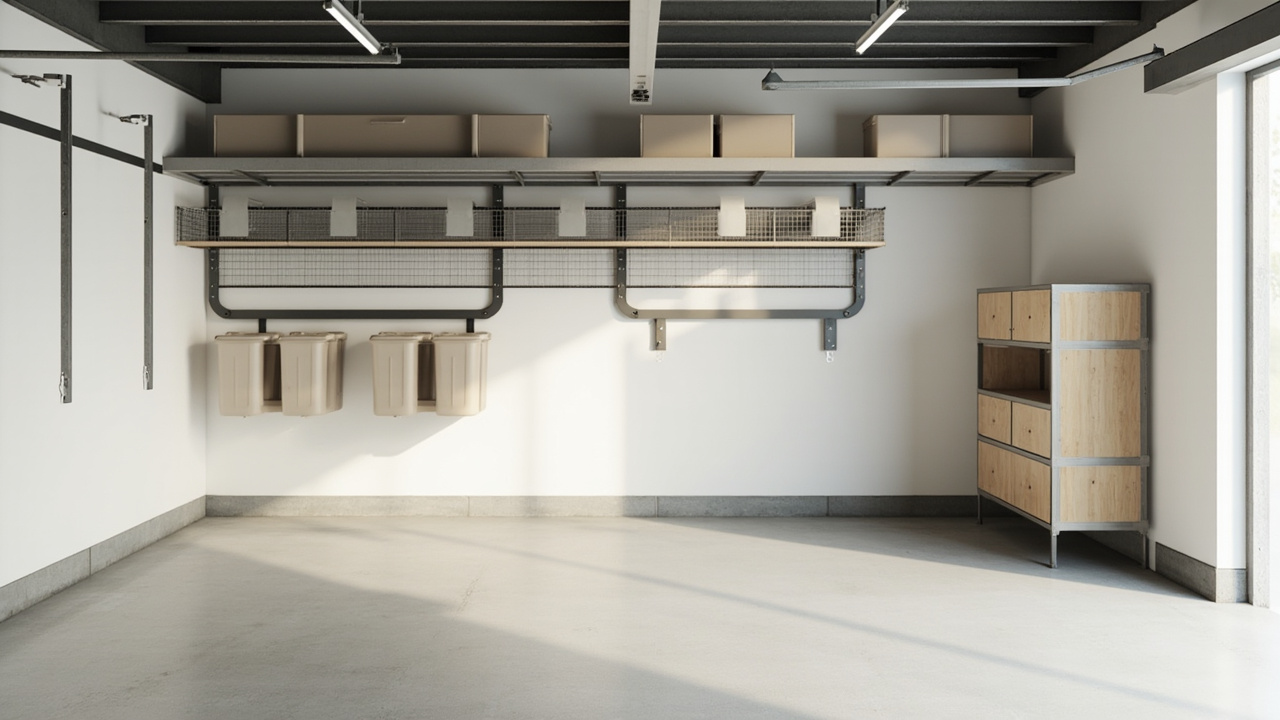
Garage storage solutions are a mix of four physical types — vertical rails, overhead ceiling racks, wall shelves, and freestanding floor systems — chosen by access frequency, load, and mounting limits. Daily tools go on the wall, lightweight seasonal bins go overhead when joists and clearance allow, medium bins sit on wall shelves; dense, heavy, or movable items live on floor racks and carts. The garage hub frames the room; the 5-zone layout places each category.
Why Storage Type Matters More Than Buying More Bins
The Four-Type Decision in One Minute
The most common mistake is buying bins before choosing where those bins live. Four storage types carry the workload in nearly every residential garage — wall rails and pegboard for daily tools, ceiling racks for seasonal overflow, mid-wall shelves for medium bins, and floor shelves or rolling carts for heavy or movable inventory. If the category list isn’t settled yet, declutter the garage first so you don’t pay to store items that should leave.
Where This Fits in the Garage Cluster
This article narrows the decision to storage type — vertical, overhead, wall, or floor-based — with exact dimensions, load ratings, and pricing. The 5-zone garage layout system teaches where each category belongs once the storage type is set.
What You Need
Vertical Storage Starter Pair
For a daily-access wall system, start with a StoreYourBoard 36-Inch Garage Tool Organizer at $49.99 — a 36-inch steel rail with four PVC-coated hooks and a stated 250-pound capacity. Pair it with a Wall Control 4-Foot Metal Pegboard Kit at $120.04 for visible hand tools on a 48-by-32-inch metal panel.
Overhead Storage Starter
If ceiling joists and garage-door clearance pass inspection, the FLEXIMOUNTS 3x6 Overhead Garage Storage Rack at $115.98 gives a 72-by-36-inch platform with a 22-to-40-inch drop and a stated 450-pound capacity. Confirm the joist layout, opener clearance, and vehicle height first.
Wall Shelf and Small-Parts Pair
For medium bins, the FLEXIMOUNTS 2-Pack 2x4-Foot Wall Shelves at $89.99 give two 24-by-48-inch shelves with a stated 600-pound combined capacity. Add Akro-Mils 30230 Stackable Garage Bins, 12-Pack at $47.88 for open-front hardware storage; each bin is 10.5 by 5.5 by 5 inches with a stated 30-pound capacity. For shelf selection, see how to choose shelf organizers.
Floor-Based and No-Drill Options
The DEWALT DXST4500BLK 3-Shelf Industrial Storage Rack at $268.34 is a 48-inch steel rack with laminate deck and a stated 4,500-pound total capacity. The Plano 4-Shelf Plastic Storage Shelves at $36.17 snaps together without tools. The Mythinglogic Rolling Garden Tool Organizer at $49.99 adds 13 side tool slots and 4 movable hooks on lockable wheels. For bin guidance, see how to choose garage storage bins.
Layout by Storage Type
Visualizing the Four Storage Types
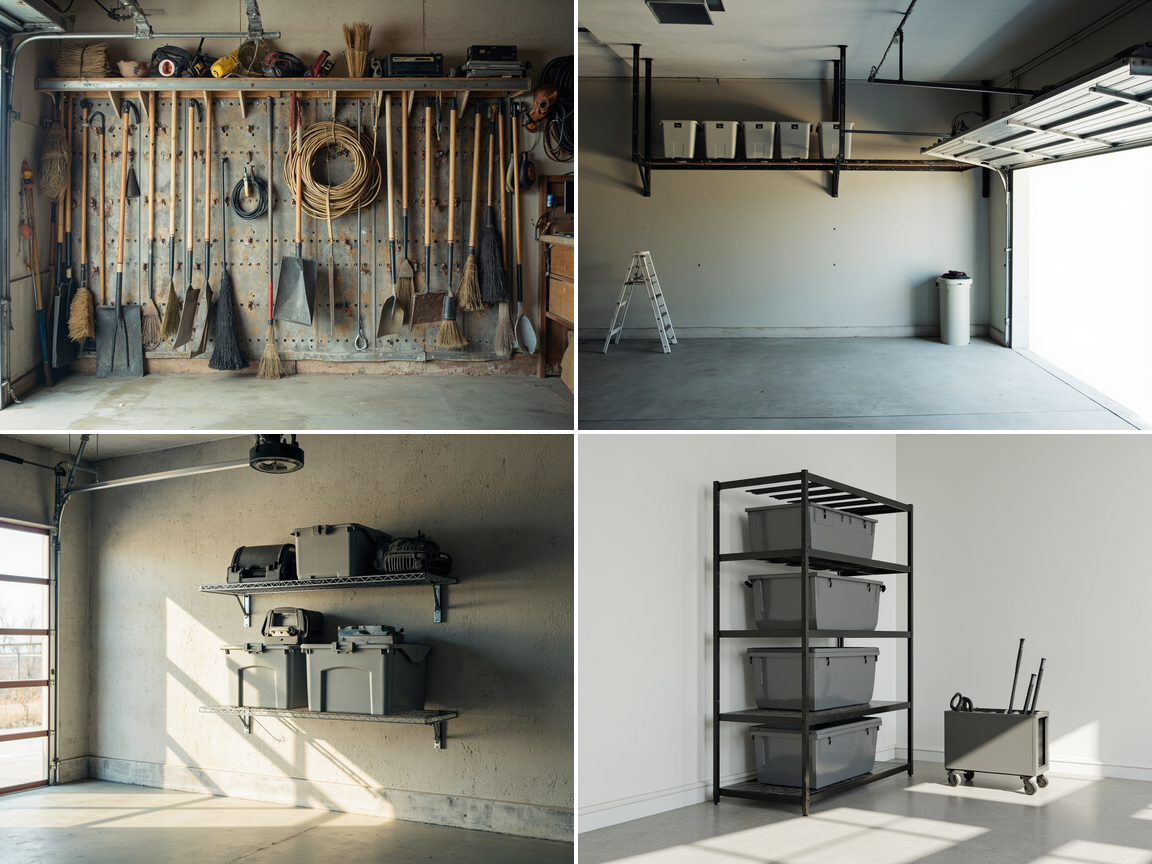
Picture one garage bay split into four zones: a tall vertical rail and pegboard on one wall, a ceiling-mounted seasonal bin area, a mid-wall floating shelf row, and a freestanding floor rack on the open side. Keyed to access frequency, not a five-zone layout.
Vertical Storage: Rails, Hooks, and Pegboard

Vertical storage covers anything that hangs within arm’s reach — long-handled tools on a StoreYourBoard 36-Inch Garage Tool Organizer at $49.99, hand tools on a Wall Control 4-Foot Metal Pegboard Kit at $120.04. The rail wins for bulky tools; the pegboard wins for many small hand tools. Pair them when the wall allows. For the full system picker by wall length and stud spacing, see the garage wall storage guide. For more, see hooks and racks for vertical garage storage.
Overhead Storage: Ceiling Racks for Seasonal Bins
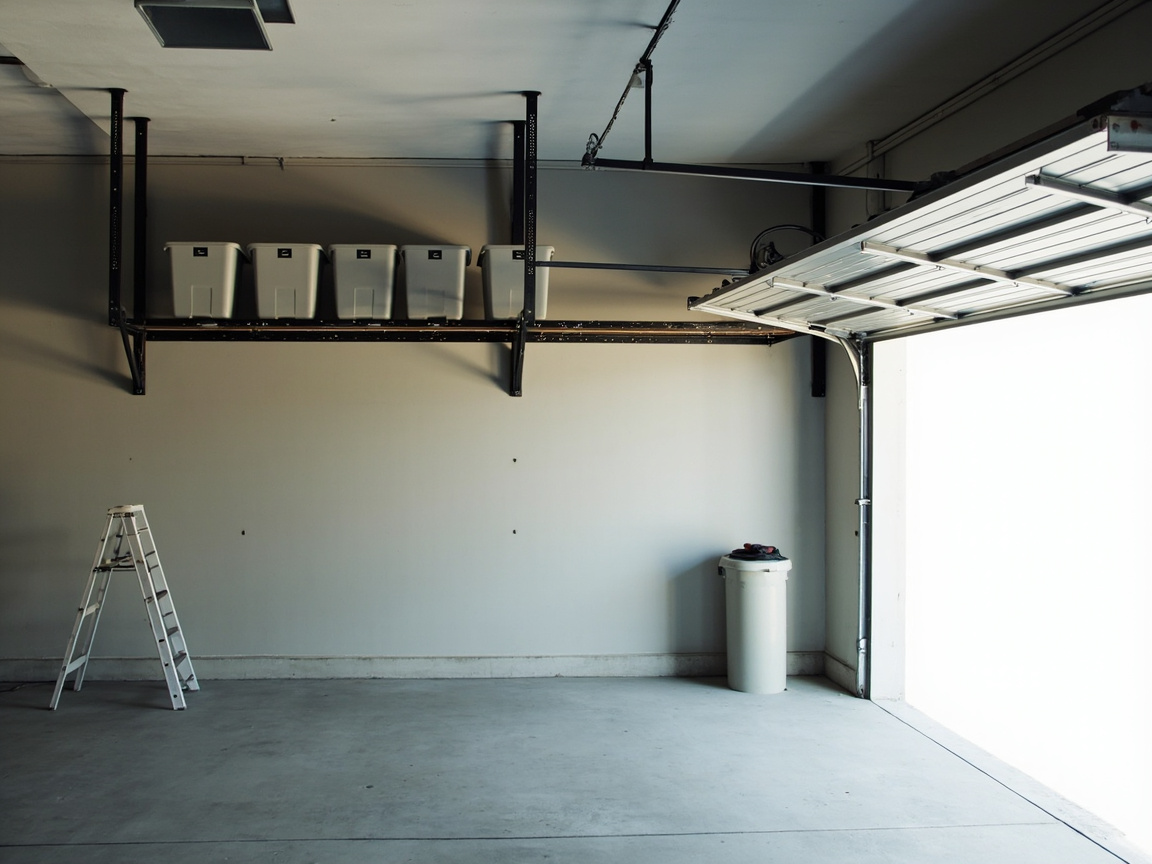
Overhead storage is the FLEXIMOUNTS 3x6 Overhead Garage Storage Rack at $115.98 — a 72-by-36-inch platform with a stated 450-pound capacity and a 22-to-40-inch drop. Run this sequence first: ceiling height → garage-door tracks → tallest vehicle. Skip overhead storage if any step fails, or for open-front small parts, flammables, fragile goods, or fragile goods.
Wall Storage: Shelves Above the Car-Door Swing

Wall shelves fill the gap between vertical rails and the ceiling. The FLEXIMOUNTS 2-Pack 2x4-Foot Wall Shelves at $89.99 give two 24-by-48-inch shelves with a stated 600-pound combined capacity for sports gear and medium totes. Add Akro-Mils 30230 Stackable Garage Bins, 12-Pack at $47.88 inside those shelves for hardware. Keep the car-door swing clear and avoid blocking panels. See how to label garage bins.
Floor-Based Storage: Shelves, Carts, and Open Bins
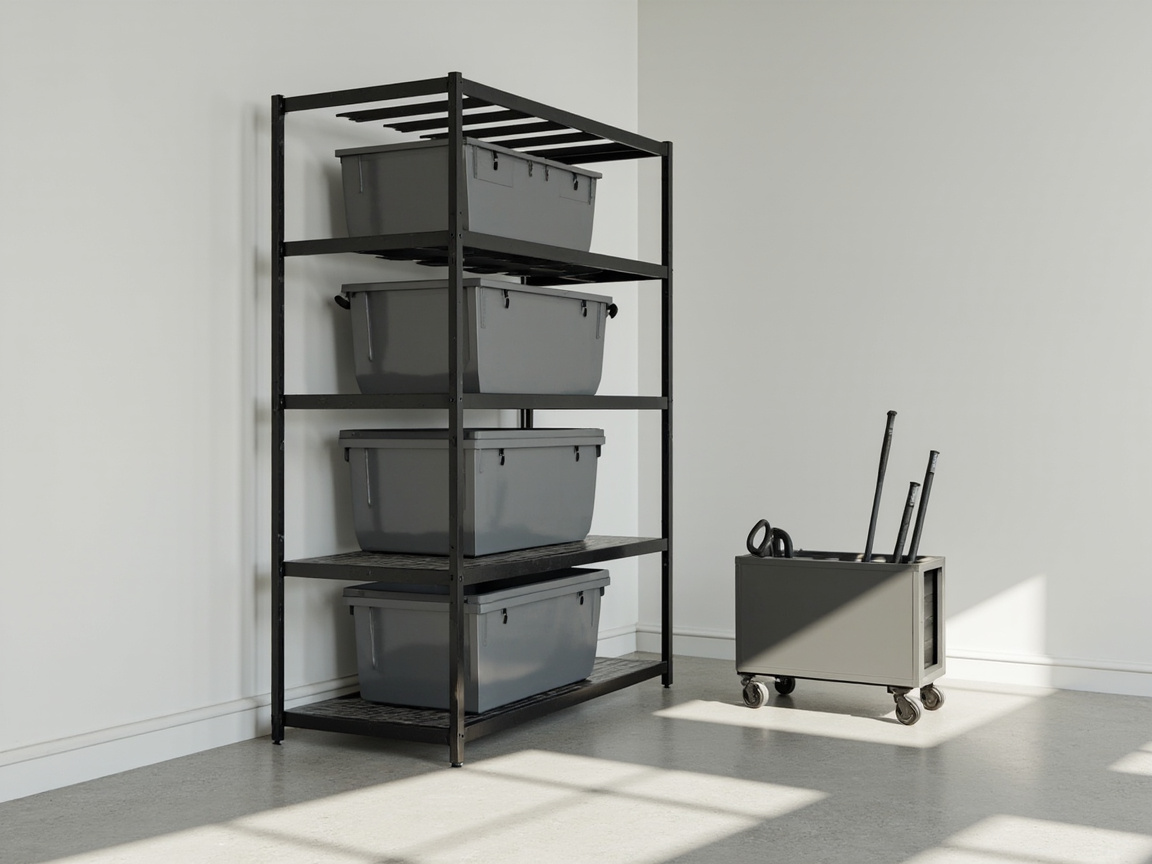
Floor-based storage covers everything that can’t mount to the wall — heavy equipment, rentals, masonry walls, low ceilings, and movable tools. The DEWALT DXST4500BLK 3-Shelf Industrial Storage Rack at $268.34 carries dense loads; the Plano 4-Shelf Plastic Storage Shelves at $36.17 snaps together for renters; the Mythinglogic Rolling Garden Tool Organizer at $49.99 rolls long-handled tools. Keep heavy items low and preserve a clear walking aisle.
Zone-by-Zone Layout
The four storage types map onto the garage’s physical zones. Walk the bay before mounting anything — measure wall lengths, ceiling height, door swing, and vehicle footprint. The 5-zone garage layout system frames what lives in each zone; this section frames how the four storage types fill those zones without making the bay feel smaller than it is.
| Zone | Storage type that wins | Why | Product path |
|---|---|---|---|
| Wall (waist-shoulder) | Vertical rail + pegboard | Daily tools within arm’s reach | StoreYourBoard 36-Inch Garage Tool Organizer · Wall Control 4-Foot Metal Pegboard Kit |
| Wall (above-door) | Mid-wall floating shelf | Keeps car-door swing clear | FLEXIMOUNTS 2-Pack 2x4-Foot Wall Shelves |
| Ceiling (perimeter) | Overhead rack | Seasonal bins out of the way | FLEXIMOUNTS 3x6 Overhead Garage Storage Rack |
| Floor (open bay) | Freestanding shelf or rolling cart | Heavy items, rentals, mobility | DEWALT DXST4500BLK 3-Shelf Industrial Storage Rack · Mythinglogic Rolling Garden Tool Organizer |
| Floor (rental or no-drill) | Snap-together plastic shelf | No holes, easy to take when you move | Plano 4-Shelf Plastic Storage Shelves |
Three layout rules that hold across zone shapes and ceiling heights:
- Daily items stay between shoulder and waist so no ladder is needed and the reach is one hand.
- Heavy items stay below shoulder height even on heavy-duty racks — falling heavy tools break feet and damage the floor.
- Seasonal items go overhead only on the perimeter, never above the vehicle bay, and never where garage-door tracks or the opener swing passes.
The map only works if the bay is zoned before the system is bought. Start by mocking zones with painter’s tape on the floor and walls — parking bay, work zone, garden zone, sports zone, and overflow zone — then assign each one a storage type from the table. Mocking with tape catches clearance problems before a single bracket is drilled.
For zone logic at the room level, the 5-zone garage layout system covers what each zone contains. For category logic at the item level — keep, donate, store — the KonMari method handles the cull before storage. For the broader essentials map across the home, see navigating essentials categories.
Tool Storage — Long-Handled, Hand, Power, and Small Parts
Tools are not one category. A single shelf or rail rarely handles all four types well, and forcing them into one bin or hook is how the garage floor becomes a tool pile again. Match the storage to the tool family first, then fit the family into a zone from the table above.
| Tool family | Storage that fits | Why | Product path |
|---|---|---|---|
| Long-handled (rakes, shovels, brooms) | Vertical rail with PVC hooks or rolling tool cart | Keeps handles off the floor, accessible by grip | StoreYourBoard 36-Inch Garage Tool Organizer · Mythinglogic Rolling Garden Tool Organizer |
| Hand tools (hammers, screwdrivers, pliers, wrenches) | Pegboard with labeled outlines | Visible at a glance, no drawer digging | Wall Control 4-Foot Metal Pegboard Kit |
| Power tools (drills, saws, sanders) | Mid-wall shelf or bench, often in cases | Weight and battery storage in one place | FLEXIMOUNTS 2-Pack 2x4-Foot Wall Shelves |
| Small parts (screws, nails, anchors, fittings) | Open-front stackable bins on a shelf | Visible label front, stackable, easy to pull one bin | Akro-Mils 30230 Stackable Garage Bins, 12-Pack |
Three principles that decide whether the tool wall actually works in daily life:
- Outline tools on the pegboard with a marker or paint pen so missing tools jump out at a glance — see how to label garage bins for the same label logic on bins.
- Match hook size to handle diameter. A 1.5-inch hook works for a shovel; a 0.5-inch hook is what a hand saw wants. Buying one hook size is the fastest way to see tools pile on the floor again.
- Keep batteries and chargers on the same shelf as the tools they power. Mixed-location chargers are why half the household’s drills are dead on a Saturday morning.
For deeper tool-category logic (grouping by frequency, by task, by user), the KonMari method is a clean framework — even outside the closet, the joy-of-keeping test works on a pegboard. For the full taxonomy of essentials across rooms, see navigating essentials categories.
Choose by Load, Access, and Installation
Access Frequency: Daily, Monthly, or Seasonal
Daily items belong on a wall rail or pegboard — within arm’s reach, no ladder required. Monthly items belong on a wall shelf or freestanding shelf, easy to reach but out of the car-door swing path. Seasonal items belong overhead only when joists and clearance pass inspection; otherwise stack against a back wall on a freestanding shelf.
Load and Center of Gravity
Heavy and dense inventory stays low — we keep the heaviest items on the bottom shelf. Don’t treat a system’s stated total capacity as the per-shelf capacity — the per-shelf rating is usually lower; we follow the manufacturer mounting and load-distribution instructions, and recheck fasteners after the first full load.
Mounting Surface and Mobility
Stud walls and exposed joists accept mounted systems. Masonry or uncertain framing requires suitable anchors or professional installation. For renters, the Plano 4-Shelf Plastic Storage Shelves and Mythinglogic Rolling Garden Tool Organizer move without repair work.
Constraint Guide by Scenario
If You Rent and Cannot Drill

If the lease prohibits holes, then skip wall rails, pegboard, wall shelves, and ceiling racks. The verified no-drill baseline costs $86.16: the Plano 4-Shelf Plastic Storage Shelves at $36.17 plus the Mythinglogic Rolling Garden Tool Organizer at $49.99. Add Akro-Mils 30230 Stackable Garage Bins, 12-Pack at $47.88 for hardware. Pair with a budget-first decluttering plan.
If Your Budget Is Under $200
If the total budget is below $200, then buy one daily-tool solution, one shelf, and one small-parts system before any overhead rack. The verified three-part baseline costs $134.04: the StoreYourBoard 36-Inch Garage Tool Organizer at $49.99, the Plano 4-Shelf Plastic Storage Shelves at $36.17, and the Akro-Mils 30230 Stackable Garage Bins, 12-Pack at $47.88.
If You Have No Usable Wall Space
If doors, windows, masonry, or built-ins consume the wall, then split storage between a joist-mounted perimeter rack and a mobile floor cart. The verified ceiling-plus-mobile baseline costs $165.97: the FLEXIMOUNTS 3x6 Overhead Garage Storage Rack at $115.98 plus the Mythinglogic Rolling Garden Tool Organizer at $49.99. If neither is safe, swap to a Plano 4-Shelf Plastic Storage Shelves at $36.17 instead of the rack.
If the Garage Has a High Ceiling of 10 Feet or More
If the ceiling is 10 feet or higher and joists and clearance are confirmed, then reserve overhead space for seasonal bins and keep daily tools on a reachable wall rail. The verified overhead-plus-daily pair costs $165.97: the FLEXIMOUNTS 3x6 Overhead Garage Storage Rack at $115.98 plus the StoreYourBoard 36-Inch Garage Tool Organizer at $49.99. Add the FLEXIMOUNTS 2-Pack 2x4-Foot Wall Shelves at $89.99 for medium-bin space.
If the Garage Has a Low Ceiling Under 8 Feet
If garage-door tracks or vehicle clearance make overhead storage impractical, then move storage to a shallow floor shelf and a reachable wall rail. The verified low-ceiling pair costs $86.16: the Plano 4-Shelf Plastic Storage Shelves at $36.17 plus the StoreYourBoard 36-Inch Garage Tool Organizer at $49.99. Add the DEWALT DXST4500BLK 3-Shelf Industrial Storage Rack at $268.34 only when dense equipment is in the workload. For more, see small-space decluttering principles.
Installation and Safety Checks Before You Buy
Find Studs or Joists and Match the Hardware
Drywall alone isn’t the mounting plan. Use a stud finder to locate framing, then match the system hardware to the framing. Ceiling racks attach per the manufacturer joist instructions — verify joist count, fastener type, and torque values. For masonry, suitable anchors or a pro installer keep the load on the wall.
Protect Door, Vehicle, and Work-Zone Clearance
Measure the full travel of the garage door, the opener swing, car doors on both sides, raised hatches, and the main walking path. A 24-inch-deep shelf blocks more parking space than most owners expect — measure your own vehicle first.
Treat Capacity as a Ceiling, Not a Target
Stated total capacity is a maximum, not a working load; we keep weight well below it. Distribute dense items across the lowest shelf and recheck fasteners after the first full load and at the three-month mark.
Common Mistakes
Mistake 1: Buying a System Before Measuring and Purging
Buying a rack before measuring wall, ceiling, and car clearances leads to wrong footprints and wasted budget. Measure first, then use the declutter-fast method — a homeowner thread surfaces the same complaint: the bin was the wrong size before it hit the wall.
Mistake 2: Treating Drywall as the Load-Bearing Structure
Loaded wall systems need studs, joists, or masonry anchors — drywall alone pulls out under heavy bins. Use a stud finder to locate framing, then follow the system’s hardware list rather than relying on anchor-in-drywall alone.
Mistake 3: Loading Overhead Storage Without a Clearance Map
Overhead racks conflict with garage-door tracks, openers, vehicle hatches, and access ladders when clearance isn’t mapped first. A Reddit DIY thread describes the failure: the rack fits the ceiling but blocks the door track.
Mistake 4: Using Deep Shelves That Steal the Parking or Door-Swing Zone
A deep shelf that blocks the car-door swing or steals parking space turns a useful system into a daily annoyance — see this Reddit thread. Mock the shelf depth with painter’s tape and walk the vehicle through first.
Maintenance and Reset Schedule
Monthly Five-Minute Retrieval Test
I move anything that takes more than two steps to retrieve into a better access tier. Return hand tools to the rail or pegboard and small parts to labeled bins — see how to label garage bins.
Quarterly Load and Fastener Check
I inspect visible sag, loose fasteners, bin damage, and blocked clearances every quarter. Apply the 5S method to standardize the reset work, and follow the 5-zone garage layout system for seasonal swaps.
Build Your Storage Mix
Start With One Daily-Access Type and One Bulk Type
Install wall or mobile daily storage first so the most-used tools stay reachable, then add a shelf or overhead rack for the bulk categories that come out only monthly or seasonally.
Continue Through the Garage Cluster
Return to the garage hub and the 5-zone layout. For bin selection, see clear vs opaque bins.