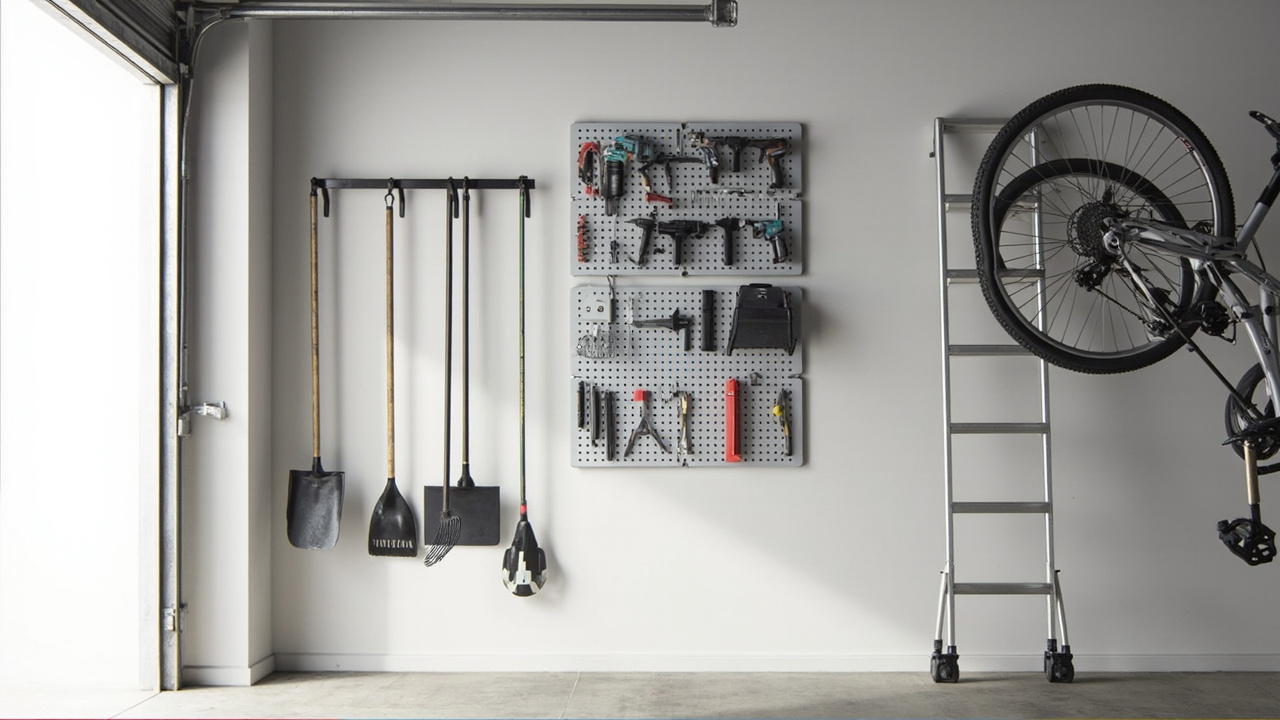
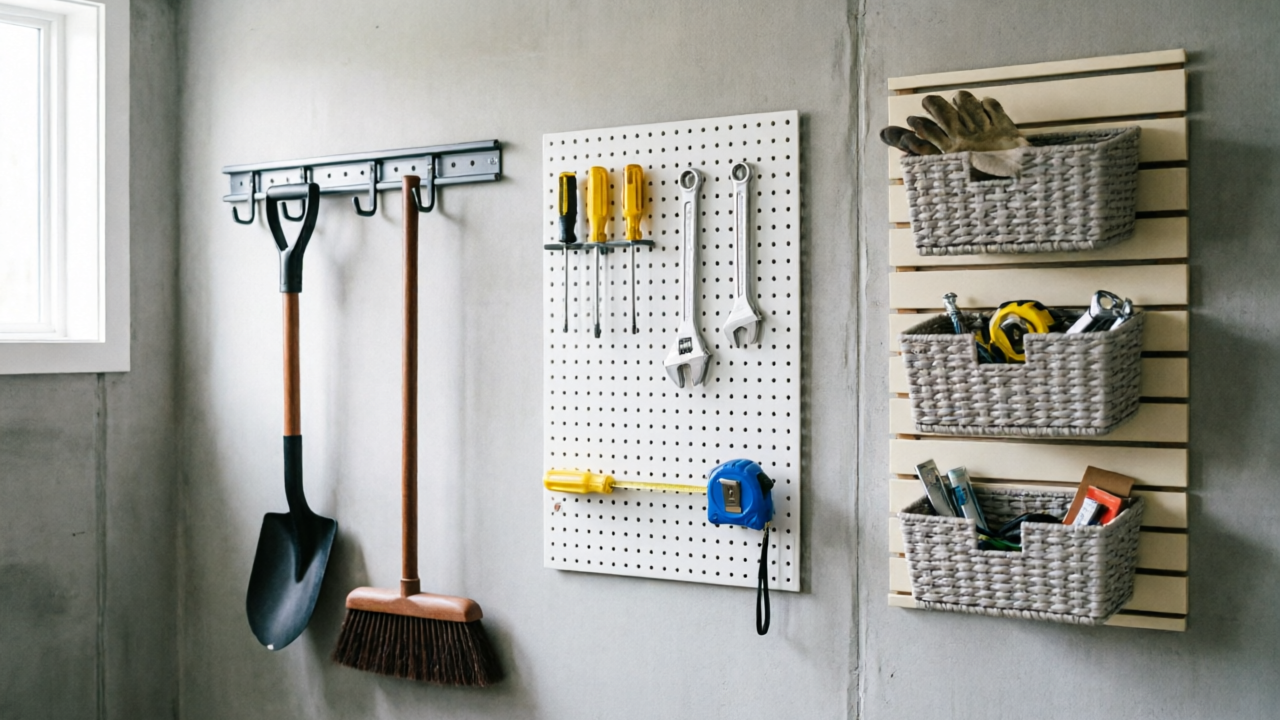
A garage wall storage system turns an empty 8-foot wall into useful, organized storage. Three systems cover the same wall: rails for long-handle tools, pegboard for small hand tools, slatwall for mid-weight gear. Pick one for your wall run, then layer the others above it as your collection grows.
Why Garage Wall Storage Beats Floor Stacking
Walls tend to hold more per square foot than floors in a busy garage, and going vertical is the core of garage wall organization: it clears floor space for the car. A common mistake is treating the wall like a basement: bins on the floor, shovels in the corner.
We cover the three systems that actually work — rails, pegboard, and tool hooks — plus the decision framework for combining them. A single 4x4-foot pegboard panel is one of the cheapest entry points; the cost and time depend on the panel brand and your studs. By the end, you’ll know which combination fits your wall length, stud spacing, and tool weight.
The Three Systems at a Glance
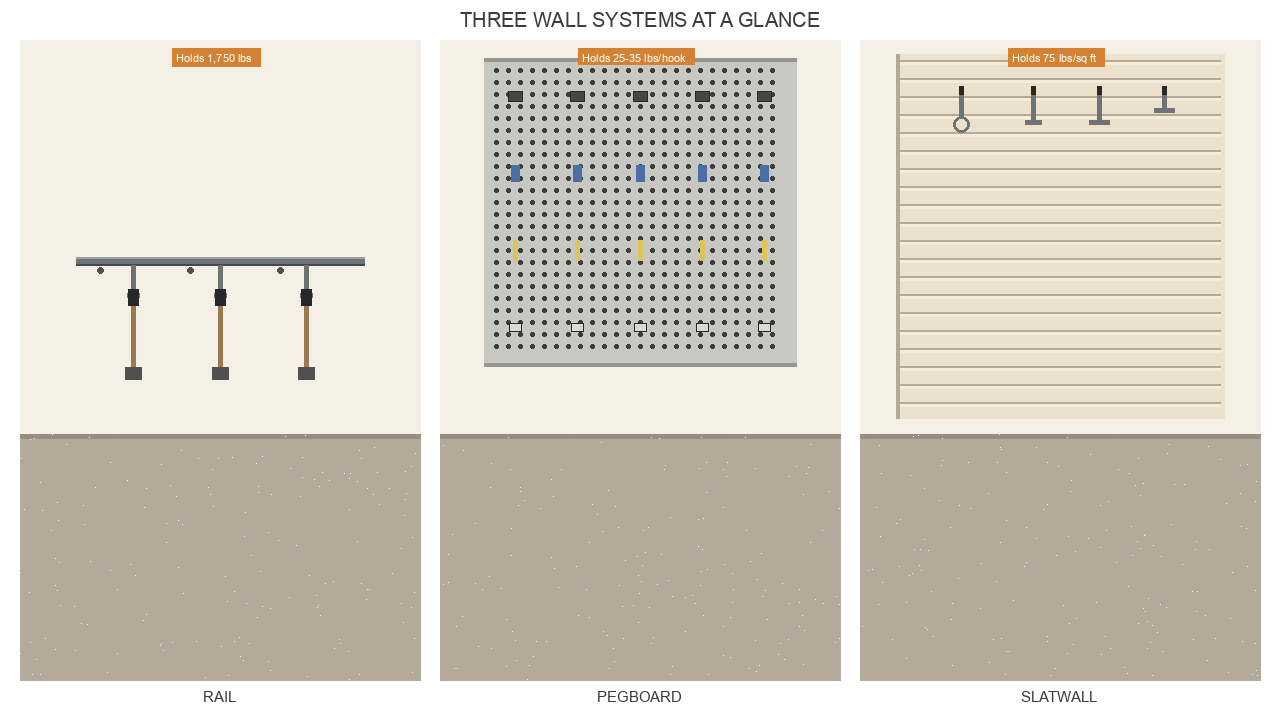
- Rails (FastTrack, Gladiator GearTrack, Wallmaster): Steel channel mounted to studs; hooks slide in. Best for long-handle tools. Rubbermaid FastTrack 2-Pack (P1) holds 1,750 lbs per 4-foot rail.
- Pegboard (1/4-inch metal or hardboard): Perforated panels with hooks and bins. Best for small hand tools. Pair with INCLY 120-piece kit (P5).
- Slatwall (Proslat, StoreWALL, Flowwall): PVC panels with horizontal grooves. Best for mid-weight tools. Each 8x4 ft panel (Proslat 88107 (P6)) holds 75+ lbs per square foot.
Step-by-Step Method: Build Your Garage Wall in One Weekend
The fastest way to build a garage wall storage system is to install the rail first, then layer pegboard or slatwall above it. Plan for roughly 3 to 5 hours on a 16-foot wall with one helper, depending on stud layout and panel cuts.
Step 1: Find the Studs and Mark the Rail Height
Locate studs every 16 inches with a stud finder — the Franklin Sensors ProSensor 710+ (P11) is the top-rated option (4.6 stars, 10,000+ reviews). Mark a horizontal line at 60 inches from the floor — that’s the rail centerline, putting the bottom hooks at hand height. Use a 4-foot level. Concrete walls need 3/8-inch wedge anchors for 75+ lb loads. Pre-mark both edges of each stud before drilling.
Step 2: Mount the Rail System
For a Rubbermaid FastTrack rail (P1), screw through the channel into each stud with a 2.5-inch wood screw. A 48-inch rail takes 3 studs. Don’t anchor only into drywall — 1,750 lbs on studs vs 50 lbs on drywall anchors.
Step 3: Add Pegboard or Slatwall Above the Rail
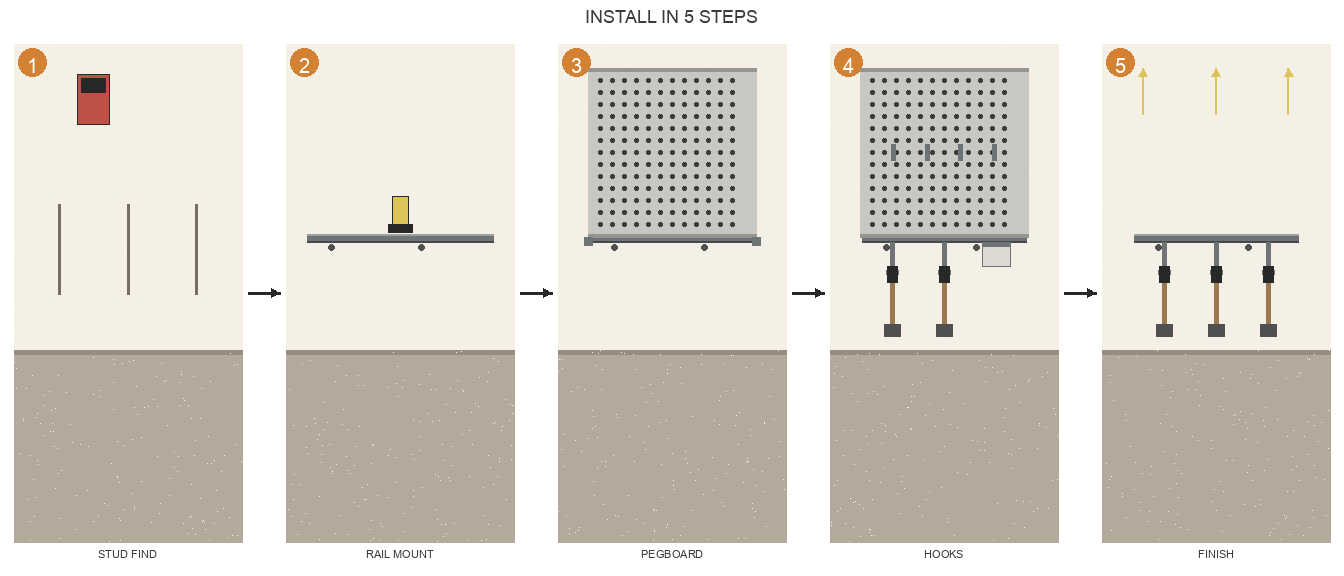
Cut a 4x4-foot pegboard panel to fit above the rail (64-84 inches off the floor). Mount into studs with 1-inch spacers for hook clearance. For slatwall, mount the 8x4-foot Proslat 88107 panel (P6) directly to studs — no spacers needed. Lay out the panel before drilling to confirm the height.
Step 4: Install Hooks and Accessories
Start with the heaviest tools: ladder hooks, bike hooks, broom holders. For ladders and bikes, a 6-pack of heavy-duty garage wall storage J-hooks (P10) at $23.99 covers both. The Rubbermaid FastTrack hook kit (P2) covers the five standard hooks. For shovels and rakes, the IMILLET 2-pack broom holder (P7) is a common long-tool hook choice.
Step 5: Test the Load and Label the Wall
Pull down on each hook with twice the expected weight to confirm the rail is anchored. Mark where each tool belongs with chalk. Photo the finished wall for reference. Tape the photo by the entry door so you remember what goes where. For rotation cycles, see the declutter maintenance routine.
Garage Wall Storage Layout by Wall Length
How much wall you have drives the system. We map three common wall lengths below.
| Rail Length | Fits | Setup | Est. Cost |
|---|---|---|---|
| 4 ft (48 in) | 8-12 ft walls, 1-car bay | 1 rail + 5-8 hooks (P1 + P2) | ~$136 |
| 8 ft (96 in) | 16-22 ft walls | 1 double rail + 4x4 pegboard above (P1 + P5) | ~$81 |
| 8 ft + panels | 24+ ft walls | rails both ends + 2 slatwall panels (P1 x2 + P6 x2) | ~$528 |
Costs track the product prices on this page (audited 2026-10-16).
Short Wall (8-12 ft) — Rail-Only, No Panels
For a one-car bay, mount a single 48-inch Rubbermaid FastTrack rail (P1) at 60 inches and add the Rubbermaid FastTrack hook kit (P2). Total: about $136 for the pair. For tight-space strategies, see the small garage organization guide.
Medium Wall (16-22 ft) — Rail + Pegboard Combo
The 2-car sweet spot. Mount one 96-inch rail at 60 inches for long-handle tools, then add a 4x4-foot pegboard panel above the rail for hand tools. The INCLY 120-piece kit (P5) fills a standard sheet with 60+ hooks and 12 bins. Pair with the garage tool bench on the same wall.
Long Wall (24+ ft) — Rail + Pegboard + Slatwall Hybrid
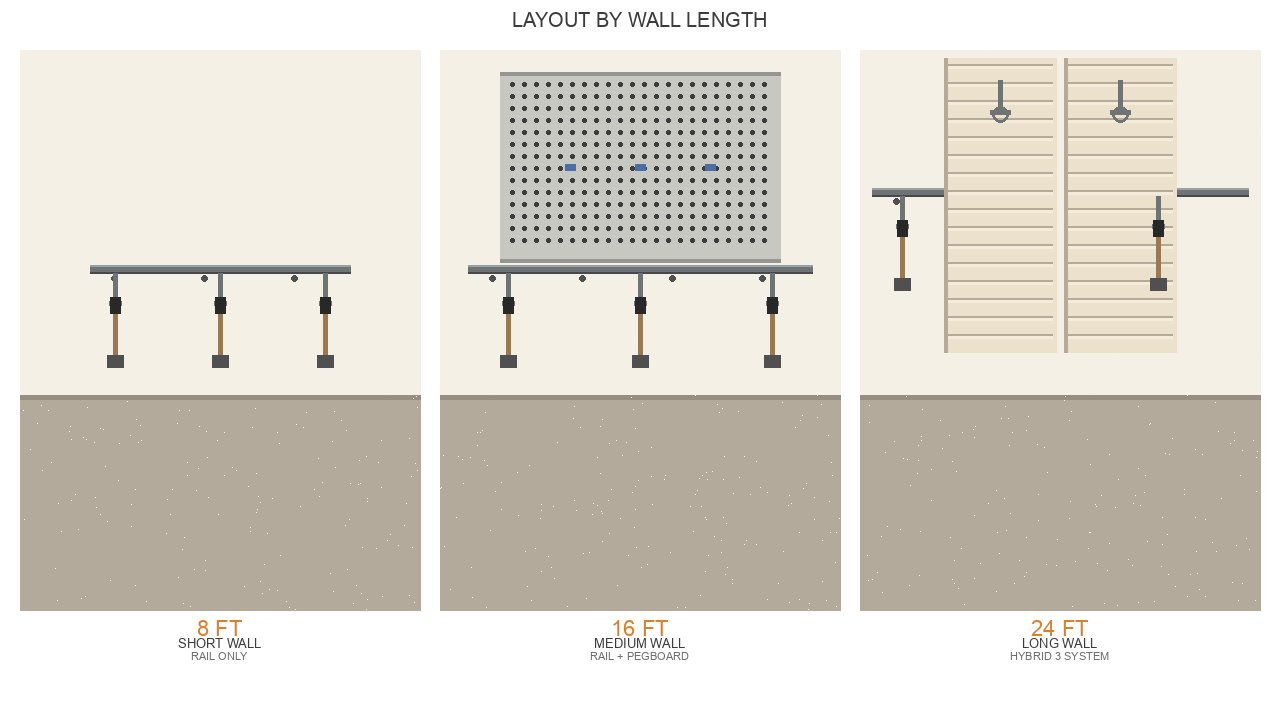
A workshop bay or 3-car tandem garage. Mount a 96-inch rail on each end for long-handle tools, then fill the middle 8 feet with two Proslat slatwall panels (P6) for 64 sq ft of mid-weight storage. The UUP 64-inch heavy-duty track (P8) is the upgrade pick for heavy tools.
Constraint Guide
Match the system to your situation, not the other way around. Below are 5 common constraints, each with a recommended system pick.
Constraint Scenarios at a Glance
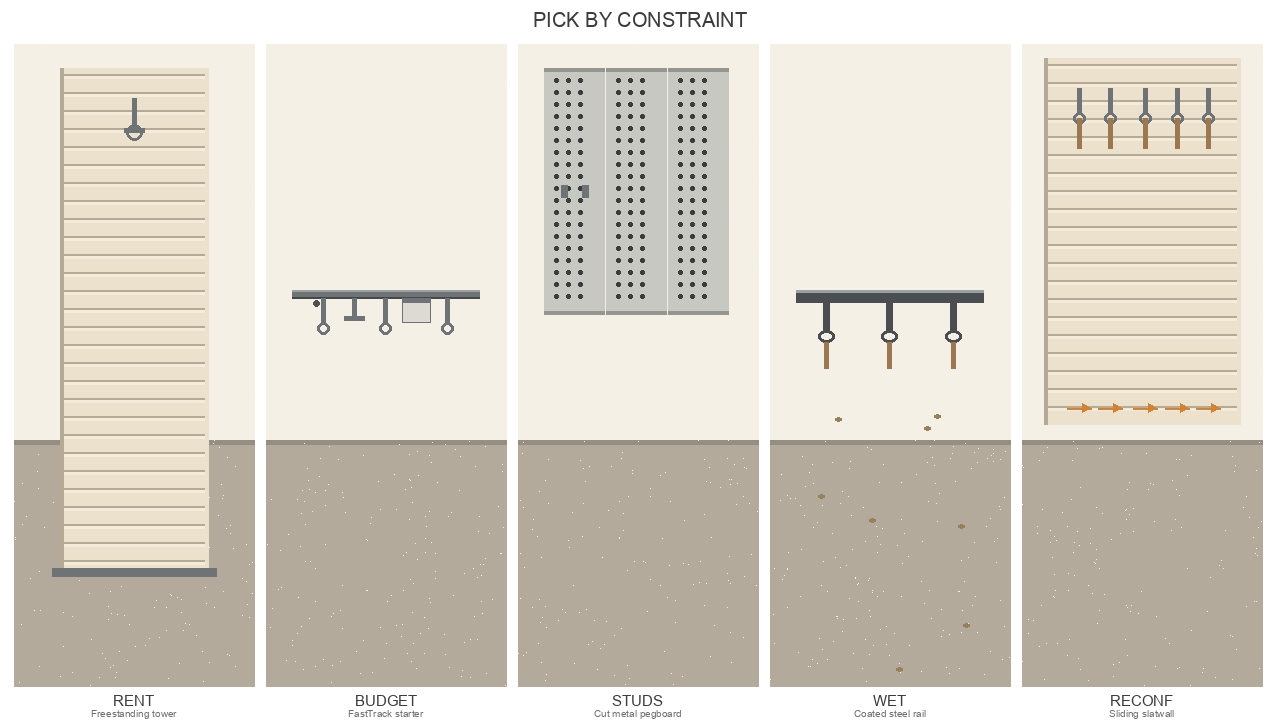
If You Rent — Rails Only, No Permanent Panels
Renters can still get functional garage wall organization with removable hooks. Use a Rubbermaid FastTrack rail (P1) with removable Command strip hooks, or skip the wall system entirely. Proslat and metal pegboard require drilling into studs — most leases don’t allow that. The UUP 48-inch track (P4) is the budget alternative for drywall-only mounting.
If You Want the Fastest Usable Wall — Rubbermaid FastTrack Rail + 5-Piece Hook Kit
The fastest path to a usable wall. The Rubbermaid FastTrack 2-Pack rail (P1) plus the Rubbermaid FastTrack hook kit (P2) covers a 1-car garage wall for about $136 combined (rail $64.12 + hooks $71.50). Pair with the IMILLET broom holder (P7) for long-handle tools.
If Your Wall Has Irregular Stud Spacing — Metal Pegboard, Not Slatwall
Metal pegboard (1/4-inch hole) cuts to fit any width with a jigsaw. Slatwall panels are 8 feet wide and assume 16-inch stud centers. If your studs are at 24 inches (newer construction), use metal pegboard or add horizontal blocking first. The INCLY 120-piece pegboard kit (P5) fits standard 1/4-inch and 1/8-inch panels, and the Wallmaster track (P3) cuts to a 24-inch bay.
If You Store Wet or Oily Tools — Powder-Coated Steel, Not Plastic
A wet shovel or oily bike chain stains plastic pegboard permanently. Choose powder-coated steel (Rubbermaid FastTrack (P1), Wallmaster track (P3), UUP 64-inch (P8)) and the IMILLET stainless steel broom holder (P7).
If You Need Frequent Reconfiguration — Slatwall, Not Pegboard
Pegboard requires unhooking and re-hanging every time you move a tool. Slatwall hooks slide horizontally without lifting — you can rearrange 10 hooks in 30 seconds. The Proslat 88107 slatwall (P6) accepts any standard slatwall hook or basket. Trade-off: slatwall accessories cost 2-3x more than pegboard hooks. Pair with the Rubbermaid FastTrack hook kit (P2) for long-handle tools.
The 5 Wall System Types Explained
Each system solves a different problem. Below are the 5 systems you will see on Amazon and at Home Depot.
Best Garage Wall Organizer by System Type
| System | Best For | Load Rating | Cost Level | Example Pick |
|---|---|---|---|---|
| Rail (FastTrack) | Long-handle tools | 1,750 lbs per 4-ft rail | $$ | Rubbermaid FastTrack 2-Pack (P1) |
| Track with hooks | All-in-one starter wall | 450-620 lbs total | $-$$ | Wallmaster 48-inch (P3) |
| Metal pegboard | Small hand tools, magnetic | 25-50 lbs per hook | $ | Wall Control pegboard pack (P9) |
| PVC slatwall | Mid-weight gear, frequent rearranging | 75 lbs per sq ft | $$$ | Proslat 88107 (P6) |
| Welded-hook organizer | Shovel and rake rows | 440-620 lbs total | $$ | UUP tracks (P4/P8) |
Rubbermaid FastTrack Rail System
A widely stocked rail system with strong FastTrack accessory support. A 48-inch steel channel mounts to studs; hooks slide in from the front. Compatible with 30+ accessories (bike, ladder, broom, J-hook, double hook). The Rubbermaid FastTrack 2-Pack (P1) holds 1,750 lbs per 4-foot rail.
Gladiator GearTrack / Wallmaster Track
A heavier-duty alternative to FastTrack. Wallmaster 48-inch track (P3) ships with 6 adjustable sliding hooks. Hooks lock into the channel with a friction lock, which prevents tools from sliding off if bumped.
Metal Pegboard (1/4-inch Hole)
Hardboard pegboard (1/4-inch hole) is the cheapest wall system per square foot. Metal pegboard (steel, 1/4-inch hole) is stronger and magnetic. Pair with the INCLY 120-piece hook kit (P5) for the full bin and hook range. The Wall Control galvanized steel pegboard pack (P9) is the metal pegboard pick for garage wall storage at $42.28 — 4.8 stars across 14,000+ reviews, the highest-rated product in this guide.
PVC Slatwall Panels (Proslat, Flowwall, StoreWALL)
Proslat 88107 slatwall panels (P6) are 3/4-inch thick PVC with grooves every 6 inches. Each 4x8-foot panel covers 32 sq ft of wall. The 75 lbs per sq ft load rating makes slatwall the heaviest-duty option after rails.
Welded-Hook Wall Organizers (UUP, Wallmaster, TIDYME)
A hybrid between a rail and a panel. The UUP 48-inch track (P4) ships with 6 welded adjustable hooks for shovels, rakes, and brooms. For heavier loads, the UUP 64-inch track (P8) bumps the rating to 620 lbs total.
How to Choose a Garage Wall Storage System
The tree below is the fastest way to pick. Answer “yes” to the first question and pick that system; if “no,” move to the next. Commit to one before adding a second.
| System | Weight per Hook | Rearranging | Cost vs Pegboard |
|---|---|---|---|
| Rails | Ladders and bikes (heaviest items) | Slide-in hooks | $$ |
| Pegboard | 25-35 lbs hardboard / up to 50 lbs metal | Unhook and re-hang | baseline |
| Slatwall | 50-75 lbs | Slide without lifting | 2-3x |
Are You Hanging Long-Handle Tools? — Start with Rails
If more than half of what you store is long-handle (broom, shovel, rake, ladder, bike), start with a rail system. The Rubbermaid FastTrack 2-Pack (P1) is the cheapest entry point. Pegboard can’t hold long tools.
Do You Need to Rearrange Often? — Slatwall Over Pegboard
Slatwall hooks slide horizontally without lifting; pegboard requires unhooking and re-hanging. The Proslat 88107 slatwall (P6) lets you rearrange 10 hooks in 30 seconds. If you reorganize monthly, slatwall is worth the 2-3x cost premium. If your layout is stable for a year or more, pegboard is fine.
Are You Storing Power Tools and Heavy Items? — Pegboard or Slatwall, Not Rails
Rails are shaped for long-handled gear rather than compact, heavy items. For cordless drills, circular saws, and paint cans, use pegboard or slatwall. The INCLY 120-piece kit (P5) covers 25-35 lb hooks; Proslat 88107 slatwall (P6) handles 50-75 lb hooks.
Common Mistakes
Five common failures in garage wall storage installations:
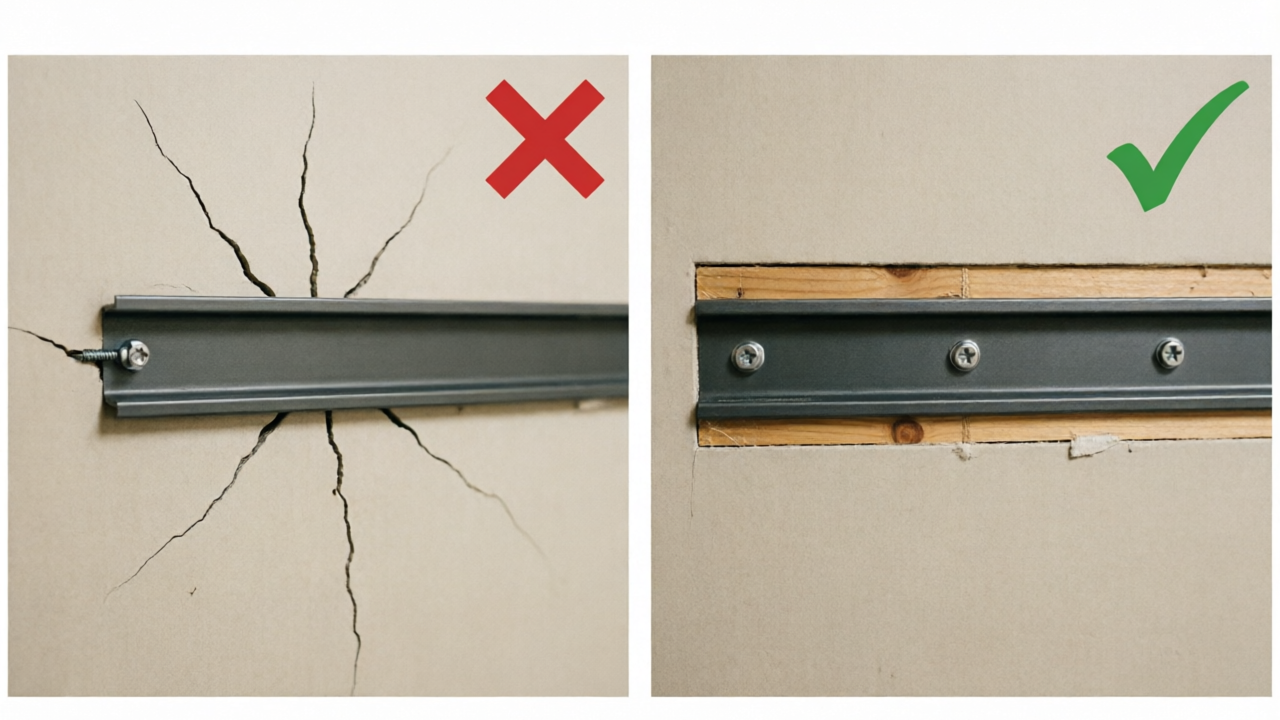
- Anchoring Rails to Drywall Only
A rail mounted only to drywall anchors will pull out under load. Always anchor into studs (the Rubbermaid FastTrack (P1) 1,750-lb rating requires studs).
- Buying a Pegboard Without Spacers
A flush-mounted pegboard won’t accept hooks — they need 1/2 inch of clearance behind the panel. Use 1-inch spacers or the pegboard becomes wall decoration. The INCLY 120-piece kit (P5) ships with hooks for both 1/2-inch and 1-inch spacings.
- Skipping the Stud Finder
Eyeballing stud locations works 30% of the time. Use a stud finder, mark both edges, and aim for the center. Missing the stud by 1/2 inch means the screw only grips drywall. The Wallmaster 48-inch track (P3) ships with a stud-finder template sticker.
- Mounting the Rail Too Low or Too High
60 inches from the floor is the sweet spot for most adults. Mounting at 48 inches puts the rail in the way of the lawn mower; mounting at 72 inches makes the top hooks unreachable. Test the height with painter’s tape. Pair with the garage overhead storage ceiling system for the ladder and seasonal bins.
- Forgetting the Broom and Mop
Rails and pegboard don’t help if the broom is still in the corner. Add at least one broom holder per rail — the IMILLET 2-pack (P7) is a common hook choice. It slides into the Rubbermaid FastTrack rail (P1) or mounts to studs.
Related
- See the full garage organization hub for an overview of all garage storage systems
- See Garage Overhead Storage for ceiling-mounted systems that complement a wall system
- See Garage Floor Shelving for floor-mounted shelving that pairs with the wall layout
- See Garage Cabinet Storage for enclosed storage next to the wall system
- See Garage Tool Bench for the workbench anchor on the same wall
- See Garage Zone Organization for the larger system-of-systems framework
- See Garage Storage Solutions for the full overview of garage options
- See Garage Organization (the hub article for the whole collection)
Key Takeaways
- Start with a Rubbermaid FastTrack rail (P1) for long-handle tools — cheapest and fastest.
- Add pegboard (P5) or slatwall (P6) above the rail only when small-item storage becomes the bottleneck.
- Always anchor rails to studs, not just drywall.
- Pick slatwall (P6) if you reorganize monthly; pick pegboard (P5) if the layout is stable.
- 60 inches from the floor is the sweet spot for rail mounting.
- For the universal reset method, see declutter fast. For the entry-point guide, see start here.
- Garage wall organization works best in layers: rail first, panels second, hooks last.