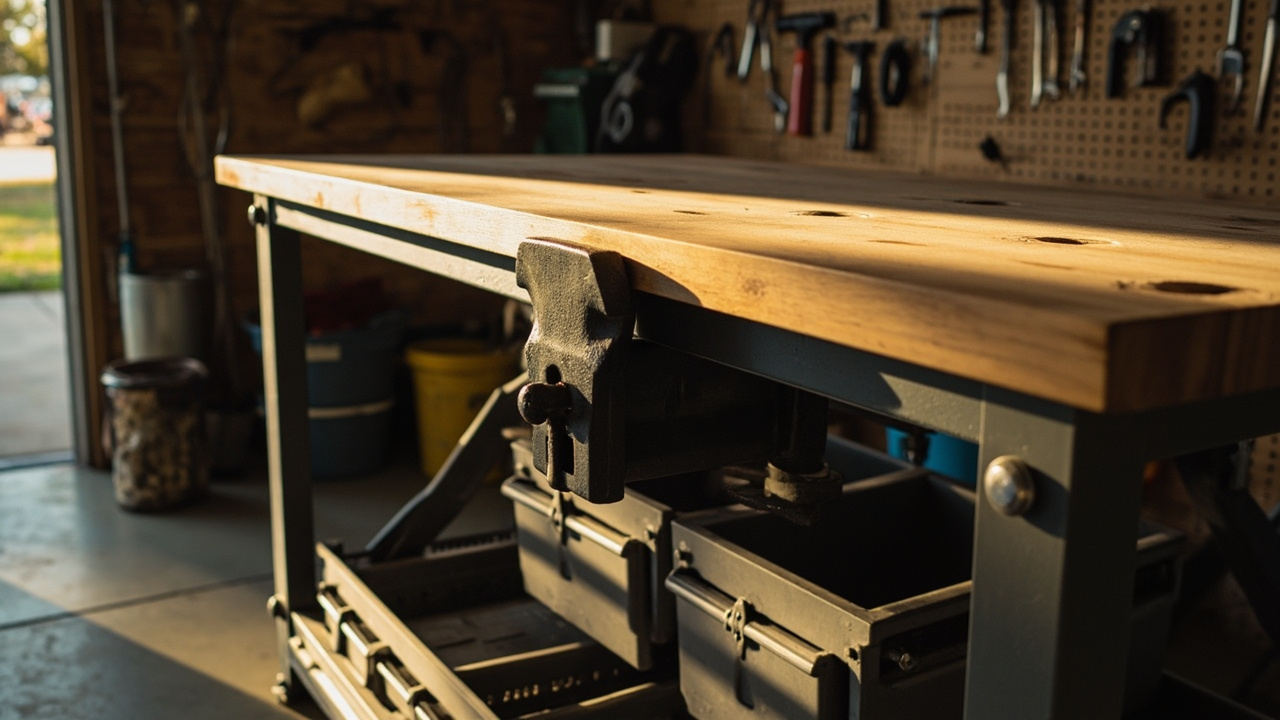
A garage tool bench is a heavy-duty work surface designed for projects — saws, engines, glue-ups, paint, and repairs. The 5 features that decide whether one survives real projects are 1,500+ lb capacity, 24 inch+ depth, 48 inch+ width, modular storage, and either integrated power or a power strip.
The garage hub frames the 5-zone system; this guide drills into the workbench zone — the active project surface in any garage. For the broader 4-type storage framework where the workbench sits alongside cabinets, floor shelves, and overhead racks, see the 4-type garage storage system. If your garage is stuffed with unrelated junk, run the garage declutter checklist first so you buy the bench you actually need.
Why a Real Workbench Beats a Fold-Down Table or Countertop
The garage workbench takes more abuse per square foot than any other surface in the house. A kitchen countertop sees plates and cutting boards; a workbench sees 80-lb engines, chop saw recoil, grinder sparks, and solvent spills. A fold-down table or repurposed dining table is rated for 50–150 lb of static load — the first transmission block on it racks the legs and sags the top.
Real workbenches use 1.3mm+ steel frames, 1 inch+ solid wood or steel tops, and cross-bracing that handles dynamic loading. They also justify their footprint through integrated features: backsplashes, mounting holes for a vise, and either integrated power (P4) or a flat back edge for a power strip (P7).
5 Features That Decide Whether a Workbench Survives Real Projects
Five specifications to read before you buy — and what each one actually means in daily use.
Five Features at a Glance
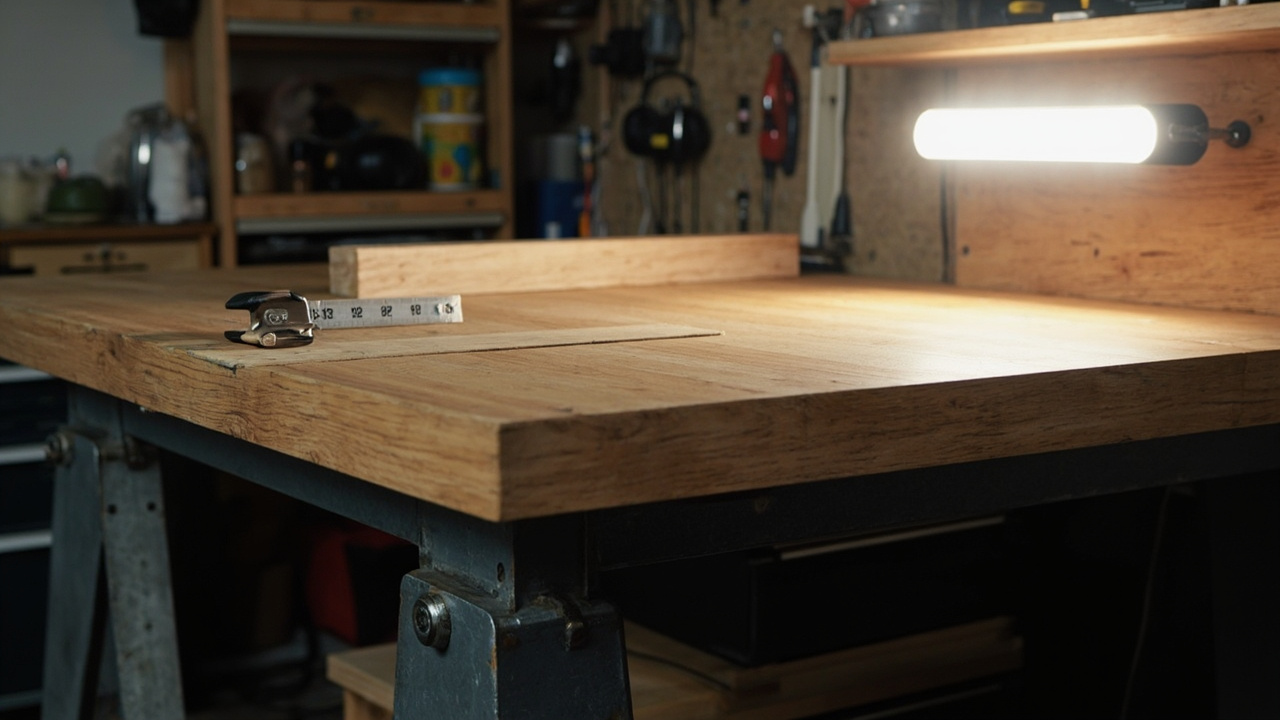
Weight Capacity (1,500 lb minimum for daily work, 1,000 lb acceptable for occasional)
Rated load is the easiest number to find and the hardest to interpret. The Keter Folding Workbench (P1) at 1,000 lb is the right pick for occasional DIY. The WORKPRO 48 inch (P2) at 2,000 lb handles daily workshop use. The WORKPRO 96 inch (P4) at 4,000 lb is overkill for most homeowners but right for engine restoration. The Montezuma 72 inch (P3) trades concentrated capacity for a 72-inch spread-out surface. We always anchor benches wider than 60 inch to wall studs when load exceeds 50% of rating.
Depth and Width (24 inch+ deep, 48 inch+ wide for real projects)
Shallow workbenches under 24 inch deep can’t hold a miter saw base or an engine block without overhang. The Keter (P1) measures 33.5 inch × 21.7 inch — fine for a folding portable but tight for stationary tools. The WORKPRO 48 inch (P2) is 48 inch × 20 inch deep; the Montezuma 72 inch (P3) is 72 inch × 24 inch deep — wide enough for a full sheet of plywood on edge. For a one-car garage with a single parking bay, a 48 inch bench fits; for a two-car or workshop layout, go 72 inch+ to avoid playing musical chairs with projects.
Surface Material (Solid Wood for finish work, Steel for heavy duty)
Solid wood tops (rubberwood, maple, beech) absorb vibration from saws and hammers. The WORKPRO 48 inch (P2) uses FSC-certified rubberwood; the Montezuma 72 inch (P3) uses a 1.25 inch solid wood top that resists glue and solvent. Steel tops (SPCC panels on P4) handle welding sparks and engine oil without staining, but transfer cold to your hands. Skip MDF or particle board — they swell with moisture.
Modular Storage Integration (Backsplash / Pegboard / Drawer / Lower Shelf)
A bare-top workbench wastes vertical space. The WORKPRO 96 inch (P4) includes an integrated pegboard backsplash — hang screwdrivers, wrenches, and clamps without a separate wall installation. The Eltean Rolling Workbench (P5) adds 6 drawers + a magnetic key-lock storage cabinet underneath, ideal for shared garages.
Power and Lighting (Integrated outlet vs add-on power strip)
Integrated power is rare and valuable — the WORKPRO 96 inch (P4) is the only bench in this guide with built-in outlets, eliminating the need for a separate power strip that competes for floor space. For benches without integrated power (P1, P2, P3, P5), the Addtam Surge Protector (P7) at $12.98 mounts with the included screw tabs and adds 6 AC outlets + 4 USB ports.
Choose by Work Profile (Decision Tree)
Five common garage user profiles, each with a recommended bench. We rank them by what we see most often in workshops.
Work Profile Decision Tree
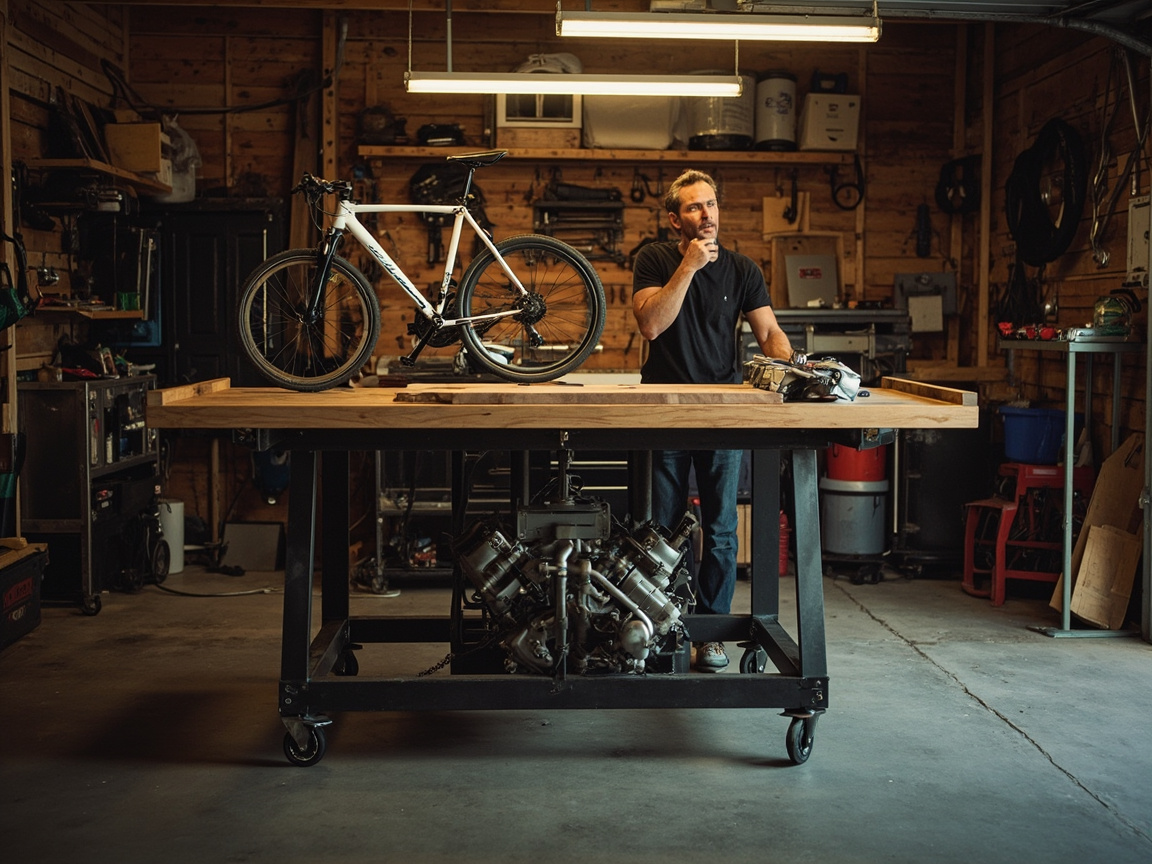
Hobby Mechanic (occasional weekends, oil changes, brake jobs)
You need a workbench that can hold an engine block or transmission occasionally and rolls out of the way when you’re parking. The Eltean Rolling Workbench (P5) is the right pick — locking cabinet with magnetic key-lock, 1000 lb capacity, rubber-mat work surface, rolls out when the car needs the space.
Woodworker / DIY Projects (saw, planer, glue-ups, finishing)
You need a wide, smooth surface that absorbs vibration and resists glue. The Montezuma 72 inch (P3) is built for this — 72 inch wide for sheet goods, 1.25 inch solid wood top, height adjustable 29 to 41 inch. See the 5-zone garage layout for placement.
Auto Restoration / Engine Work (rebuilds, machining, parts cleaning)
You need maximum rated capacity, integrated power, and 24 inch+ depth for engine stands. The WORKPRO 96 inch with Power (P4) is the only bench in this guide that meets all three — 4,000 lb capacity, integrated outlet, built-in pegboard.
Weekend DIY / Light Projects (occasional assembly, painting, small repairs)
You don’t need a permanent workbench — a portable folding surface that stores flat against the wall is the right answer. The Keter Folding Workbench (P1) at 1,000 lb sets up in 30 seconds and folds to 4.4 inches thick — perfect for one-car garages.
Mixed Use (cars + projects, varying load, multi-purpose)
You need a mid-tier adjustable workbench for both car-adjacent work and household projects. The WORKPRO 48 inch (P2) at 2,000 lb and 31.5 to 39.4 inch height adjustment is the most versatile single pick — fits a one-car garage, handles engines, adjusts for the whole family.
Layout by Garage Size
Three garage-size scenarios. Match the bench to the bay, not the catalog.
Garage Size Layout at a Glance
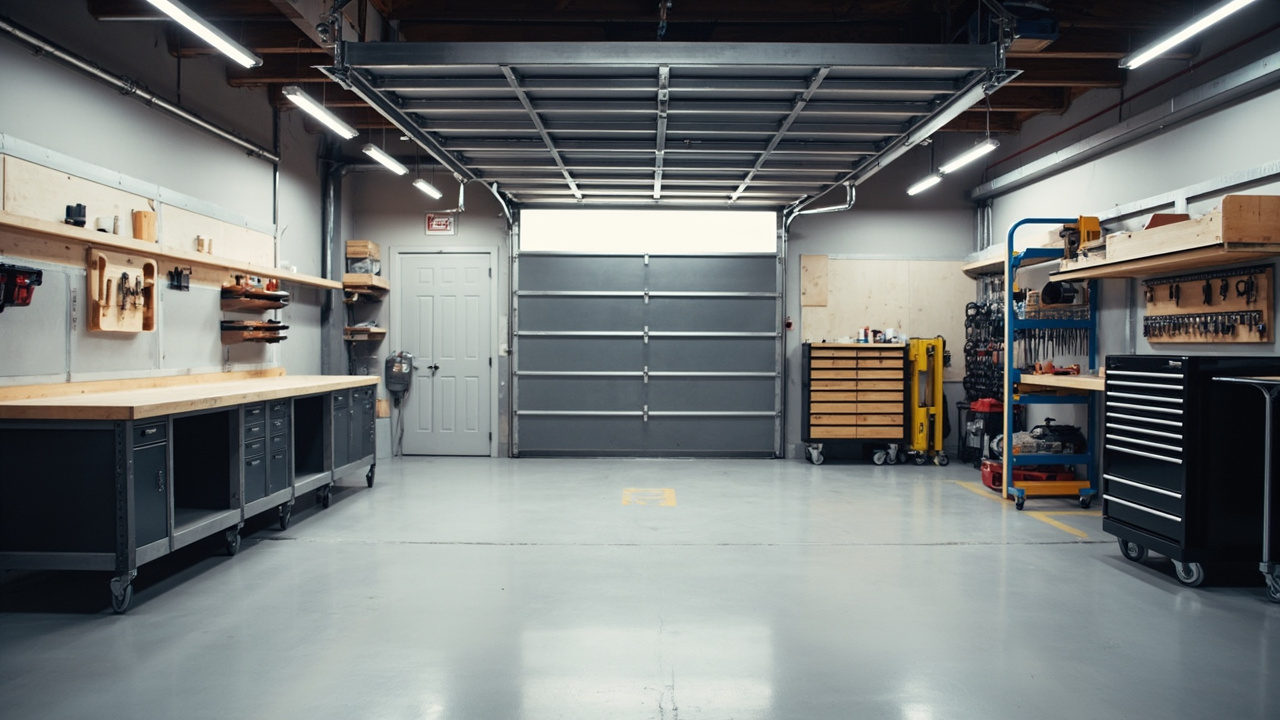
1-Car Garage (12x22 ft) — Folding or Compact Fixed Bench
Single-bench layout for the typical 12x22 foot bay. Park the Keter Folding Workbench (P1) against the back wall when the car is in, fold it out when working. Add a WORKPRO Vise (P6) for cutting and filing tasks. For space-constrained strategies, see the small garage organization guide.
2-Car Garage (22x22 ft) — One Wide Fixed Bench + Rolling Companion
Two-zone layout for the 22x22 two-car. Mount one WORKPRO 96 inch with Power (P4) along the back wall with integrated power for grinders and sanders. Add a Eltean Rolling Workbench (P5) for tool storage. Pair with an Addtam Power Strip (P7) for the second bench if you don’t have P4.
Workshop / Detached Garage (24x24+ ft) — Premium Wide + Companion Benches
Workshop layout with a wide primary bench. Mount the Montezuma 72 inch (P3) along the back wall for finish work and staining, and add the WORKPRO 48 inch (P2) as a secondary bench for metalwork or sharpening. Use the WORKPRO 96 inch (P4) instead if you want integrated power and pegboard on the primary bench. Pair with garage overhead storage above to keep seasonal bins off the work surface.
Constraint Guide
Five real-world constraints that change the product choice.
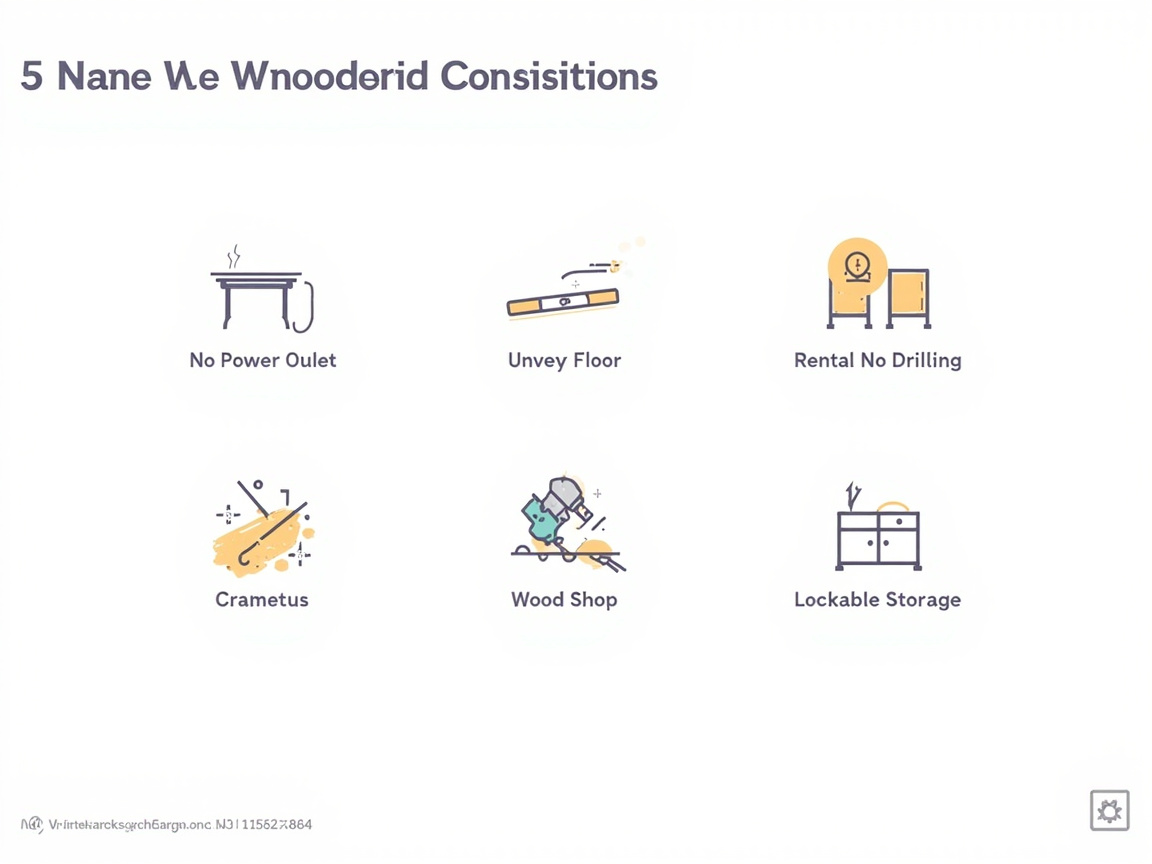
If Your Garage Has No Power Outlet Near the Bench — Pick the WORKPRO 96 inch (P4) for Integrated Power
If running a new electrical circuit isn’t in your budget, the WORKPRO 96 inch (P4) is the only bench with a built-in power outlet — one wall plug gives 6+ outlets on the bench. For other benches, add an Addtam Power Strip (P7) and route its 5ft cord.
If Your Garage Floor Is Uneven or Sloped — Pick a Bench with Adjustable Leveling Feet (P2 or P4)
Old garages settle — concrete slabs can slope 1/2 inch over 8 feet. The WORKPRO 48 inch (P2), WORKPRO 96 inch (P4), and Montezuma 72 inch (P3) include adjustable leveling feet. Use composite shims if your floor slopes more than 1/4 inch over the bench length.
If You Rent and Cannot Drill the Wall — Pick the Keter Folding (P1) or Eltean Rolling (P5)
Rental rules usually prohibit wall-mounted storage. The Keter Folding Workbench (P1) is fully portable — sets up and folds without installation. The Eltean Rolling Workbench (P5) rolls on casters and locks — no wall mounting required.
If Your Garage Doubles as a Wood Shop — Pick the Montezuma 72 inch (P3) for Finish Work
A garage that also functions as a wood shop needs a wide, glue-resistant surface. The Montezuma 72 inch (P3) is purpose-built — 72 inch wide for sheet goods, 1.25 inch solid wood top resists glue and solvents. Skip rubberwood for solvent-heavy work — the open grain absorbs acetone. The storage bins decision guide pairs the bench with small-parts bins.
If You Need Lockable Tool Storage — Pick the Eltean Rolling Workbench (P5)
For shared garages (apartment, multi-family, roommates) or any garage where tools must lock, the Eltean Rolling Workbench (P5) has a magnetic key-lock cabinet and 6 drawers underneath a rubber-mat work surface. Most workbenches are either fully open or fully cabinet; P5 is the only mid-tier pick with both. The garage cabinet storage guide covers dedicated cabinet-only setups.
Common Mistakes
Five owner mistakes that shorten workbench life from 10+ years to 1–2 years.
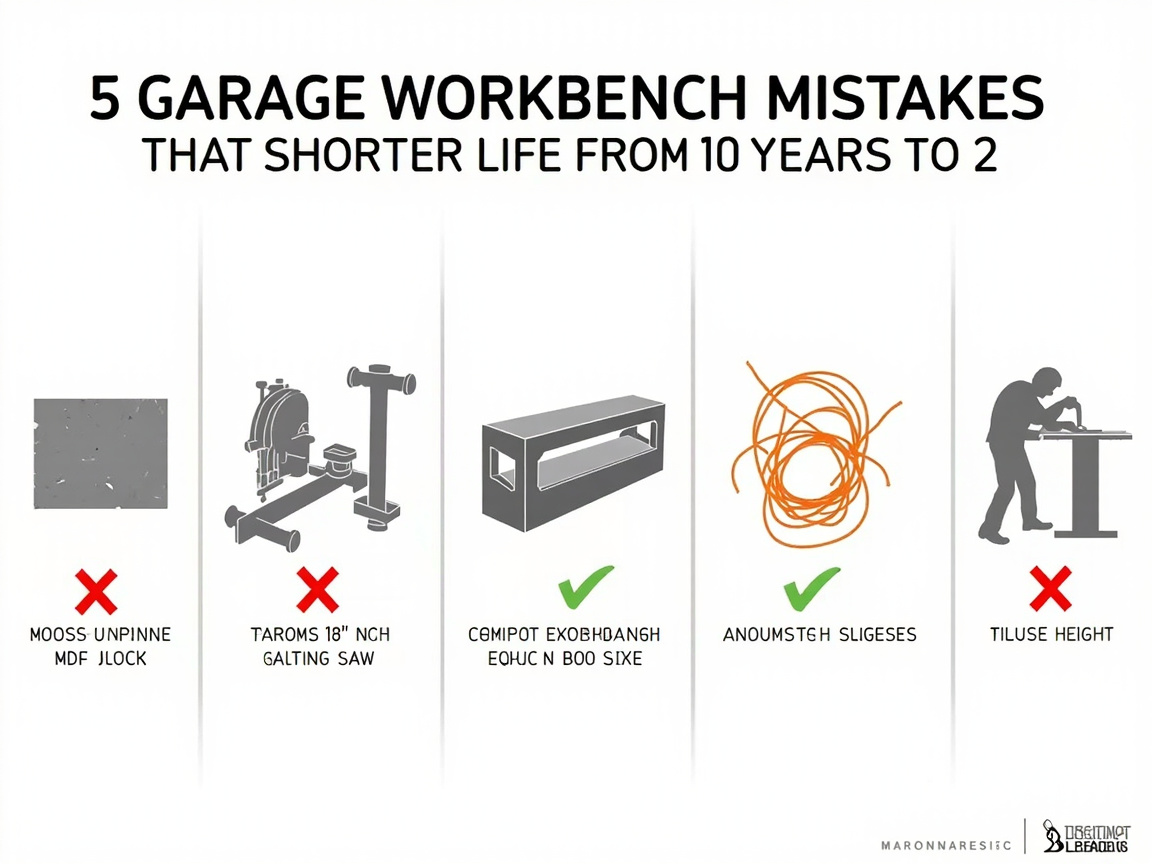
- Buying the Cheapest MDF-Top Workbench and Expecting It to Survive Saws or Engines
MDF and particle board tops swell with any moisture — a sweaty engine block, a wet lawnmower, a spilled drink. Within a year the top warps and any load over 50 lb crumbles the corners. We have seen Keter folding (P1) plastic/composite tops and WORKPRO/Montezuma solid wood and steel tops handle moisture correctly.
- Choosing a Workbench That’s Too Shallow (Under 24 inch Depth) for Real Projects
A shallow 18 inch-deep workbench can’t hold a miter saw base without overhang. Saw recoil tips the workpiece forward and off the bench. We recommend the Montezuma 72 inch (P3) at 24 inch depth for stationary tools; the WORKPRO 48 inch (P2) at 20 inch works for hand-tool work only.
- Skipping the Vise at Setup and Never Adding It Later
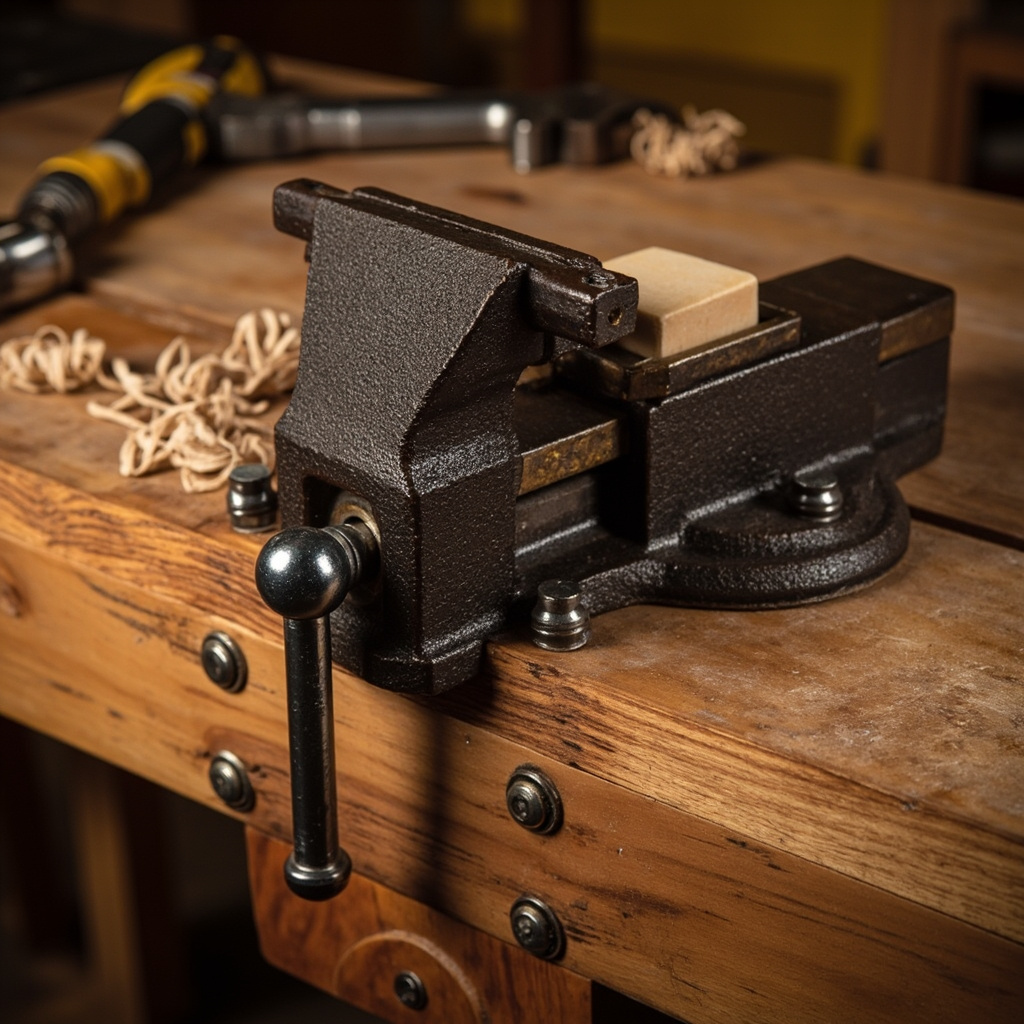
A bare-top workbench is missing half its utility. A vise lets you hold metal for cutting, file work, and glue-ups without clamps — the WORKPRO 4-1/2 inch Vise (P6) at $43.69 bolts to any bench top in 15 minutes.
Proper Vise Mounting
- Forgetting the Power Strip Until the First Project Needs Power
Only the WORKPRO 96 inch (P4) has power built in. For P1, P2, P3, and P5, the Addtam Power Strip (P7) at $12.98 is the cheapest insurance against mid-project outlet scrambles.
- Choosing the Wrong Height and Ignoring Adjustment
Standard homeowner workbench height is 34–36 inches. Taller users (above 6 feet) work better at 38–40 inches. We always pick adjustable benches (P2 or P3) when multiple family members share the workspace. The 5S method frames bench organization around “set positions” — sort tools, set heights, shine surfaces, standardize, sustain.
What You’ll Need (7 Picks Across $13–$380)
Seven products. Workbench first: Keter Folding (P1) $109.99 / 1,000 lb — portable. WORKPRO 48 inch (P2) $191.99 / 2,000 lb — adjustable. Montezuma 72 inch (P3) $328.91 — premium wood. WORKPRO 96 inch (P4) $379.99 / 4,000 lb — integrated power. Eltean Rolling (P5) $269.99 — locking cabinet.
Accessories: WORKPRO Vise (P6) $43.69. Addtam Power Strip (P7) $12.98.
When to Call a Pro
Three scenarios where DIY hits a hard limit.
- Concrete work — drilling anchor holes into concrete or running a new 240V circuit for a welder or compressor requires an electrician or concrete contractor. Budget $300–$800 for a 240V outlet.
- Wall anchoring into concrete or metal studs — if your garage wall is concrete block, brick, or metal studs, standard wood-stud lag screws won’t hold. Use concrete wedge anchors ($30/box of 50) or call a handyman.
- Reconfiguring garage door tracks — moving the tracks back for a wider workbench is a garage-door technician job. Budget $500–$1,500.
Related
- Garage hub — full 5-zone garage organization system
- 4-type garage storage system — workbench + cabinet + floor shelves + overhead storage
- Small garage organization — layout strategies for one-car garages
Key Takeaways
- Pick by work profile, not price — a hobby mechanic needs a lockable rolling cabinet; a woodworker needs a wide solid wood top.
- 1,500+ lb capacity and 24 inch+ depth are non-negotiable for any bench that sees real projects.
- Solid wood or steel tops, never MDF — MDF swells with moisture and bows under load.
- Add the vise and power strip at first setup — bare-top benches become unused tables.
- Anchor any bench wider than 60 inch to wall studs — tip-over risk on heavy pulls.