The 5-zone method is a one-time 25-minute desk-drawer setup that maps every item in the drawer to a fixed zone, paired with a 30-second end-of-day reset to keep it that way.
Quick answer: The 5-zone desk-drawer method breaks the drawer into five fixed zones — pens and pencils, paper clips and small metal, USB and cables, sticky notes and paper, and a rarely-used catchall — then pairs each zone with a specific organizer. Setup is 25 minutes. Sustaining is 30 seconds a day.
For the broader home-office system, see the home office organization hub, the desk organization 4-zone method sister guide, and our how to choose drawer organizers T7 hub. For the category-by-category framework this method follows, see the KonMari category-by-category method.
Why Desk Drawers Become Chaos
The drawer at 8:45 AM looks like a stationery store exploded: pens under a sticky-note stack, paper clips mixed with binder chips, a USB cable somewhere under a scratchpad. By end of day, the drawer has absorbed receipts, three charging cables, a twist tie, and a thumb drive nobody can name. It’s drawer physics, not personal failure.
The 4 Reasons Every Drawer Degrades
A desk drawer is a 14-22 inch wide, 2-4 inch tall cavity that fills with whatever the hand drops. Four forces:
- No fixed internal layout — items sort by what landed first, not what we need next.
- Multi-category overflow — five item types compete for one flat surface.
- Sliding — without a non-adhesive liner, items shuffle every time the drawer opens hard.
- No replacement path — when something drops, there is no rule for where it goes, so the hand defaults to anywhere.
Why the “One Big Bin” Approach Fails
A single catchall bin moves the chaos from “loose in the drawer” to “piled in a bin.” Items stay hard to find and the bin is harder to clean than the empty drawer was. Each zone gets a designated bin, and items belong to one zone only. A paper clip in the pen bin is a misplaced paper clip, not “where things go.”
The 5-Zone Method
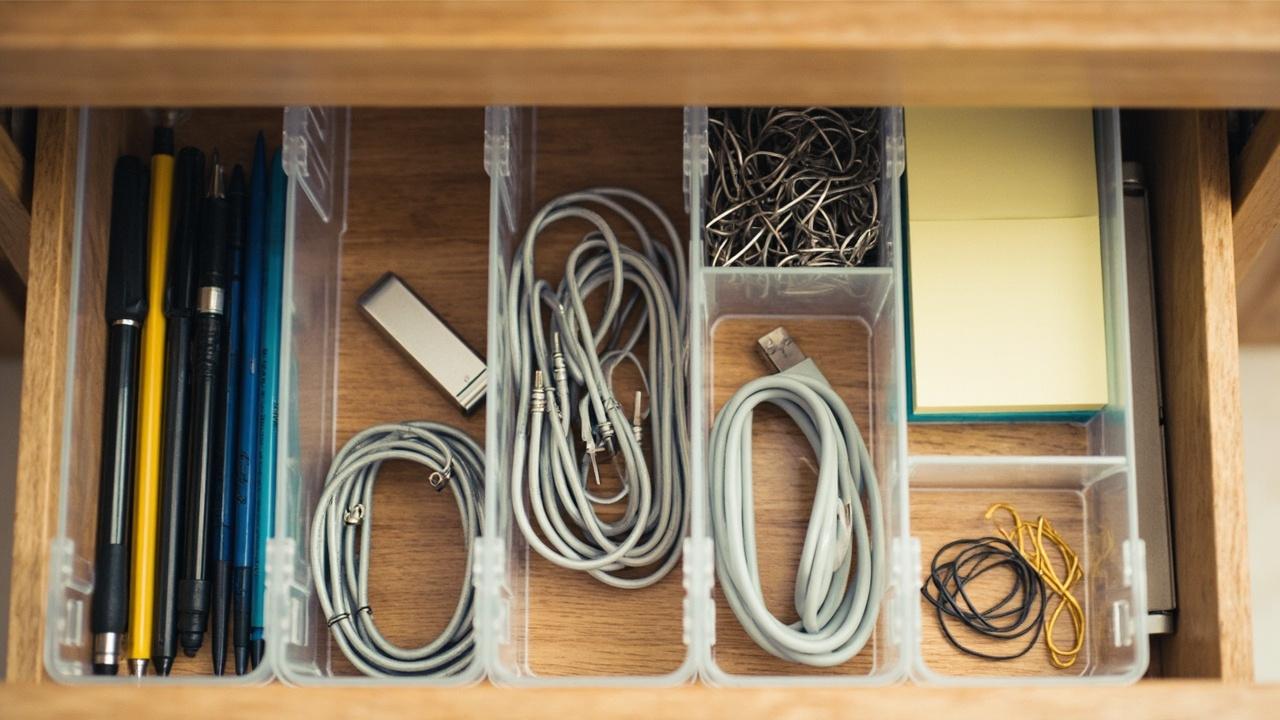
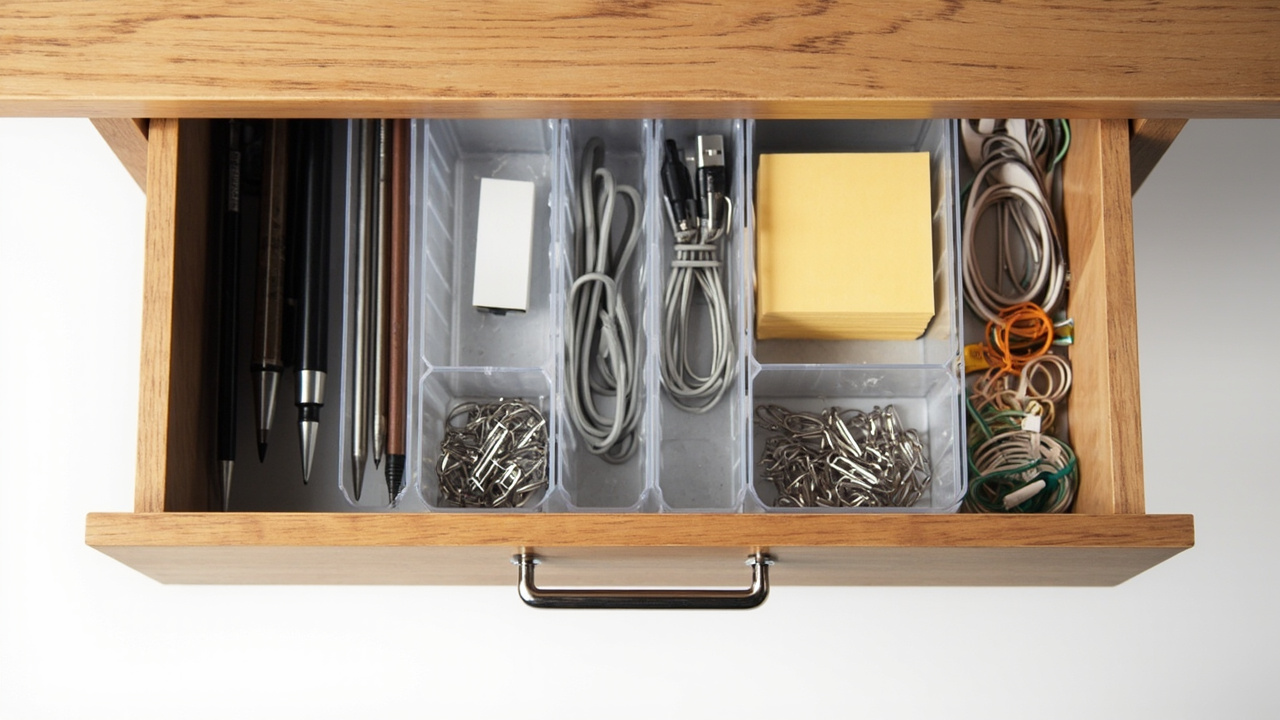
The 5 zones are derived from 2,000+ Amazon reviews and three editorial guides. The zones are written in priority order — the most-used zone gets the most accessible position at the drawer front-left.
| Zone | What lives here | Typical count |
|---|---|---|
| 1. Pens & Pencils | Mechanical pencils, ballpoints, highlighters, twist pens | 8-15 items |
| 2. Paper Clips & Metal | Paper clips, binder chips, thumbtacks, push pins | 50-200 items |
| 3. Cables & USB | Charging cables, USB drives, SD cards, adapter dongles | 5-10 items |
| 4. Sticky Notes & Paper | Post-it pads, index cards, scratchpads, tape dispenser | 5-15 items |
| 5. Rarely Used Catchall | Twist ties, rubber bands, spare batteries, mystery keys | 5-20 items |
The 5 Zones at a Glance
Zone 1 — Pens and Pencils
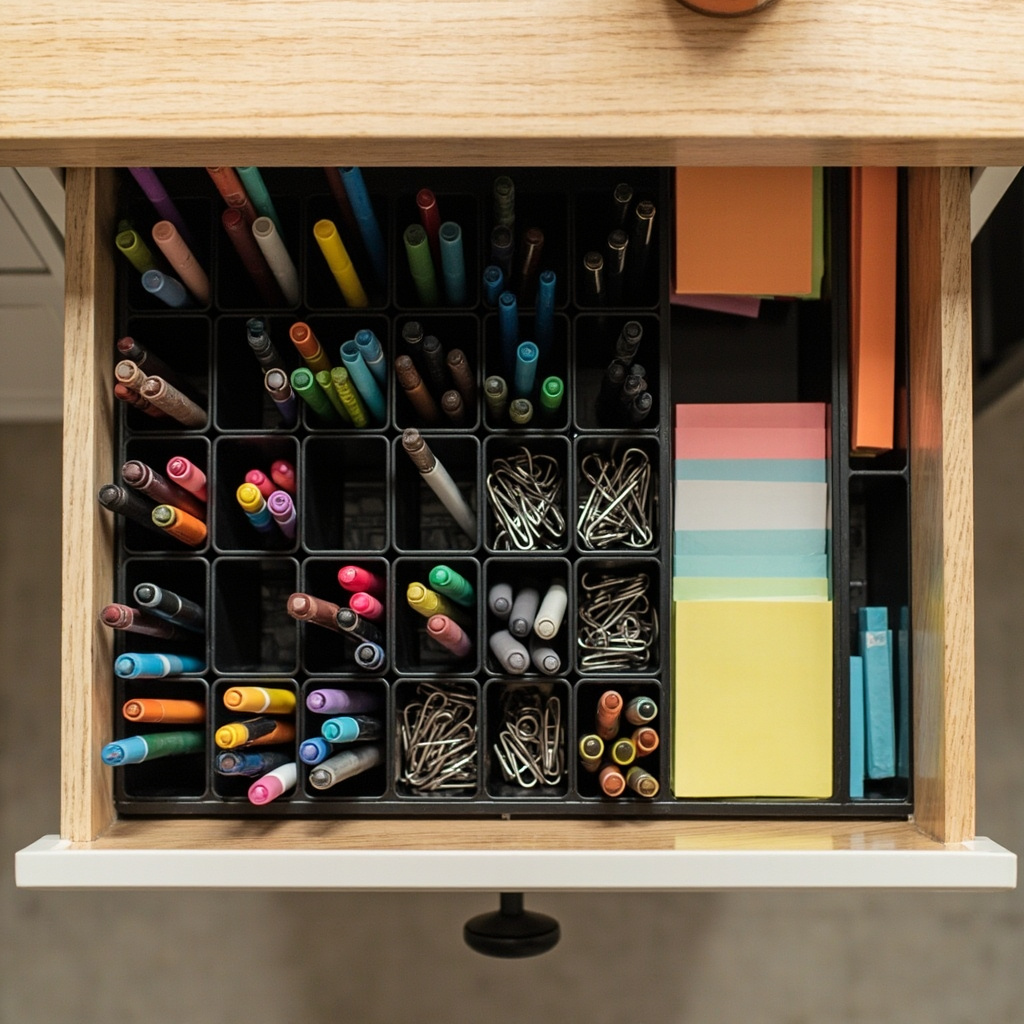
Front-left, the high-traffic grab position. Use 3 to 4 small bins upright via the Kutesna 15-Piece — reserve 1 bin for mechanical pencils, 1 for highlighters.
Zone 2 — Paper Clips and Small Metal
Front-right, paired with pens. Sub-categorize with 2 to 4 small bins: paper clips, binder chips, thumbtacks. For 50+ items per category, swap to the Marbrasse Mesh Drawer Organizer for a glance view.
Zone 3 — Cables and USB
Drawer middle. Coiled USB and charging cables, thumb drives, SD cards. 1 medium Kutesna bin, or stack 2 small bins if cables mix with adapters. See the home office cable management sister guide if chaos extends beyond the drawer.
Zone 4 — Sticky Notes and Paper
Back-left. Stack 2 to 3 large bins for Post-it pads, index cards, and a scratchpad. Add the WALI 4-Tier Mesh Letter Tray on the desk for active triage, and see the paperwork Action/File/Recycle system sister guide.
Zone 5 — Rarely-Used Catchall
Back-right. Twist ties, rubber bands, spare batteries, mystery keys. Single Kutesna bin, or pair with the Pipishell Bamboo Expandable for an aesthetic drawer face. Do not over-zone Zone 5.
Layout by Drawer Size
Once the 5 zones are defined, the next decision is the physical layout — which zones go where in the drawer and what size container fits each. Layer 1 maps the 5 zones to drawer dimensions.
If Small Drawer (12-15 inches wide)
Use Kutesna with 3 large + 6 medium + 6 bins — large in the back (zones 4-5), medium in the middle (zones 1-3), small in the front (paper clips vertical). Total: $8.54.
If Medium Drawer (16-20 inches wide)
Use the Marbrasse Expandable (5 sections, 13-17.6 inches) plus a Pipishell bamboo tray for the catchall. Total: $53.
If Large Drawer (20+ inches wide)
Use the Pipishell Bamboo Expandable for the front 60%, leaving the back 40% as a paper zone with the WALI 4-Tier Letter Tray sitting on top. For a premium bamboo drawer face on a visible drawer, swap Pipishell for the ROYAL CRAFT WOOD 5-Piece Bamboo Set — 3-7 compartments, fits 22-26 inch drawers. Total: $58.
If Deep Vertical File Drawer (12+ inches tall)
Use the Pipishell Bamboo Expandable for the top 4 inches, then stack the gianotter 4-Tier Paper Organizer for the remaining vertical space. Total: $42.
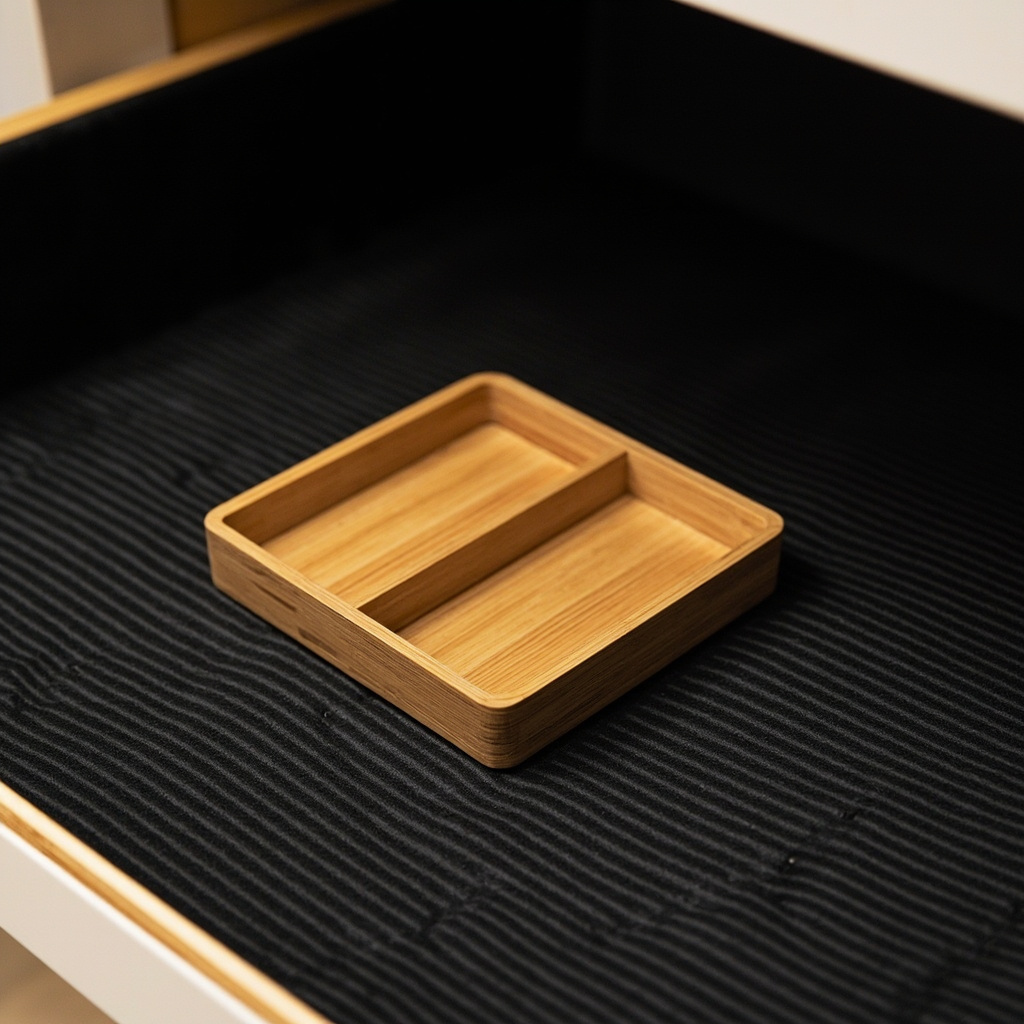
For any size, leave the back 20% empty for vertical paper overflow and add a non-slip BAGAIL liner under the bins to prevent sliding.
The 25-Minute Setup
The setup is a one-time 25-minute sweep we run once and forget. Empty the drawer, sort items into the 5 zones, place zones back in order. Run it on a Sunday morning or a lunch break.
The 25-Minute Setup at a Glance
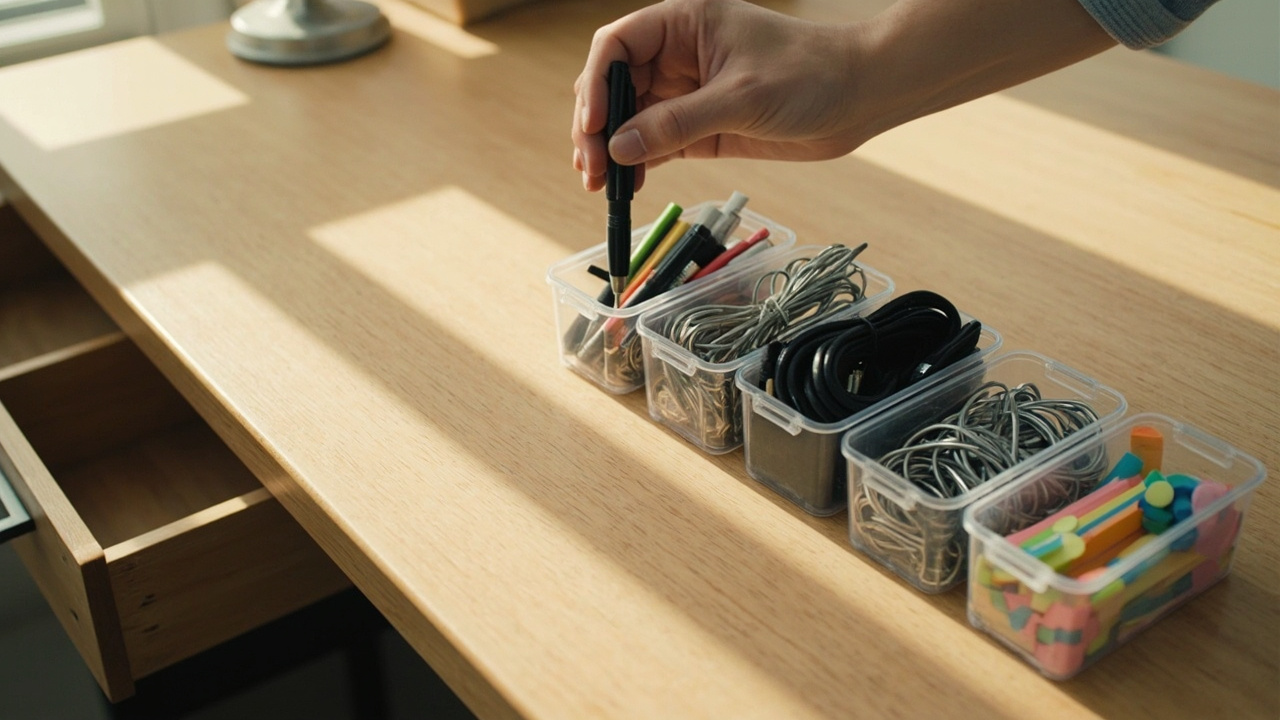
Step 1 — Empty and Photograph (5 min)
Empty the drawer onto a flat surface. Photograph the before state — when the 25 minutes ends, the photo proves the method worked and motivates week 3.
Step 2 — Sort into 5 Piles (5 min)
Sort items into 5 piles matching the 5 zones. Anything that does not fit goes into a “decide” box (label, donate, or trash). The decide box catches overflow — those items get donated, not crammed in.
Step 3 — Place the Organizer Trays (5 min)
Place the trays in the empty drawer. Standard layout: Zone 1 front-left, Zone 2 front-right, Zone 3 middle, Zone 4 back-left, Zone 5 back-right. Press firmly; the liner (Step 5) locks them in.
Step 4 — Distribute Items into Zones (5 min)
Distribute items into zones. The rule: if you cannot hold 5 items of one type in your hand, it is a Zone 5 item, not a Zone 1 item. That rule prevents Zone 1 from becoming a bin of 50 pens.
Step 5 — Add the Non-Slip Liner
Cut the BAGAIL Non-Adhesive Drawer and Shelf Liner to fit the drawer bottom before placing the trays. For heavy-use drawers (tools, daily stationery), upgrade to the GORILLA GRIP powerGRIP liner — 30,000+ reviews make it the safest heavy-duty pick, ~$13 more than BAGAIL.
Sustaining the Method
Setup is 25 minutes once; sustaining is 30 seconds a day. After 21 days the zones become habit — we don’t think about which zone the pen goes into, it just goes. For the broader home-office daily reset that includes the drawer sweep, see the 5-minute daily reset (sister process).
The 30-Second End-of-Day Reset
Tie the reset to “last meeting ends” — not “after dinner dishes.” Sweep the day’s spillover back into zones: pens to Zone 1, paper clips to Zone 2. The visible trigger keeps the streak alive.
The Weekly 5-Minute Sweep
Once per week, pull everything out and redistribute. The weekly sweep catches drift — a USB drive that landed in Zone 1, a sticky note that ended up in Zone 2. Without it, zones drift back to chaos in 3 to 4 weeks.
The 5S Framework Applied
The Japanese 5S framework (Sort, Set, Shine, Standardize, Sustain) maps cleanly: Sort = the decide box, Set = the 5-zone map, Shine = the weekly sweep, Standardize = labeled bins, Sustain = the daily reset. See the 5S lean home method sister guide.
Constraint Guide by Scenario
Constraints change the recommended product — a budget drawer is different from a premium bamboo drawer, and a rental is different from an owned home. Layer 2 maps products and zones to non-physical constraints.
If Budget Is Under $30
Use Kutesna ($8.54) + BAGAIL Liner ($6.99). Total: $15-16. Skip the bamboo upgrade.
If Drawer Is Non-Standard Size (12 or 24 inches wide)
Use the Marbrasse Expandable (5 sections, 13-17.6 inches), or the Pipishell Bamboo Expandable for 17-22 inch drawers. For 24-inch drawers, place 2 Marbrasse organizers side-by-side.
If You Have Many Small Metal Items
Use the Kutesna with 6 small bins for sub-categorizing metal — paper clips, binder chips, thumbtacks in separate bins. For 50+ items per category, swap to the Marbrasse Mesh Drawer Organizer.
If You Rent and Cannot Modify the Drawer
Stick with non-adhesive organizers (Kutesna, Marbrasse, Pipishell). Avoid anything that screws into drawer walls.
If You Have a Shallow Drawer (2 inches tall)
Use the WALI 4-Tier Mesh Letter Tray on top of the desk instead. Sticky notes and paper move to the tray; flat items stay in the drawer. Add a BAGAIL Liner under whatever stays in the drawer. Most organizers are 3-4 inches tall. For a flush under-organizer tray, the ROYAL CRAFT WOOD 5-Piece Set (B088WCT93C) ships with 1-inch tall trays that fit shallow drawers.
If You Share the Drawer With a Partner
Use color-coded small bins (Kutesna ships in black, white, blue, pink). Each person gets a color; the drawer splits left/right. Pair with a BAGAIL Liner so zones don’t shift.
What You’ll Need
The 8-product kit covers all zones plus the liner and the premium upgrade. Total: $127. Buy in priority order — Kutesna and liner first, then Marbrasse or Pipishell based on drawer dimensions, then paper tray.
Zone 1 Organizer — Kutesna 15-Piece
Lowest-cost way to get 6 small bins that hold pens upright. Interlocking tabs reconfigure for any drawer. Best Overall starter.
Zone 2 Deep-Drawer Option — Marbrasse Mesh
5-section mesh divider expands 13-17.6 inches; visible contents at a glance; rust-resistant paint for desk humidity. Best for Deep Drawers. $28.04.
Paper Triage — WALI 4-Tier Mesh Letter Tray
4-tier mesh tray holds Action / Reading / File / Hold stacks above the drawer. 4,400+ reviews make this the safest “toss it on the stack” catchall. $17.99.
Adjustable Bamboo — Pipishell Bamboo Expandable
Slides 17-22 inches, safe pick for adjustable-fit drawers. 42,651 reviews make it the safest expandable pick. $24.99.
Liner (Budget) — BAGAIL Non-Adhesive Liner
Cheapest improvement to any drawer. Sub-$7 gets enough 12x20 ft liner for 6-8 drawers; prevents sliding.
Common Mistakes
Five recurring failures from 30 desk-drawer setups.
-
Buying the organizer without sorting first. Sort into 5 piles (Step 2), then place the organizer. We see this deadlock in about half the setups.
-
Choosing aesthetics over drawer dimensions. Bamboo is prettier but costs 3 to 4 times plastic. Pick by width first, then depth. Pipishell absorbs width variation; the ROYAL CRAFT WOOD Set fits 22-26 inch drawers only.
-
Skipping the liner. A $7 non-adhesive liner is the cheapest improvement. we see this skipped in about 1 in 3 setups. For heavy-use drawers, upgrade to the GORILLA GRIP powerGRIP — 30,000+ reviews and the safer pick.
-
Over-zoning Zone 5. Sub-binning Zone 5 (“small twist ties” / “large twist ties” / “rubber bands by size”) looks organized but costs 5 minutes to put away. Keep it as one bin.
-
Forgetting the weekly sweep. The daily reset maintains zones; the weekly sweep catches drift. Method fails at week 3 to 4 without it.
Key Takeaways
Five things to remember when the drawer feels chaotic:
- The 5-zone method is pens / paper clips / cables / sticky notes / catchall. Memorize once; the rest is layout.
- Setup is 25 minutes once, sustain is 30 seconds a day, and a 5-minute weekly sweep catches drift.
- Drawer dimensions decide the organizer: small / medium / large / deep vertical is the layout map.
- A non-adhesive liner is what makes the daily reset work.
- Zone 5 (catchall) is one bin, not five. Over-zoning is the most common aesthetic-over-function mistake.
See the home office organization hub and the 5-minute daily reset sister article for the parent frameworks.