
A home office paper filing system is the decision that decides whether a sheet gets a date, a folder, or a shredder — before it lands on your desk. I’ve rebuilt this on three desks, and every time the breakthrough was the same: four named categories, one physical home for each, and a 15-minute reset that catches the slips before they become piles. For the broader room map, start at the home office organization hub.
Quick Answer
Four categories carry every paper: Active for next actions, Reference for lookups, Archival for records you keep, Sentimental for memory items. Give each category one physical home, plain-language labels, and a 15-minute weekly reset. Buy only after measuring — a cabinet is optional when a portable box covers your Archival volume.
Why “I’ll Deal With It” Creates Paper Piles
The phrase feels harmless, but every sheet that lands with that promise becomes a future decision. Three failure patterns repeat across most home offices.
First, undefined next actions. A bill, a school form, and a tax notice all look similar when they arrive. Without a category, you keep them in mind without a date, and the mind drops them after a few days.
Second, duplicate storage. Mail first lands on the entry table, then on the kitchen counter, then on the desk. Each move feels like progress, but you now have three homes for one item.
Third, temporary inboxes become permanent. A stack to “deal with later” tends to outlast every later. It becomes the rule, not the exception.
A simple paper filing system for the home office replaces every “deal with it” with one of four outcomes: an action, a lookup file, a long-term record, or a memory box. For the broader habit side, see declutter maintenance routine.
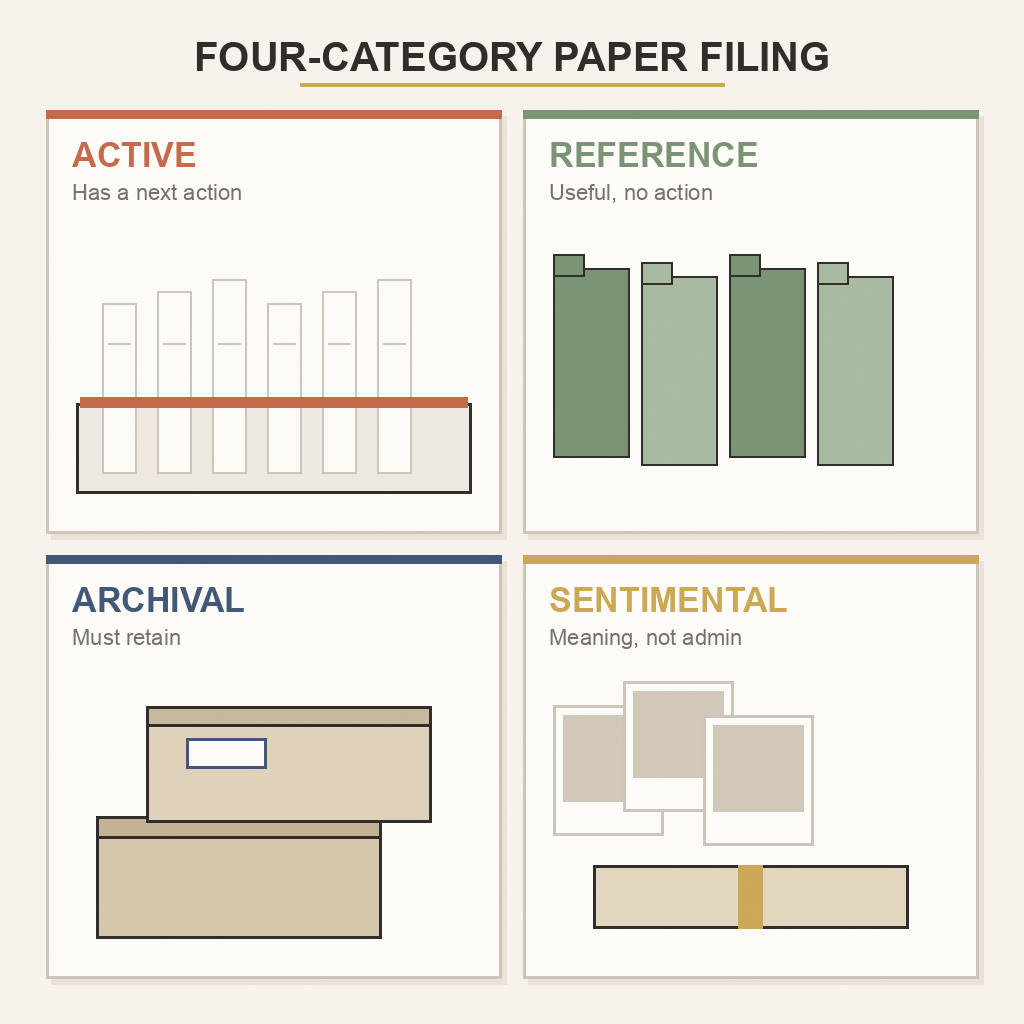
The Four-Category Filing Framework
Every sheet in your home office belongs in one of four categories. The labels are plain English so anyone in the household can file without asking. A one-question test sorts most papers in under ten seconds.
Active: Papers With a Next Action
Active holds the sheets that need a date or a reply. Unpaid bills, renewal forms, school permission slips, and medical intake paperwork all start here. Use a shallow, visible sorter — a Fellowes 11-section desktop organizer works on a compact desk and keeps every section in eye-line. Set a weekly review date on your calendar. Don’t archive unresolved work — that’s how bills become late fees.
Reference: Useful but Not Actionable
Reference is for papers you’ll want to find later but don’t need to act on this week. Warranties, manuals, school handbooks, and current policy documents belong here. Group by topic rather than by date. Use consistent labels, and avoid a category for every document. If a label has only one paper in it after a month, the category is too narrow — fold it into a sibling.
Archival: Records to Retain
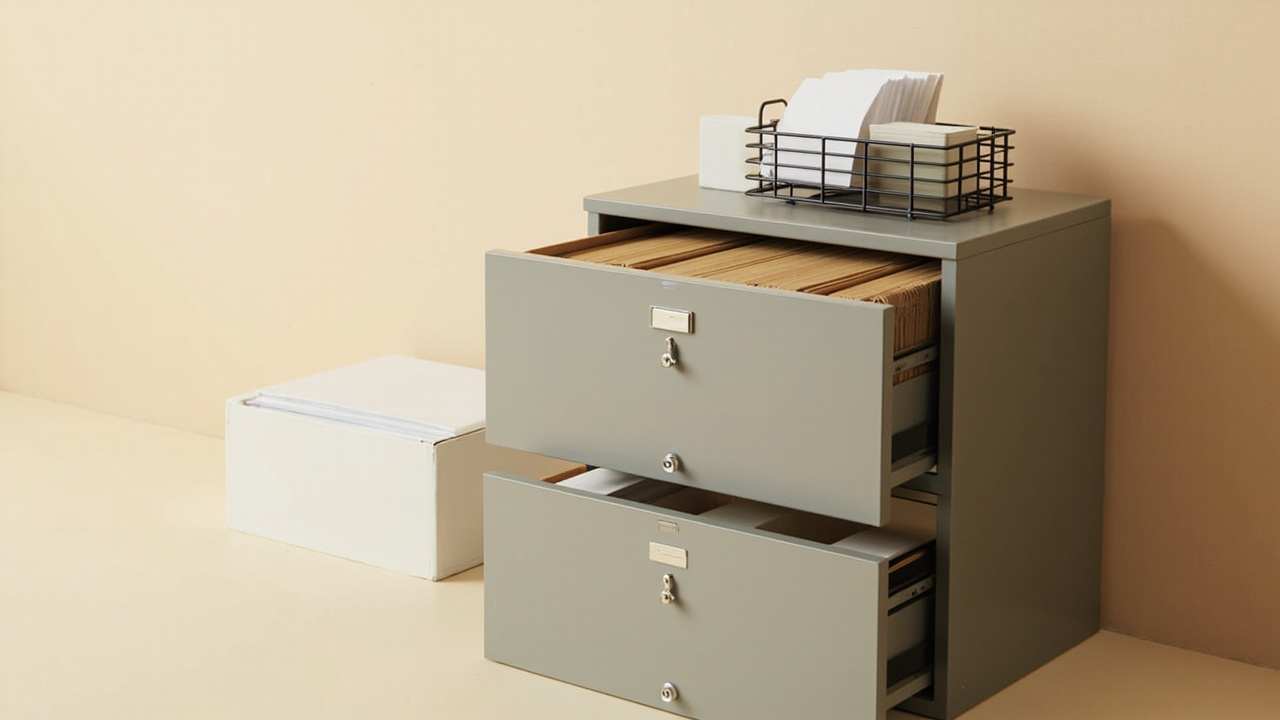
Archival is for tax, property, legal, and identity records your household is required to keep or has decided to keep. Treat retention as a household policy: write the years down once and stop re-deciding. A lockable Staples 3-Drawer Vertical File Cabinet, Letter Size, Lockable works for sensitive records when the desk is shared. Don’t mix Archival and Active in the same drawer.
Sentimental: Meaning, Not Administration
Cards, children’s artwork, and letters belong somewhere outside the operational files. One bounded memory box per family member is plenty; scan only when scanning reduces clutter rather than adds another copy. Skip the urge to label every drawing — the box already has an owner.
Sort Every Sheet Without Re-reading Everything
The fastest path through a backlog is to stop re-reading. Five passes clean most surfaces in under an hour.
The 10-Second Decision Tree
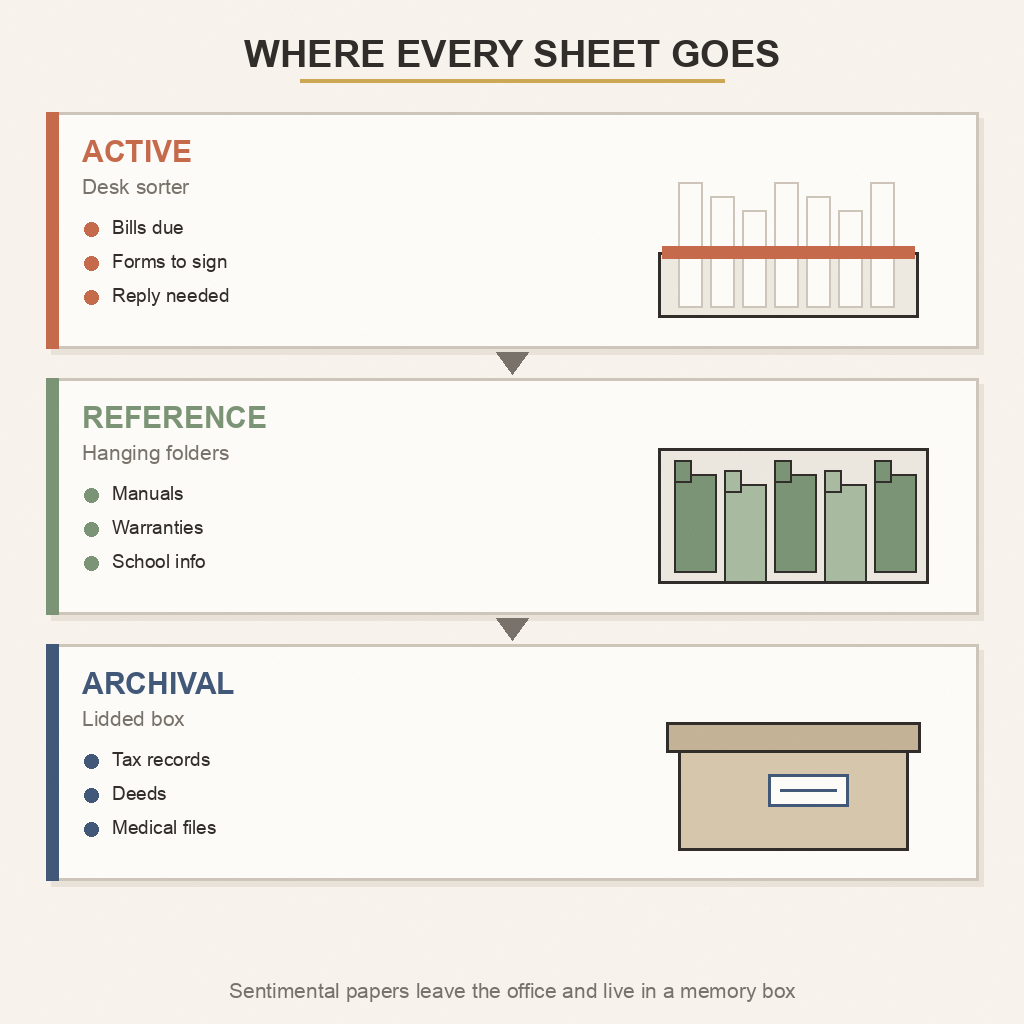
For each sheet, ask one question: what happens next? If a date or reply is inside seven days, Active. If you may need it later, Reference. Tax, legal, or identity records go to Archival; memory items to Sentimental. Anything that survives all four questions goes into the shred or recycle bag. For deeper labeling guidance, see how to label anything.
What to Scan, Shred, Recycle, or Keep
Use a simple four-box rule. Scan when a digital copy replaces a paper original you still want — manufacturer PDFs are easy wins. Shred anything with an account number you no longer use, expired offers, and junk mail. Recycle plain paper without personal data. Keep tax records, identity copies, and current contracts per your household policy. Identity documents deserve secure disposal rather than a recycling bin. This is a practical starting framework, not legal advice — confirm local retention requirements for official records.
Layout by Office Size
Match the system to the room you have, not the cabinet on sale.
Small Desk: One Active Sorter
When the desk footprint is small, choose a single vertical sorter for Active and let Reference live in a portable file box under or beside the desk. A Pendaflex portable desktop file carries all four categories without taking up chair space. Cap the inbox at the sorter’s capacity — if it overflows, the reset has slipped.
Shared Office: Named Zones
Shared desks need named zones so two people don’t file under each other’s name. Give each person an owner label, then share one household cabinet for Reference and Archival. Use the Staples 3-Drawer Vertical File Cabinet for locked identity storage and a Pendaflex portable file box for overflow that travels between rooms.
Dedicated Wall: Cabinet Plus Index
When a wall is dedicated to files, place the highest-use folders between eye and waist height and reserve top shelves for closed-year archival boxes. The Staples 3-Drawer Vertical File Cabinet keeps sensitive records locked, and a simple index card on the cabinet front tells every household member where each category lives. Add an upright Amazon Basics magazine rack on the desk for manuals and current reference papers.
Constraint Guide
Five common situations change which product earns its space. Each branch is an if–then decision, not a generic shopping list.
If You Rent, Then Choose Freestanding Storage
Avoid drilling and built-ins. Use a freestanding Staples 3-Drawer Vertical File Cabinet that you can move at the end of a lease, and pair it with a Pendaflex portable file box for overflow. Place the system beside the desk so paper never travels more than an arm’s reach.
If You Have No Floor Space, Then Go Vertical
When floor space is the constraint, go vertical. Mount an Amazon Basics wall file organizer for Active intake — but check wall material and load rating first. If mounting isn’t allowed, use a Fellowes desktop organizer on top of the desk as a desktop tower instead.
If Records Are Sensitive, Then Lock Them
Identity, financial, and medical records belong in a locked cabinet. The Staples 3-Drawer Vertical File Cabinet, Letter Size, Lockable ships with a built-in lock for this case. Don’t leave sensitive documents in an open sorter overnight, especially on a shared desk.
If You Move Often, Then Use a Portable File Box
Frequent movers should keep the system light. A Pendaflex portable file box carries all four categories in a single, latchable case, and Amazon Basics hanging file folders move between the box and any future cabinet. Don’t turn a portable box into a permanent archive — review contents at every move and shred what no longer earns the trip.
If Your Household Shares Files, Then Label by Owner and Category
Shared households need owner labels before they need category labels. Use Amazon Basics hanging file folders with two-tab inserts so each folder shows both the topic and the owner, and reserve one drawer of the Staples 3-Drawer Vertical File Cabinet for each person’s sensitive records. Keep a shared index card next to the cabinet — never rely on memory or color alone.
Build the Physical Filing Station
A physical station is what turns the four categories from an idea into a habit.
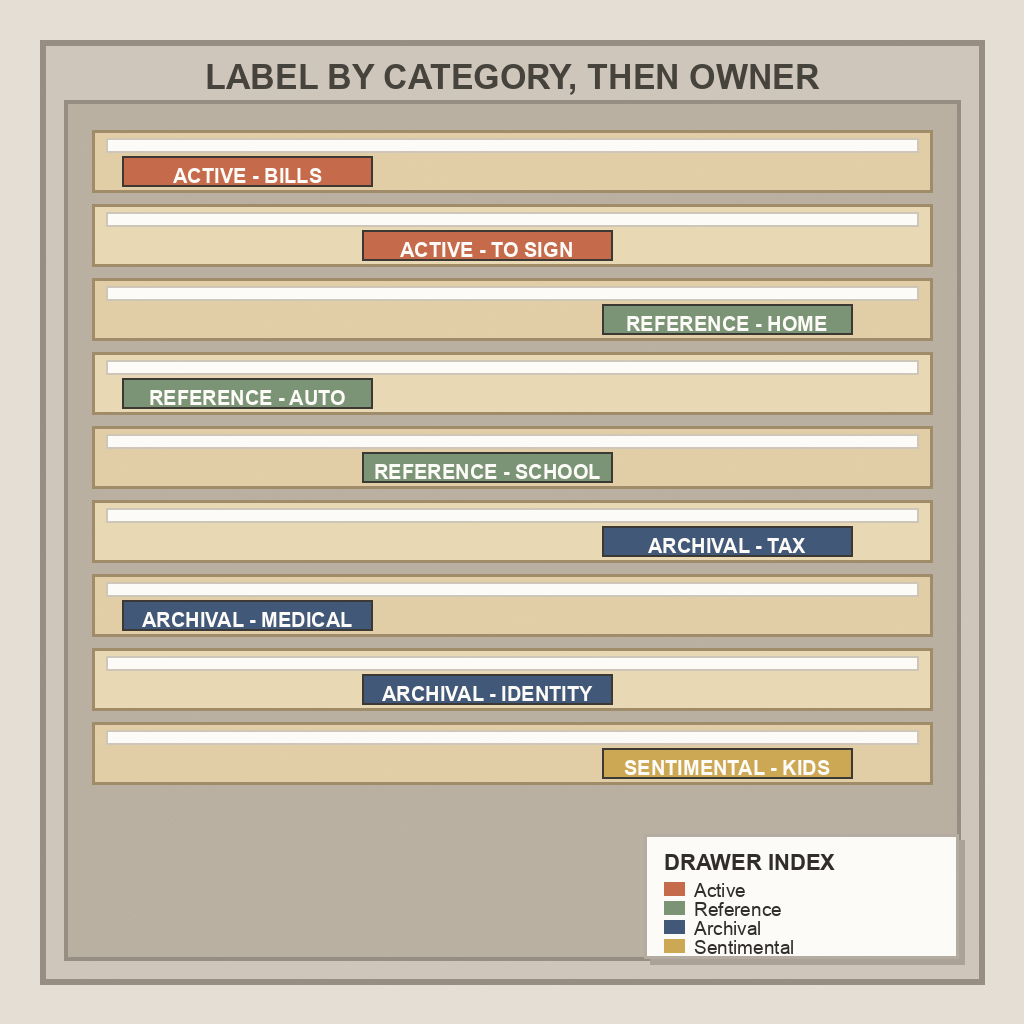
Cabinet Setup: Four Zones, One Index
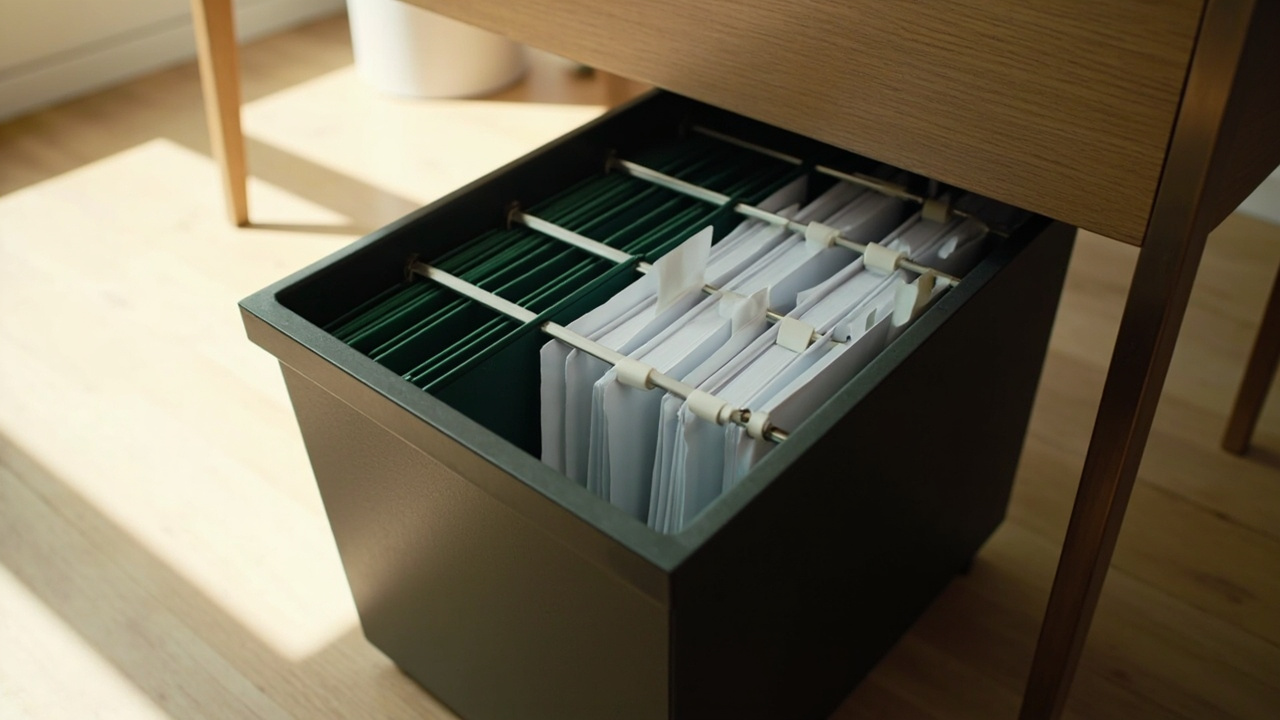
Reserve each drawer or section for one category and keep them in the same order across the household. The Staples 3-Drawer Vertical File Cabinet maps cleanly to three categories plus overflow — Active on top, Reference and Archival below, with the lockable drawer reserved for sensitive records. Place an index card on the cabinet front so anyone filing can match the drawer to the category.
Label Rules That Survive Real Life
A label is only as good as the words on it. Use a noun plus a scope or date — “Insurance—Current,” “Taxes—2025,” or “Warranty—Appliances.” Avoid “Miscellaneous” because it hides the decision you should be making. Amazon Basics hanging file folders come with adjustable tabs you can rewrite as categories evolve. For deeper tab technique, see how to label anything.
The Weekly 15-Minute Reset
The reset is what keeps the four categories honest. A short weekly rhythm beats a long monthly clean-up.
Reset the Active Queue
Empty Active every week. Every remaining item needs an owner and a next date; anything without one is shredded, recycled, or filed. Cap the queue at the sorter’s capacity — if it overflows, the system has drifted. Pair this reset with the daily reset routine.
Audit Categories Quarterly
Once a quarter, review every label. Merge empty categories. Move expired Reference material to Archive or disposal. Rename labels that drifted from what they actually hold — a “Medical—2024” folder now full of school permission slips is overdue for a split.
Common Mistakes
Five failure cases show up across most home offices.
-
Creating “Miscellaneous” Too Early. The first sign that a filing system is failing is a Miscellaneous folder. It hides the decision that makes retrieval possible. If a paper doesn’t fit an existing label, make a new one or fold it into a sibling — never into “Misc.”
-
Filing Before Capturing the Next Action. A bill filed before its due date can still go unpaid. Always capture the action date — paper, calendar, or reminder — before the sheet leaves the desk. Active is not just a sorter; it’s a date ledger.
-
Buying a Cabinet Before Measuring. Cabinets that don’t fit the door frame, the under-desk height, or the chair path become expensive doorstops. Measure width, depth, drawer clearance, and the delivery path before selecting the Staples 3-Drawer Vertical File Cabinet or any lockable file storage.
-
Mixing Active and Archival Records. When Archival lives next to Action, the daily queue gets buried under closed years. Keep them in separate drawers, separate boxes, or separate shelves. The friction of crossing zones keeps the queue small.
-
Over-Labeling Every Single Paper. Too many micro-categories make retrieval slower, not faster. Group by decision and retrieval frequency: a folder opened once a year can share space with a sibling topic. The 25-pack of Amazon Basics hanging folders covers a household.
What to Buy Only If Needed
Conditional branches keep the method from becoming a product hunt. Buy only when the constraint is real.
Buy a Cabinet Only If Archival Volume Exceeds One Box
If a single Pendaflex portable file box already overflows with Archival records, step up to the Staples 3-Drawer Vertical File Cabinet. Measure before you buy. A cabinet without a measurement is a future move.
Buy a Wall Sorter Only If the Wall and Workflow Support It
An Amazon Basics wall file organizer earns its space when there’s no desk room and the wall can hold it. Use it for daily intake, not sensitive archives.
Buy a Label System Only If Multiple People File Papers
A label maker is useful when ownership is ambiguous. For a single filer, handwritten tabs on the Amazon Basics hanging folders do the same job. Don’t buy a label maker until the workflow sticks.
Four-Category Filing Examples by Paper Type
A short tour by paper type helps new filers find their footing.
Household Administration
Bills and renewals land in Active until they’re paid or resolved. The supporting record — paid invoice, policy renewal — moves to Reference when the action closes. School papers follow the same path: permission slip in Active, then the printed acknowledgment in Reference.
High-Value and Identity Records
Tax returns, property records, and identity copies belong in Archival inside the locked Staples cabinet drawer. Keep a retrieval index — a single card listing each closed year — so you don’t search every year for a tax question. Don’t recommend unsecured display; the lock is the point.
Key Takeaways and Related Reading
Four categories carry the system: Active, Reference, Archival, Sentimental. One physical home per category, plain-language labels, and a 15-minute weekly reset keep it honest. Measure before you buy a cabinet, and skip the label maker until multiple people file papers. For the broader habit loop, return to paperwork workflow, desk organization, desk drawer organization, whole home-office setup, and the daily reset routine.