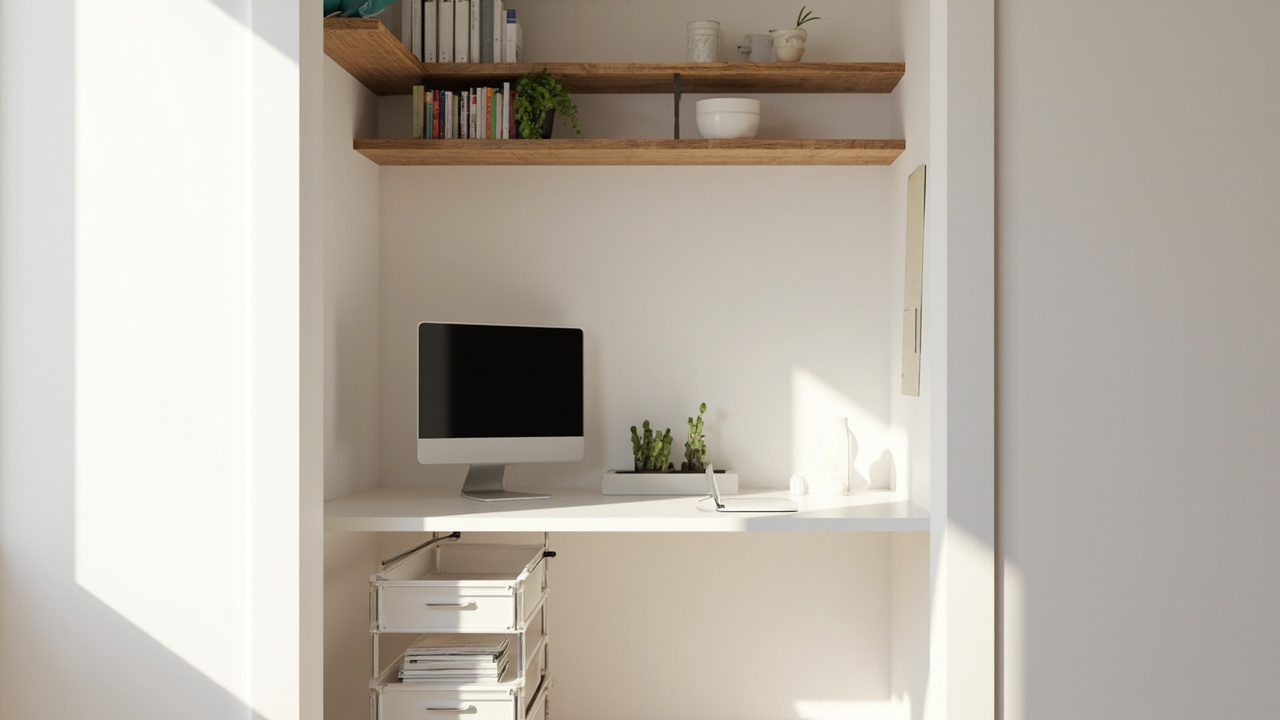
A small home office under 50 sq ft stays organized when you split the space into five zones, pick furniture that fits the room’s narrowest dimension, and run a 5-minute daily reset. Corner desks reclaim dead angles, closet offices need 24-inch-max depth, and folding wall desks buy back floor space in multi-purpose rooms. The real gains come from vertical storage and under-desk drawers — not from buying more bins. For the full collection, start at the home-office organization hub.
Why Small Offices Get Messy Fast
Small offices clutter quicker than any other room because every surface does double duty. A 4-square-foot desk is your writing space, monitor stand, filing area, and lunch table. When one item lands out of place, the cascade starts: a coffee cup pushes a stack of papers into the keyboard zone, the keyboard displaces a notebook, and within 48 hours the desk is unusable.
In our experience, three forces drive the mess. First, vertical space sits empty while horizontal surfaces overflow. Second, mobile storage stays parked instead of rolling to where clutter accumulates. Third, no daily reset means each day’s small mess compounds into a weekly crisis. The fix is structural, not motivational — change the zones and the furniture, and the mess has nowhere to build up.
The 5-Zone System for Under 50 Sq Ft
Every small office under 50 sq ft has the same five functional zones. Assigning each zone a physical location and a storage type eliminates decision fatigue and prevents cross-zone contamination.
Zone System at a Glance
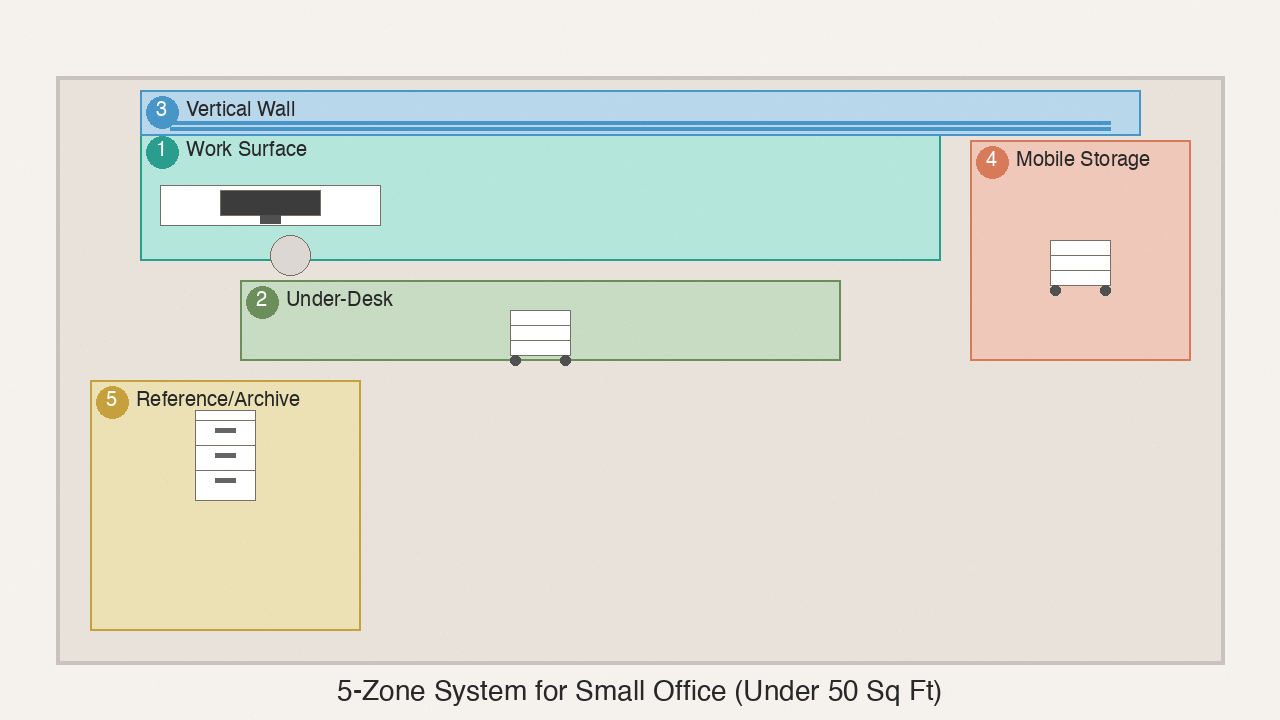
Zone 1: Work Surface
Your desk top holds only what you’re actively using. The goal is 60 percent visible clearance at all times. A Simple Trending monitor stand with drawer lifts the screen to eye level and reclaims six inches of depth underneath for pens, a stapler, and charging cables. Nothing else lives on the surface permanently.
Zone 2: Under-Desk
The gap beneath your desk is the most underused storage volume in a small office. It should hold your CPU, a rolling file cart, or a slim drawer unit — not your feet and a tangle of cables. An IRIS USA 3-drawer rolling cart stores printer paper, chargers, and reference books without claiming floor space that a walking path needs. For the cable mess specifically, see our cable management guide.
Zone 3: Vertical Wall
When the floor is full, the wall is your only growth direction. AMADA floating shelves above the desk hold books, mail trays, and objects that would otherwise crowd the surface. A VIZ-PRO magnetic dry-erase board serves as a visual task board, pin board, and whiteboard in one — replacing three single-use tools with a single wall-mounted surface.
Zone 4: Mobile Storage
A rolling cart is the most flexible storage unit in a tight office. It moves to the closet when not in use, slides under a tall desk during work sessions, and rolls into the hallway for temporary overflow. Park it against the wall between the desk and the door; the narrow footprint (under 16 inches wide) fits gaps that no fixed cabinet can use.
Zone 5: Reference and Archive
Inactive paper, completed project binders, and rarely-used reference books live outside the active work zone — in a filing cabinet, on a high shelf, or in a labeled box under the bed. Keeping reference material in Zone 5 (not Zone 1) is one of the most effective clutter-prevention habits in a small space. For a deeper system, read about the 5S method for home.
Closet Office Setup
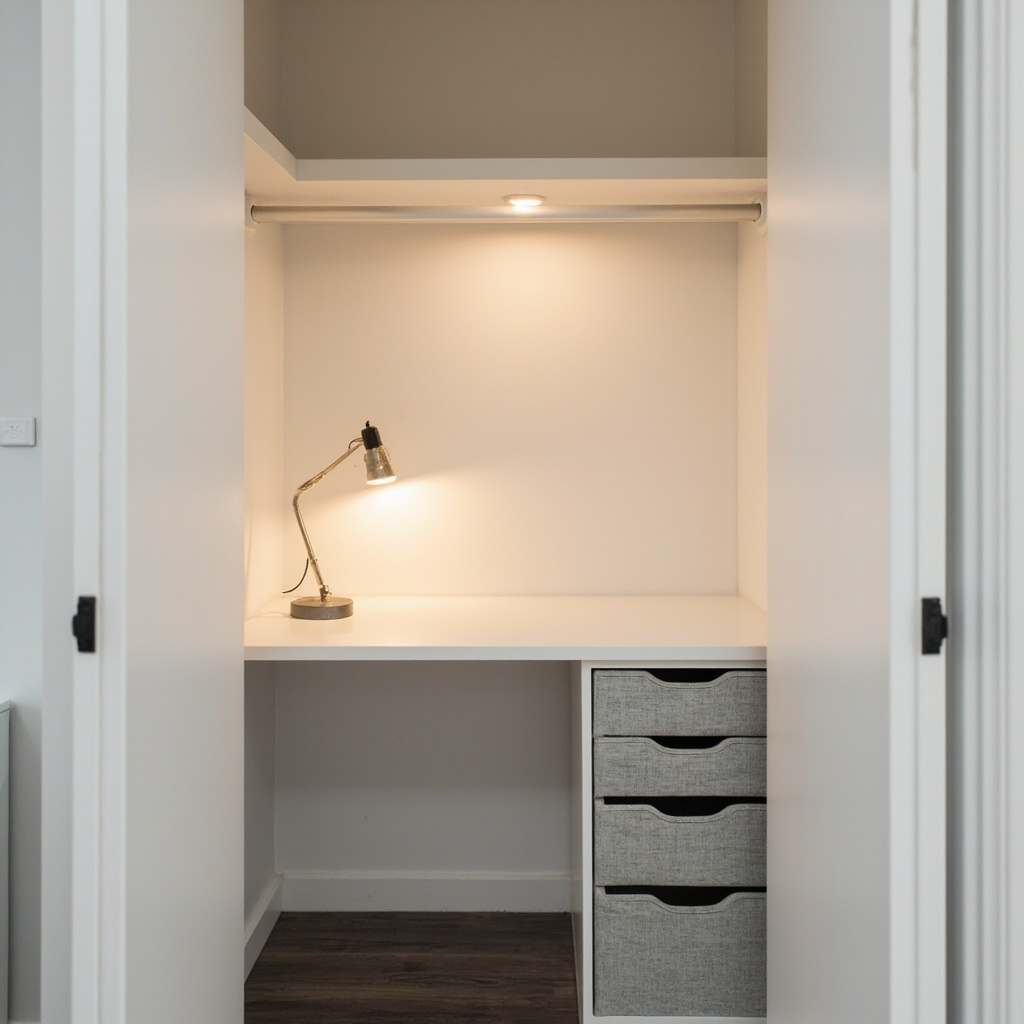
A closet office is the highest-density small-office configuration: a reach-in closet 24 to 30 inches deep and 36 to 72 inches wide becomes a fully functional workstation.
Closet Layout Overview
Measure Before You Buy
Standard closet interior depth is 24 inches. A desk deeper than 20 inches leaves no clearance for a chair. Measure the interior depth at the door jamb (where the frame narrows) and at the back wall — the two numbers can differ by up to 2 inches in older homes. The 47-inch-wide Lufeiya desk with file drawers fits a standard 48-inch closet opening with half an inch of clearance on each side.
Ventilation and Lighting
A closet office has no window. You need two light sources: a task light clamped to a shelf and a bias light behind the monitor to reduce eye strain. Ventilation matters more than lighting: closets trap heat from monitors and laptops. Leave the closet door open during work sessions and consider a small USB fan clipped to a shelf.
Corner Desk Optimization
Corner spaces collect dust and unused furniture. An L-shaped desk turns that dead corner into your most productive surface area.
L-Shape vs Straight Desk
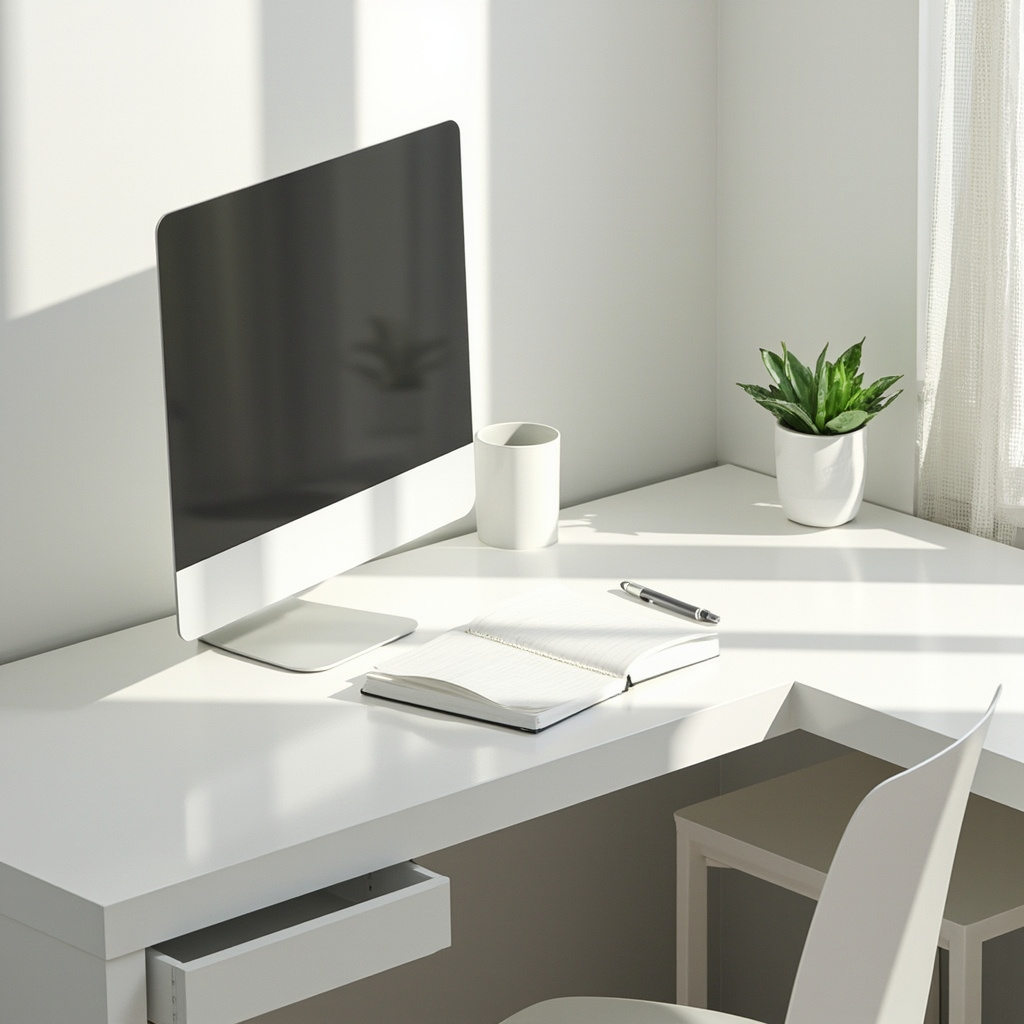
A 47-inch Lufeiya L-shaped corner desk gives you two work zones: a primary surface for the monitor and keyboard, and a perpendicular arm for writing, note-taking, or a second screen. The footprint is 47 by 47 inches — larger than a straight desk but more efficient per square foot because the corner becomes the focal point. For keeping that desk surface clear, see our desk organization guide.
Corner Dead Space
The inside of the L-shape (where the two arms meet) is where items disappear. Install a corner shelf riser or a small lazy susan to make that space reachable. Don’t stack papers flat in the corner — they won’t surface again.
Layout by Square Footage
Under 25 Sq Ft (Closet or Nook)
Use a wall-mounted folding desk that drops down for work and folds away for storage. The Tangkula Folding Wall Table has a built-in drawer, giving you storage when the desk is folded. Pair it with a stool that slides under. Total floor footprint when folded: 12 inches of depth.
25 to 50 Sq Ft (Small Room)
A small room fits a straight desk (47 inches wide) plus one rolling cart and one floating-shelf set above. Keep the desk against the longest wall, not the window — natural light should come from the side, not from behind the monitor (which causes glare) or behind your back (which throws a shadow on the desk).
Multi-Purpose Room
When the office shares a bedroom or living room, use a folding wall desk or a desk that doubles as a console table. The desk faces the wall during non-work hours and holds a lamp, a book stack, or a tray. A rolling cart tucked into a corner moves to the closet when guests arrive.
Constraint Guide by Scenario
Scenario Overview
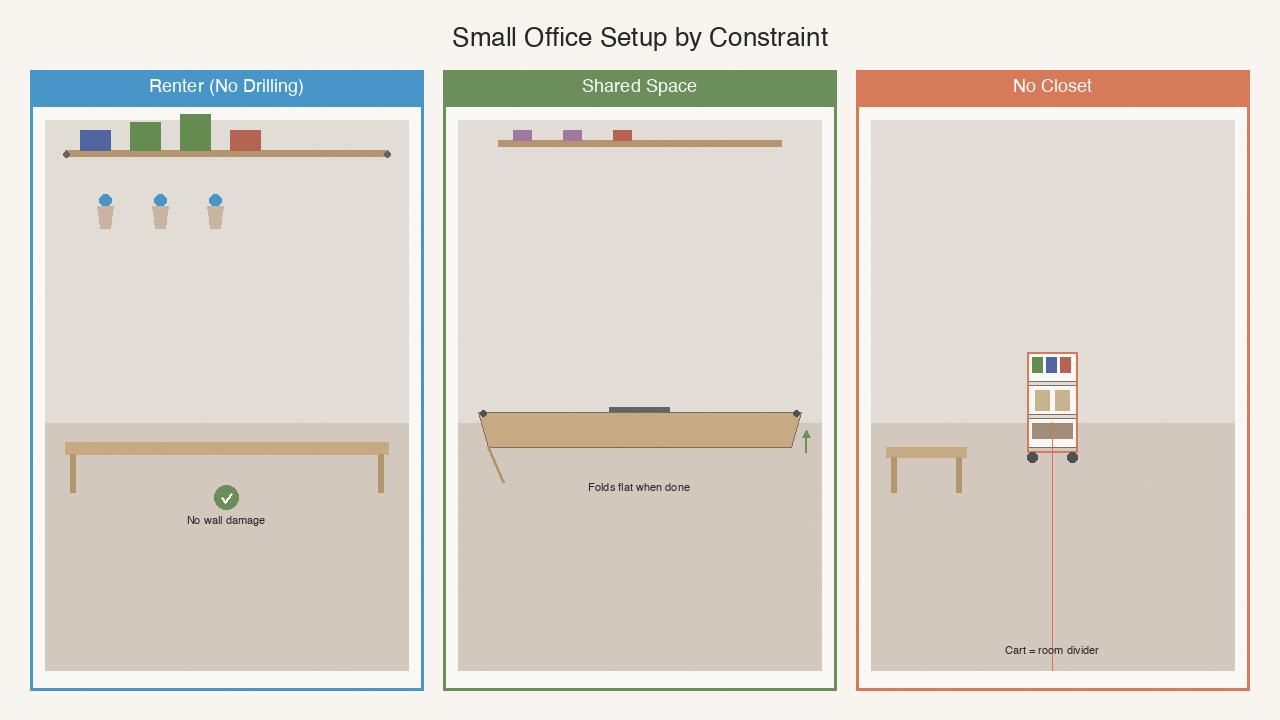
If You Rent (No Drilling Allowed)
Replace wall-mounted shelves with tension-rod shelving or freestanding ladder shelves. Use adhesive hooks (rated for 5 pounds or less) for lightweight items. Skip the floating shelves — they require drywall anchors your landlord won’t forgive. Choose a Simple Trending monitor stand with drawer for desk-surface storage that needs zero installation, and pair it with an IRIS rolling cart that slides into any gap without hardware. For more renter-friendly ideas, read about frugal home organization.
If You Share the Space
A Tangkula Folding Wall Table signals work mode when deployed and restores the living room when folded flat. An IRIS rolling cart moves between rooms so your supplies don’t live on the dining table. Establish a daily 5-minute reset — learn the full home-office daily reset — and make it non-negotiable.
If You Have No Closet
When there’s no closet to hide your office in, create visual containment instead. A screen, a bookshelf placed perpendicular to the wall, or a desk positioned with its back facing the room hides cable clutter and stored items. An IRIS rolling cart acts as a movable partition, while AMADA floating shelves on the wall above keep supplies visible without claiming floor space.
Common Mistakes
-
Buying a desk before measuring. The most common error in small-office setup is purchasing a desk that’s 6 inches too deep for the alcove. Measure the interior depth at the narrowest point (door jamb, radiator, baseboard) and subtract 4 inches for chair clearance before browsing.
-
Ignoring the vertical wall zone. Small-office owners fill the floor and desk surface but leave 80 square feet of wall completely empty. Floating shelves and a magnetic board cost under $60 combined and reclaim the equivalent of a 3-shelf bookcase in floor space. Learn more in our wall and vertical storage guide.
-
Using a fixed file cabinet instead of a rolling cart. A stationary cabinet parks in one spot and becomes an obstacle. A rolling cart with the same storage capacity moves to wherever the work happens and rolls out of sight when the workday ends.
-
No daily reset routine. Without a 5-minute shutdown routine, clutter compounds daily and becomes a weekly 2-hour cleanup. The fix isn’t more willpower — it’s a checklist posted on the magnetic board. For the full system, read about small-space decluttering.
-
Putting a monitor directly on the desk. This wastes 6 inches of horizontal depth, forces neck strain, and offers no under-monitor storage. A monitor stand with a drawer solves all three problems for under $20.
Decision Tree: Which Setup Fits You?
Ask these questions in order:
- Do you have a dedicated room? Yes — proceed to question 2. No — choose a folding wall desk for a multi-purpose room.
- Is the room under 50 sq ft? Yes — choose an L-shaped corner desk to maximize surface area. No — a straight desk with a rolling cart is sufficient.
- Can you convert a closet? Yes — use a straight desk (not L-shaped) with integrated drawers. No — use the corner or a wall section with floating shelves above.
- Do you rent or own? Rent — skip wall-mounted shelves; use tension rods and freestanding units. Own — floating shelves are your highest-value investment.
- Need to hide the office when not in use? Yes — folding wall desk plus rolling cart that moves to a closet. No — fixed desk with open shelving works fine.
Maintenance: Daily and Weekly Reset
A small office stays organized through rhythm, not willpower. The daily reset is five minutes at the end of each work session: clear the surface, file the day’s papers, plug in the laptop, and close the rolling cart drawers. The weekly reset is fifteen minutes on Friday afternoon: empty the under-desk cart, wipe down surfaces, process the inbox tray, and re-stock supplies. Learn the full system in our home-office daily reset guide.
Related
- Home-office organization hub — start here for the full collection
- Small home-office storage — the physical storage companion to this article
- Home-office organization — the umbrella guide
- Desk organization — keep the surface clear
- Wall and vertical storage — maximize the wall zone
- Cable management — tame the under-desk tangle
- How to choose drawer organizers — the buying guide
- Hooks and racks for vertical storage — the vertical storage guide
Key Takeaways
- Split any small office into five zones: surface, under-desk, vertical wall, mobile storage, and archive.
- Measure the narrowest depth (door jamb, baseboard, radiator) before buying any desk.
- Corner desks reclaim dead angles; straight desks fit closets; folding desks buy back floor in multi-purpose rooms.
- Vertical storage (floating shelves, magnetic board) is the cheapest way to expand a small office.
- A rolling cart beats a fixed cabinet in every small-space scenario.
- A five-minute daily reset prevents the weekly two-hour cleanup.